

In a competitive and fast-evolving business landscape like India, transparency, financial accuracy, and regulatory compliance are essential for every organization—whether small, medium, or large. One of the most reliable ways to ensure this is through auditing. As companies expand and financial operations become more complex, audits help maintain trust, credibility, and accountability.
This comprehensive guide explains what an audit is, why it matters, the major types of audits in India, and the advantages of auditing. It also highlights the role of professional firms such as KKS Capital Advisor, which assist businesses in ensuring accurate audits and robust financial governance.
What Is an Audit?
An audit is a systematic examination of financial records, statements, operations, and processes of a business to ensure accuracy, compliance, and fairness. In simple terms, auditing checks whether the financial information presented by a company truly reflects its financial performance and position.
Audits may be conducted internally by company employees or externally by independent auditors. In India, audits must adhere to:
- The Companies Act, 2013
- Income Tax Act
- GST Act
- Standards on Auditing (SA) issued by ICAI
The primary objective of auditing is to build confidence among stakeholders—owners, investors, lenders, government authorities, and the public.
Auditing in Accounting: Why Is It Important?
Auditing in accounting refers to the verification and evaluation of a company’s financial statements and accounting records. It helps identify discrepancies, fraud, errors, or misstatements that may affect the reliability of financial information.
Accounting without auditing can lead to:
- Inaccurate financial reporting
- Manipulated or fraudulent transactions
- Poor decision-making
- Loss of investor confidence
This is why audit is a crucial pillar of corporate governance.
Importance of Auditing for Indian Businesses

Whether you’re running a startup, SME, or corporate enterprise, understanding the importance of auditing is essential.
Here are key reasons why audits matter:
1. Ensures Accuracy and Reliability of Financial Information
Audits verify that all financial transactions are recorded correctly. This gives management confidence in the figures used for planning and strategy.
2. Prevents and Detects Fraud
Regular audits discourage fraudulent behavior and help catch irregularities early.
3. Strengthens Internal Controls
Audit reports evaluate the effectiveness of internal systems, reducing operational risks.
4. Enhances Credibility with Stakeholders
Investors, banks, and regulatory bodies trust companies with audited financial statements.
5. Ensures Statutory Compliance
Indian laws require many types of audits. Non-compliance can lead to penalties, legal issues, or reputational damage.
6. Improves Decision-Making
Accurate, audited financials support budgeting, forecasting, investments, and expansion decisions.
7. Builds Public Trust
Audited companies gain a stronger public image and market confidence.
Types of Audits in India
India has a structured auditing framework with different types of audits to address various legal and financial requirements. Here are the major types of audits in India:
1. Statutory Audit
Mandated under the Companies Act, all companies registered in India must undergo a statutory audit. The objective is to ensure financial statements represent a true and fair view.
2. Tax Audit
Under Section 44AB of the Income Tax Act, businesses crossing specified turnover thresholds must undergo a tax audit. It ensures correct computation of taxable income and adherence to tax laws.
3. Internal Audit
Internal audits are conducted by an organization’s internal team or outsourced experts. They focus on:
- Internal processes
- Operational efficiency
- Risk management
Certain companies are mandated by law to conduct internal audits based on turnover and capital criteria.
4. GST Audit
Businesses with turnover exceeding the prescribed limit must undergo audits to ensure GST compliance, correct input tax credit claims, and accurate tax payments.
5. Cost Audit
Prescribed under the Companies Act, certain industries (like pharma, steel, cement, power) must conduct cost audits to verify cost records.
6. Management Audit
This evaluates managerial policies, decision-making processes, and organizational efficiency.
7. Compliance Audit
Ensures that the organization follows all legal, regulatory, and policy requirements.
8. Forensic Audit
Performed when fraud or financial misconduct is suspected. It involves in-depth investigation and evidence collection.
9. Operational Audit
Focuses on reviewing the effectiveness of operations, workflow, and resource utilization.
10. Due Diligence Audit
Conducted before mergers, acquisitions, or investments to assess financial health and risks.
Each type of audit plays a unique role in strengthening financial discipline and business integrity.
Advantages of Auditing
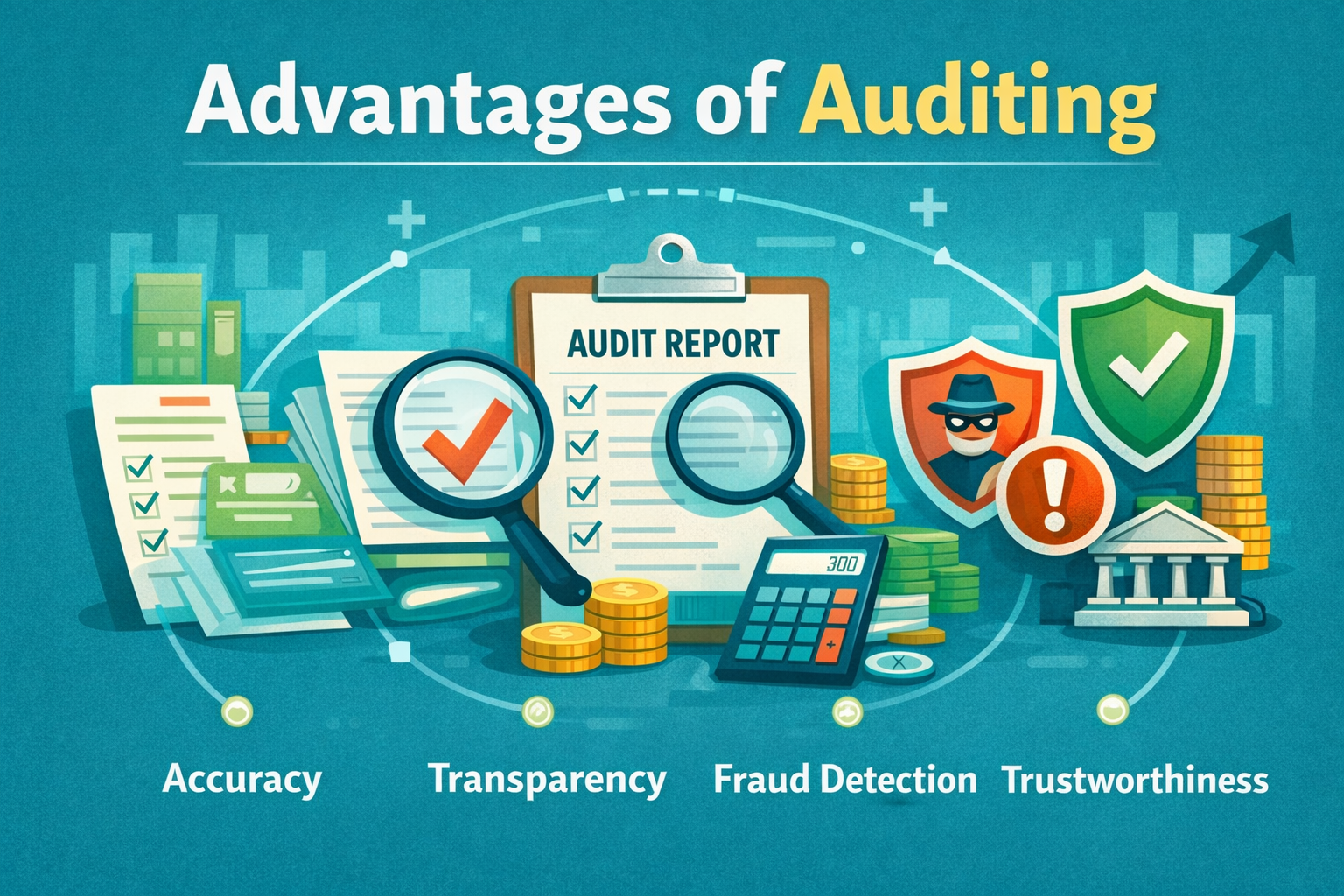
Audits offer numerous benefits beyond compliance. Here are major advantages of auditing for businesses in India:
1. Reduces Business Risk
Audits reveal weaknesses in internal systems, helping companies correct issues before they escalate.
2. Helps in Obtaining Loans and Investments
Banks and investors rely on audited financial statements. It increases trust and smoothens funding processes.
3. Enhances Operational Efficiency
Regular audits highlight inefficiencies and provide actionable recommendations.
4. Ensures Transparency
Audits promote ethical practices and transparency across departments.
5. Facilitates Better Financial Planning
With accurate financial data, budgeting and forecasting become more reliable.
6. Helps in Regulatory Compliance
Timely audits ensure adherence to Indian laws and prevent penalties.
7. Detects Errors and Fraud Early
This protects the organization from financial loss and reputational harm.
8. Strengthens Market Reputation
Audited businesses create confidence among customers, suppliers, and the general public.
The Role of Audit and Advisory Firms – KKS Capital Advisor
Professional firms play a crucial role in ensuring the audit process is smooth, compliant, and insightful. KKS Capital Advisor, for instance, assists businesses with:
- Financial auditing
- Tax and compliance audits
- Internal audit services
- Risk assessment
- Business advisory and financial consulting
Their expertise helps companies maintain accuracy, adopt best practices, and meet all regulatory requirements efficiently.
Engaging experienced advisors ensures not just compliance, but also improved financial discipline and better governance across the organization.
Conclusion
Auditing is a vital component of financial management and corporate governance in India. Whether it’s ensuring accuracy in financial statements, boosting transparency, detecting fraud, or meeting statutory compliance, audits play an indispensable role in building strong and trustworthy organizations.
Understanding the importance of auditing, the various types of audits in India, and the advantages of auditing helps businesses strengthen their internal systems and gain stakeholder confidence. Professional firms such as KKS Capital Advisor further support companies in implementing effective audit practices that align with Indian regulations and global standards.