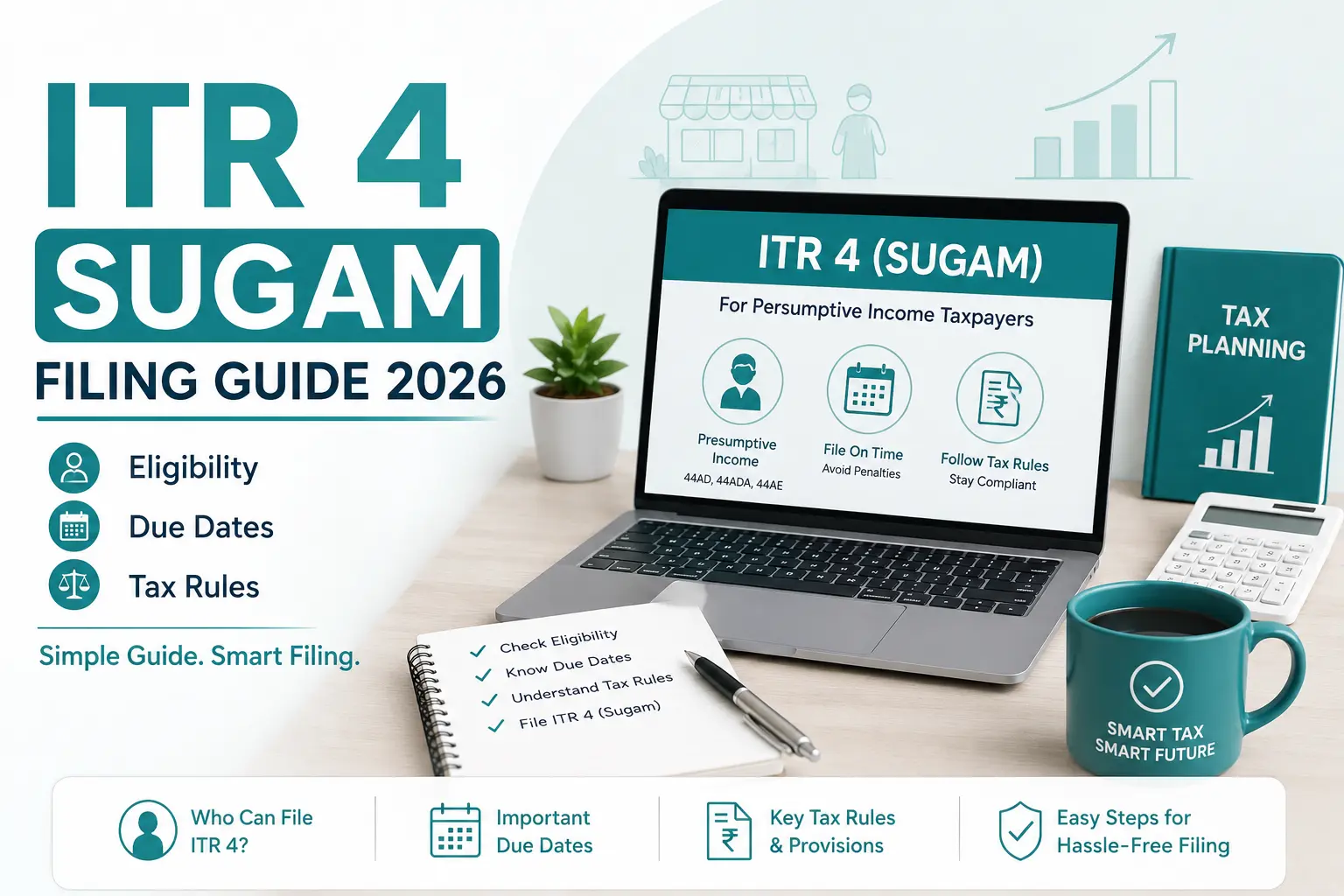
ITR 4 Sugam Filing Guide 2026: Eligibility, Due Dates & Tax Rules
Introduction
If you run a small business, work as a freelancer, or earn income as a professional — and you’ve been wondering how to file ITR 4 SUGAM — this guide is exactly what you need. ITR 4 SUGAM is the go-to form for small business owners and self-employed professionals who fall under the presumptive taxation scheme. It simplifies the entire process by removing the requirement for maintaining detailed books of accounts, which is a huge relief for lakhs of small taxpayers.
Table of Contents
ToggleIn this comprehensive guide by KKS Capital Advisor, we break down everything about ITR 4 SUGAM filing for AY 2026-27 (FY 2025-26) — from eligibility and the presumptive income scheme to a clear step-by-step filing walkthrough. Let’s get you ready to file accurately and on time.
What Is ITR 4 SUGAM?
ITR 4 SUGAM is the income tax return form for individuals, Hindu Undivided Families (HUFs), and firms (other than LLPs) who opt for the presumptive taxation scheme under Sections 44AD, 44ADA, or 44AE of the Income Tax Act. The word ‘SUGAM’ means ‘convenient’ in Hindi — and for eligible taxpayers, this form truly delivers on that promise.
Instead of calculating actual profits, presumptive taxation lets you declare a fixed percentage of your turnover as income. This removes the burden of maintaining complex accounting records, making the ITR 4 form AY 2026-27 ideal for small businesses and working professionals with relatively simple finances.
ITR 4 SUGAM Eligibility: Who Can File?
Before you start the ITR 4 SUGAM filing process, check if you qualify. Here’s who is eligible:
- Individual taxpayers, HUFs, and partnership firms (excluding LLPs)
- Resident taxpayers only — NRIs cannot use this form
- Total income up to Rs 50 lakh
- Business income under Section 44AD (turnover up to Rs 3 crore for non-cash businesses or Rs 2 crore otherwise)
- Professional income under Section 44ADA (gross receipts up to Rs 75 lakh for non-cash transactions; Rs 50 lakh otherwise)
- Income from goods carriage under Section 44AE (owning not more than 10 goods vehicles)
- Salary/pension income
- Income from one house property
- Income from other sources like interest
Who Cannot File ITR 4?
You should not use the ITR 4 SUGAM form if:
- You are a company, LLP, or Association of Persons (AOP)
- Your total income exceeds Rs 50 lakh
- You have capital gains income
- You have income from more than one house property
- You have foreign income or foreign assets
- You hold unlisted equity shares or are a director in a company
- You want to opt out of presumptive taxation and maintain regular books of accounts
Presumptive Taxation Under ITR 4: Sections 44AD, 44ADA & 44AE Explained
The heart of the ITR 4 SUGAM filing is the presumptive taxation scheme. Understanding each section will help you declare income correctly.
Section | Who It Applies To | Turnover / Receipt Limit | Deemed Income % |
44AD | Small businesses (trading, manufacturing, etc.) | Up to Rs 3 Cr (non-cash) / Rs 2 Cr (otherwise) | 8% of turnover (6% for non-cash transactions) |
44ADA | Specified professionals (doctors, CAs, architects, lawyers, etc.) | Up to Rs 75 lakh (non-cash) / Rs 50 lakh | 50% of gross receipts |
44AE | Transporters owning goods vehicles | Max 10 goods vehicles | Rs 1,000 per ton per month (heavy vehicles); Rs 7,500/month (others) |
Important Note on Section 44AD
If you opt for Section 44AD in any assessment year, you must continue using it for the next 5 consecutive years. If you opt out during this period, you won’t be able to use Section 44AD for the next 5 years. This is a critical decision — plan before you file.
Documents Required for ITR 4 SUGAM Filing
Keep these documents ready before you begin the ITR 4 form AY 2026-27 filing:
- PAN card and Aadhaar number
- Bank account details (all accounts used for business)
- Form 26AS and Annual Information Statement (AIS)
- Form 16A or TDS certificates from clients
- Details of total turnover or gross receipts for FY 2025-26
- Advance tax payment challans (if any)
- Proof of deductions to be claimed under Chapter VI-A (80C, 80D, etc.)
- Rental income details if you have one house property
- Interest income statements from banks
How to File ITR 4 SUGAM Online: Step-by-Step Process
Here’s your complete step-by-step guide to ITR 4 SUGAM filing online for AY 2026-27:
- Visit the Income Tax e-filing portal at www.incometax.gov.in. Log in using your PAN or Aadhaar as your user ID along with your password.
- From the dashboard, navigate to ‘e-File’>’Income Tax Returns’>’File Income Tax Return’.
- Select Assessment Year 2026-27, choose ‘Online’ mode, and click ‘Continue’.
- Under the filing status question, select ‘Individual’, ‘HUF’, or ‘Firm’ — whichever applies to you. Then choose ITR-4 as your form.
- The portal will pre-fill data from Form 26AS, AIS, and your employer records. Review all pre-filled information carefully for accuracy.
- Go to Part A: General Information — enter your personal details, business/profession details, and bank account information.
- Fill in Part B: Income Details — Enter your turnover or gross receipts and select the applicable section (44AD, 44ADA, or 44AE). The portal will compute presumptive income automatically.
- Add salary income (if any), house property income, and other source income in the relevant sections.
- Fill in Part C: Deductions — Enter all deductions under Chapter VI-A that you are eligible for.
- Review Part D: Tax Computation — cross-check the tax calculated against your TDS and advance tax payments. Pay any remaining tax via Challan 280 before submission.
- Preview the complete ITR 4 form and submit it once you are satisfied with the entries.
- E-verify your return within 30 days using Aadhaar OTP, net banking, or by posting the physical ITR-V to CPC Bengaluru.
New Tax Regime vs Old Tax Regime for ITR 4 Filers
ITR 4 filers can also choose between the new and old tax regimes. Here’s what you need to know for AY 2026-27:
- New Tax Regime: Default from AY 2024-25. Lower tax rates but no deductions for 80C, 80D, HRA, etc. For business income, Section 44AD presumptive income still applies.
- Old Tax Regime: You can claim deductions like 80C (up to Rs 1.5 lakh), 80D (health insurance), 80G (donations), home loan interest, etc. This can significantly reduce tax for those with heavy investments.
- Businesses under Section 44AD must file Form 10-IEA to opt for the old tax regime. Missing this step means you’ll be taxed under the new regime by default.
Use the tax calculator available on the IT portal to run both scenarios before deciding. The right choice depends entirely on your actual expense and investment patterns.
Expert Tips for ITR 4 SUGAM Filing — Best Practices
- Match your declared turnover with GST returns (GSTR-1, GSTR-3B) to avoid discrepancies — the tax department cross-checks these
- Keep a basic record of receipts and payments even under presumptive taxation — it helps if your return is picked up for scrutiny
- If your actual profit is higher than 8% or 50% under presumptive tax, declare the actual figure to avoid future queries
- File advance tax on time (by 15th March each year) to avoid interest under Sections 234B and 234C
- Don’t forget to report all bank accounts in the return, even those not actively used for business
- If you crossed the turnover threshold during FY 2025-26, switch to ITR 3 and maintain proper books of accounts
- Reach out to KKS Capital Advisor for help evaluating which section (44AD vs 44ADA vs 44AE) applies to your specific income type
Common Mistakes to Avoid When Filing ITR 4 SUGAM
- Filing ITR 4 despite having capital gains — you must use ITR 3 in such cases
- Declaring income below the presumptive limit (8% or 50%) without opting out properly — this attracts scrutiny
- Not matching turnover with GST returns — a major red flag for the IT Department
- Forgetting to report interest income from savings accounts or FDs
- Missing the e-verification step — an unverified return is treated as not filed
- Not paying advance tax when total tax liability exceeds Rs 10,000 — leads to interest charges
- Using ITR 4 if your LLP earnings are your primary business income — LLPs must use ITR 5
Due Dates for ITR 4 SUGAM Filing AY 2026-27
Taxpayer Category | Due Date |
Individuals, HUFs, Firms (non-audit cases) | 31st July 2026 |
Businesses requiring tax audit (turnover > Rs 1 crore) | 31st October 2026 |
Belated return (with late fee) | 31st December 2026 |
Revised return | 31st December 2026 |
Updated return (ITR-U) | Within 2 years from end of AY |
FAQ'S
Q1. Who is required to file ITR 4 SUGAM?
ITR 4 SUGAM is filed by individuals, HUFs, and firms (not LLPs) who opt for the presumptive taxation scheme under Sections 44AD, 44ADA, or 44AE, with total income up to Rs 50 lakh. It’s ideal for small business owners, freelancers, and specified professionals.
Q2. What is the turnover limit for Section 44AD under ITR 4?
For FY 2025-26, the turnover limit under Section 44AD is Rs 2 crore for businesses where cash transactions exceed 5% of total receipts, and Rs 3 crore for businesses where cash transactions are 5% or less. The higher limit encourages digital payments.
Q3. Can a doctor or CA file ITR 4 SUGAM?
Yes. Doctors, chartered accountants, architects, lawyers, engineers, and certain other specified professionals can file ITR 4 under Section 44ADA, provided their gross receipts don’t exceed Rs 75 lakh (for non-cash) or Rs 50 lakh (otherwise). They declare 50% of gross receipts as income.
Q4. Can I claim deductions under Chapter VI-A while filing ITR 4?
Yes. Even under presumptive taxation, you can claim deductions under Section 80C, 80D, 80G, and other applicable sections. These reduce your taxable income after the presumptive income is calculated. Make sure you’re in the old tax regime to avail these deductions.
Q5. What happens if my actual profit is lower than the presumptive rate?
If your actual profit is lower than the presumptive rate (8% or 50%), you can declare your actual lower profit. However, in that case, you must maintain books of accounts as per Section 44AA and get a tax audit done if your income exceeds the basic exemption limit.
Q6. Is GST turnover the same as income tax turnover?
Not always. GST turnover includes the value of supply, while income tax turnover may differ based on nature of income and adjustments. Always reconcile both carefully. Discrepancies between GSTR returns and ITR 4 declarations can invite notices from tax authorities.
Q7. What if I own more than 10 goods vehicles? Can I still file ITR 4?
No. Section 44AE is available only if you own 10 or fewer goods vehicles at any time during the financial year. If you exceed this limit, you cannot use the presumptive scheme under this section and must maintain regular books and file ITR 3.
Q8. How do I e-verify my ITR 4 after filing?
You can e-verify through Aadhaar OTP, net banking login, DEMAT account, or by generating an Electronic Verification Code (EVC). E-verification must be done within 30 days of submission. Without e-verification, your return is treated as invalid.
Conclusion
Understanding how to file ITR 4 SUGAM correctly can save you considerable time and effort as a small business owner or freelancer. The presumptive taxation scheme is one of the most taxpayer-friendly provisions in India’s income tax law—it reduces paperwork and makes compliance achievable even without an accountant.
But you still need to verify your eligibility, report income accurately, match your turnover with GST records, and file on time. Getting even one part wrong can lead to notices, penalties, or the dreaded tax scrutiny.
At KKS Capital Advisor, we specialize in ITR 4 SUGAM filing for small businesses, freelancers, doctors, architects, and professionals across India. Our team ensures your return is accurate, compliant, and filed well before the deadline for AY 2026-27.