
Accounting is the backbone of any business, providing clarity, transparency, and a structured approach to managing finances. Whether you run a small business, a startup, or a large corporation, understanding the golden rules of accounting is essential for accurate record-keeping, compliance, and decision-making.
This guide covers the three golden rules of accounting, explores the types of accounts, explains the benefits of accounting, and highlights how businesses can leverage professional advisory services like KKS Capital Advisor for better financial management.
What Are the Golden Rules of Accounting?
The golden rules of accounting—also known as golden principles of accounting—are the fundamental principles that guide the recording of financial transactions. These rules ensure consistency, accuracy, and clarity in bookkeeping, forming the foundation of the double-entry system of accounting.
Understanding these rules is critical for anyone involved in finance, accounting, or business management.
The Three Golden Rules of Accounting

Accounting is based on three types of accounts: Personal Account, Real Account, and Nominal Account. Each type follows a specific rule for recording transactions.
1. Personal Account
Definition: Personal accounts relate to individuals, companies, or organizations.
Golden Rule: “Debit the receiver, credit the giver.”
Example:
- If a business purchases goods on credit from Mr. Sharma, Mr. Sharma is credited because he is the giver, and the business is debited because it is the receiver.
This rule ensures clarity in tracking transactions involving people or entities.
2. Real Account
Definition: Real accounts deal with tangible and intangible assets owned by the business. Examples include cash, machinery, buildings, patents, and vehicles.
Golden Rule: “Debit what comes in, credit what goes out.”
Example:
- If a company buys furniture for the office, the furniture account is debited (what comes in), and the cash or bank account is credited (what goes out).
This rule helps in maintaining precise records of asset movements within the business.
3. Nominal Account
Definition: Nominal accounts track expenses, losses, incomes, and gains. Examples include salaries, rent, interest, and sales revenue.
Golden Rule: “Debit all expenses and losses, credit all incomes and gains.”
Example:
- If the company pays electricity bills, the electricity expense account is debited, and cash or bank is credited.
- Conversely, when the company earns interest income, the interest account is credited.
By following this rule, businesses can accurately record profits, losses, and operational costs.
Types of Accounts in Accounting
Accounting relies on categorizing transactions into various account types. Understanding types of accounts is crucial to applying the golden rules correctly.
1. Personal Accounts
- Natural Person Accounts: Individuals such as Mr. A, Mrs. B
- Artificial Person Accounts: Companies, firms, or organizations
- Representative Personal Accounts: Accounts representing certain people or groups, like “Outstanding Salaries”
2. Real Accounts
- Tangible Assets: Cash, machinery, buildings, stock
- Intangible Assets: Patents, goodwill, copyrights
3. Nominal Accounts
- Expenses and Losses: Rent, salaries, depreciation
- Incomes and Gains: Interest, commission, sale of goods
By classifying accounts correctly, businesses can maintain organized and transparent financial records, simplifying auditing and reporting.
Benefits of Accounting
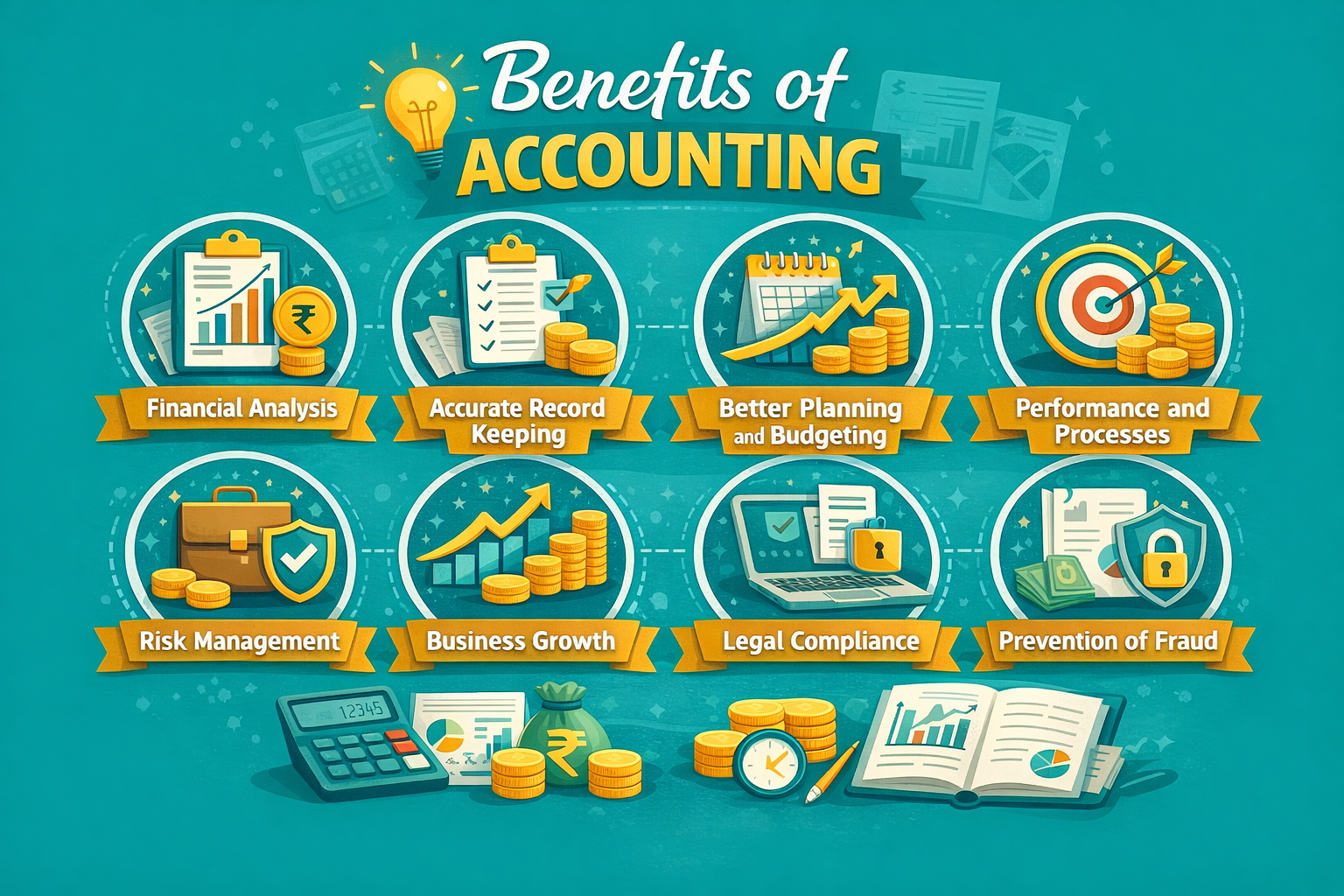
Adhering to accounting rules and applying the golden principles of accounting offers numerous advantages for businesses. Here are some key benefits of accounting:
1. Accurate Financial Records
Proper accounting ensures that all transactions are systematically recorded, reducing errors and discrepancies.
2. Supports Decision-Making
Accurate financial data helps business owners and management make informed decisions regarding investments, expenses, and growth strategies.
3. Legal Compliance
Maintaining books in accordance with accounting principles ensures compliance with statutory requirements like GST, Income Tax, and Company Law in India.
4. Assists in Auditing
Structured accounting simplifies audits, making it easier to assess financial health and compliance.
5. Helps in Budgeting and Forecasting
Well-maintained records allow businesses to forecast revenues, plan expenses, and set realistic budgets.
6. Enhances Credibility
Audited and accurate financial statements improve the trustworthiness of the business in the eyes of investors, banks, and stakeholders.
7. Detects Fraud and Errors
A systematic approach to accounting helps identify irregularities, minimizing financial risks.
8. Facilitates Financial Analysis
Accounting provides insights into profitability, liquidity, and operational efficiency, helping optimize business performance.
How the Golden Rules Simplify Accounting
The three golden rules of accounting create a framework that simplifies bookkeeping:
- Consistency: Transactions are recorded uniformly, ensuring accurate historical data.
- Clarity: Each entry clearly shows who received, who gave, and what came in or went out.
- Error Detection: Following structured rules makes it easier to identify and correct mistakes.
- Decision Support: Accurate accounting helps management assess the financial position and make strategic choices.
By mastering these rules, businesses can ensure that their accounting processes are accurate, transparent, and compliant with legal standards.
KKS Capital Advisor: Professional Accounting Support
Many businesses, especially startups and SMEs, face challenges in implementing proper accounting systems. This is where professional advisory services like KKS Capital Advisor play a crucial role.
KKS Capital Advisor assists businesses with:
- Setting up robust accounting systems
- Bookkeeping and financial reporting
- Compliance with Indian accounting standards
- Tax filing and audits
- Advisory on financial planning and risk management
Engaging experienced advisors ensures businesses maintain accurate records, optimize finances, and comply with statutory regulations.
Conclusion
The golden rules of accounting form the foundation of accurate financial record-keeping. By understanding the types of accounts, applying the golden principles of accounting, and leveraging professional advisory services like KKS Capital Advisor, businesses can ensure transparency, accuracy, and compliance.
Implementing these rules helps in detecting errors, planning budgets, enhancing credibility, and making informed financial decisions. Whether you are a small entrepreneur or a large organization, mastering the three golden rules of accounting is essential for sustainable business growth and financial stability.