POEM Tax India Rules Explained: Foreign Company Residency Risks in 2026
If your company is registered outside India but most of the key business decisions happen in India, you need to read this carefully. The POEM tax in India rules were introduced to stop companies from avoiding Indian taxes by simply incorporating abroad while actually running everything from here. And in 2026, tax authorities are looking at this more closely than ever before. Let’s understand what POEM is, how it works, and what risks your company might be facing right now.
What Does POEM Actually Mean?
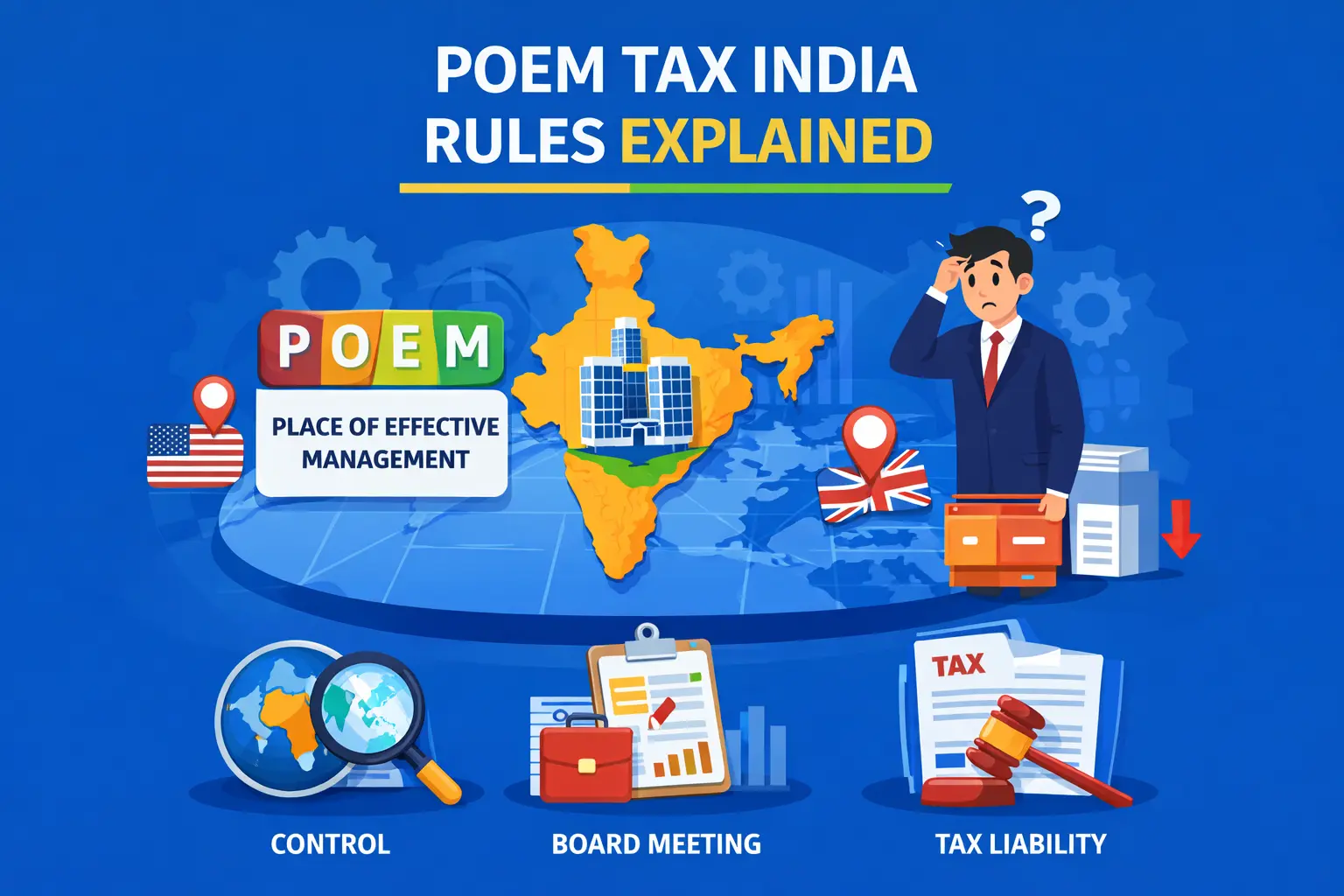
POEM stands for Place of Effective Management. It is a concept used in Indian income tax law to decide whether a foreign company should be treated as an Indian tax resident, and therefore taxed in India on its global income. The basic idea is simple. Where is the company really being managed from? Not on paper. Not as per the registration certificate. But in actual practice, where do the key people sit, where do the important decisions get made, and where does the real control of the business lie?
If the answer is India, then under POEM tax rules India, that foreign company can be declared an Indian tax resident. And once that happens, it has to pay tax in India on its entire worldwide income. Not just the income earned in India. This is a big deal. And many companies did not take it seriously enough when the rules first came in.
When Did POEM Rules Come Into Effect in India?
The POEM India Income Tax provisions were introduced through the Finance Act, 2015. They became effective from the financial year 2016-17 onwards. The government also released detailed guidelines in January 2017 to help companies understand how POEM would be determined in practice. Before POEM, a foreign company was only taxed in India on income that was earned or received here. But after POEM, if the company’s effective management is found to be in India, it becomes a full Indian tax resident. The tax treatment changes completely.
Also, it is important to note that POEM applies only to companies. It does not apply to individuals, partnership firms, or LLPs. So if you run a foreign private limited company or a foreign subsidiary with Indian directors making key decisions, this is directly relevant to you.
How Does the Tax Department Decide POEM?
This is where most business owners get confused. The POEM tax residency rules are not based on one single factor. The tax department looks at the overall picture. First of all, they check where the board of directors meets and makes decisions. If board meetings happen regularly in India, that is a strong indicator of POEM being in India.
But they also look beyond board meetings. They check where the senior management team is located. They look at where strategic decisions, like entering new markets, approving budgets, or hiring top executives, are actually made. Also, if the company’s accounting records, legal documents, and key business data are maintained in India, that adds to the case for Indian POEM. One important thing the guidelines clarify, just because directors occasionally travel to India for meetings does not automatically make India the POEM. The department looks at the overall pattern of decision-making throughout the year, not just one or two meetings.
What Are the Real Risks for Foreign Companies in 2026?
The POEM provisions in income tax act create serious financial exposure for companies that are not careful. Here is what can happen if your foreign company is declared an Indian tax resident. Your company’s global income, income earned from all countries, not just India becomes taxable in India. This can dramatically increase your tax liability overnight. Also, the company would need to comply with Indian income tax return filing requirements, audit requirements, and transfer pricing rules. All of this adds to the compliance burden significantly.
There is also the risk of interest and penalties for past years if the tax department determines that POEM existed in India for earlier financial years but tax was not paid accordingly. In 2026, Indian tax authorities are becoming sharper at identifying companies that exist only on paper in foreign jurisdictions. Especially with the growth of international information sharing between tax departments, it is much harder to hide the real place of management. Because of all this, companies with cross-border structures need to review their POEM tax India position carefully this year.
How to Protect Your Company from POEM Risk
The good news is that POEM risk can be managed if you plan properly. Here are some practical steps. Make sure your foreign company’s board meetings are held outside India. Not just on paper but genuinely. Directors should physically be present in the country where the meeting is held. Keep proper minutes and records of these meetings.
Also, make sure that major strategic decisions are taken by people who are based outside India. If all your senior decision-makers sit in India and only coordinate with a token foreign director occasionally, that is a red flag. Keep proper documentation showing that the company’s management and control genuinely operates from outside India. Emails, meeting records, organizational charts, and decision logs all matter. And most importantly, get a qualified tax advisor to review your company’s structure. A proper POEM assessment done in advance is far better than dealing with a tax demand later.
Get Expert Help Before It Is Too Late
POEM is a complex area of international taxation. It is not something you want to figure out on your own, especially when the stakes involve your company’s entire global income being taxed in India.
Talk to KKS Capital Advisors
At KKS Capital Advisors, we work with businesses that have cross-border structures and help them understand their POEM tax India position clearly. Our team of experienced chartered accountants and tax professionals has been advising companies since 2013 on complex tax and compliance matters. We review your company’s management structure, identify POEM risks, and help you take the right steps to protect your business before the tax department comes knocking.