
How to Register a Private Company in India (2026): Step-by-Step SPICe+ Process, Documents & Cost

A private limited company is the most popular business structure for startups and growing SMEs in India. If you are wondering how to register a private company in India, the process offers limited liability, a separate legal identity, easier access to funding, and strong credibility with customers, banks, and investors. But the company incorporation process in India involves several linked forms and approvals, and one avoidable error, such as a name clash, an incorrect document, or an unsigned form, can push your timeline back by weeks.

In this guide, the Chartered Accountants at KKS Capital Advisor explain exactly how to register a private company in India in 2026 – the eligibility, the full SPICe+ process step by step, the documents required, the real Pvt Ltd registration cost in India, the timeline, and the compliance you must complete immediately after incorporation.

Quick answer

To register a private limited company in India, you apply online through the MCA’s SPICe+ (INC-32) integrated form. The process is: obtain a Digital Signature Certificate (DSC) for the directors, reserve the company name in SPICe+ Part A, file SPICe+ Part B with the MOA (INC-33), AOA (INC-34), INC-9 declaration and AGILE-PRO-S (for PAN, TAN, GST, EPFO, ESIC and bank account), and pay the fees. You need at least 2 directors and 2 shareholders, a registered office, and there is no minimum paid-up capital. Total cost typically ranges from ₹7,000 to ₹25,000 (state-dependent), and incorporation usually completes in 5 to 10 working days with clean documents. You then get the Certificate of Incorporation with CIN, PAN and TAN.

What this guide covers

  • Why choose a private limited company
  • Eligibility and minimum requirements
  • Documents required for company registration
  • The step-by-step SPICe+ registration process
  • Pvt Ltd registration cost in India (fee breakdown)
  • How long does company registration take in 2026
  • Post-incorporation compliance you must not miss
  • How KKS Capital Advisor helps you incorporate smoothly
  • Frequently asked questions

Why choose a private limited company?

Before the process, it helps to know why this structure is so widely chosen:

  • Limited liability: Shareholders’ personal assets are protected; liability is limited to their shareholding.
  • Separate legal entity: The company can own assets, sue and be sued in its own name, independent of its owners.
  • Easier fundraising: Venture capital, angel investors and banks strongly prefer to fund private limited companies.
  • Perpetual succession: The company continues to exist regardless of changes in ownership or directors.
  • Credibility: A registered ‘Pvt Ltd’ builds trust with customers, vendors and partners.

Private limited vs other business structures

Before you register, it is worth confirming that a private limited company is the right vehicle for you. Here is how it compares with the common alternatives:

Structure

Best for

Liability

Key limitation

Private Limited Company

Startups seeking funding & scale

Limited

Higher compliance

One Person Company (OPC)

Solo founders wanting a company

Limited

One member; conversion rules apply

Limited Liability Partnership (LLP)

Professional & service firms

Limited

Harder to raise equity funding

Partnership Firm

Small traditional businesses

Unlimited

No separate legal identity

Sole Proprietorship

Very small / single-owner setups

Unlimited

Limited credibility & funding

For most founders who intend to raise capital, onboard co-founders, or build a credible brand, the private limited company remains the default choice despite its slightly higher compliance.

Eligibility and minimum requirements

Requirement

Minimum condition (2026)

Directors

Minimum 2, maximum 15; at least one must be resident in India

Shareholders (members)

Minimum 2, maximum 200

Director + shareholder overlap

A person can be both a director and a shareholder

Paid-up capital

No minimum; can start with any amount (e.g., ₹1 lakh authorised capital is common)

DIN & DSC

Every director needs a DIN (allotted via SPICe+) and a Class-3 DSC

Registered office

A valid address in India with proof and owner’s NOC

Unique name

Name must not resemble an existing company or a registered trademark

Documents required for company registration

For each director and shareholder

  • PAN card (mandatory for Indian nationals)
  • Aadhaar card and one more identity proof (passport / voter ID / driving licence)
  • Address proof not older than 2 months (bank statement / utility bill / mobile bill)
  • Passport-size photograph
  • Passport (mandatory for foreign nationals, notarised/apostilled)

For the registered office

  • Latest utility bill (electricity / water / gas) not older than 2 months
  • Rent agreement (if rented) plus a No-Objection Certificate (NOC) from the owner
  • Sale deed / property document (if owned)

Registered office requirements

Every company must have a registered office in India from the date of incorporation (or within 30 days), and it must be capable of receiving official communication. It does not have to be a commercial space – a residential address can be used, provided you have valid proof and permission. You need a recent utility bill in the owner’s name, and if the premises are rented or borrowed, a No-Objection Certificate (NOC) from the owner along with the rent agreement. The registered office address appears on your Certificate of Incorporation and all official records, so choose it carefully; changing it later requires additional filings. Many founders use a professional or virtual office in the early stage, which is acceptable as long as statutory documents can be served there.

Step-by-step private limited company registration process

The entire private limited company registration process runs through the MCA portal using the integrated SPICe+ (Simplified Proforma for Incorporating Company Electronically Plus) form. Here is the sequence our team follows.

Step 1 – Obtain Digital Signature Certificates (DSC)

Every proposed director and subscriber must have a Class-3 DSC to sign the e-forms. This is the first practical step and takes a day or two with video KYC.

Step 2 – Reserve the company name (SPICe+ Part A)

Apply for name reservation in SPICe+ Part A with up to two proposed names in order of preference. Check availability on both the MCA name search and the trademark registry to avoid rejection. A reserved name is valid for a limited period, within which you must complete incorporation.

Step 3 – File SPICe+ Part B (incorporation details)

Part B captures the company’s details: registered office address, authorised and paid-up capital, and the particulars of directors and shareholders. DINs for up to three directors are allotted through this form itself.

Step 4 – Prepare and attach MOA, AOA and declarations

  • e-MOA (INC-33): Memorandum of Association – the company’s objects and constitution.
  • e-AOA (INC-34): Articles of Association – the internal rules of management.
  • INC-9: Auto-generated declaration by directors and subscribers.

Step 5 – File AGILE-PRO-S (linked form)

This linked application registers the company for PAN, TAN, GST (optional), EPFO, ESIC, Profession Tax (where applicable) and opens a bank account – all in one integrated filing.

Step 6 – Pay fees and submit

Pay the government fees and applicable stamp duty, then submit the forms signed with the DSCs. The Central Registration Centre (CRC) processes the application.

Step 7 – Receive Certificate of Incorporation

On approval, the Registrar issues the Certificate of Incorporation containing the Corporate Identity Number (CIN), along with the company’s PAN and TAN. Your company is now legally born.

What you receive after registration

Once your company is incorporated, you receive a complete set of legal documents and identifiers that let you start operating, open a bank account and sign contracts:

  • Certificate of Incorporation (COI): The official proof of your company’s existence, carrying the CIN.
  • Corporate Identity Number (CIN): A unique 21-character number identifying your company with the ROC.
  • Company PAN and TAN: Issued automatically through the SPICe+ process for tax purposes.
  • MOA and AOA: Your registered charter documents defining objects and internal rules.
  • DINs for directors: Director Identification Numbers allotted during incorporation.
  • EPFO, ESIC and (optional) GST registration: Set up through the AGILE-PRO-S linked form.

Pvt Ltd registration cost in India (2026)

The Pvt Ltd registration cost in India depends mainly on your state (stamp duty varies), the number of directors (DSC cost), and professional fees. Government processing fees for small-capital companies are largely nominal or zero. Here is a realistic breakdown:

Cost component

Typical range (2026)

Digital Signature Certificate (per director)

₹800 – ₹2,500

Government / MCA filing fee (small capital)

Nominal to nil

Stamp duty on MOA/AOA (state-dependent)

₹200 – ₹12,600

Professional / CA fee

₹5,000 – ₹15,000

Approximate total

₹7,000 – ₹25,000


Note: costs rise with higher authorised capital and in states with higher stamp duty. Optional add-ons like a trademark application or a virtual office also affect the total.

How long does company registration take in 2026?

  • DSC: 1–2 working days.
  • Name reservation (Part A): typically 1–3 working days.
  • Incorporation (Part B + attachments): 2–5 working days after name approval.
  • Total: about 5–10 working days with clean, complete documentation. A resubmission or query can extend this to a few weeks.

Post-incorporation compliance you must not miss

Incorporation is the beginning of your compliance calendar, not the end. Missing these early steps invites penalties:

  • INC-20A (commencement of business): File within 180 days of incorporation after depositing the subscribed capital.
  • Open a current bank account and bring in the shareholders’ subscription money.
  • Appoint an auditor: Within 30 days of incorporation via Form ADT-1.
  • Maintain statutory registers and issue share certificates within 60 days.
  • Annual filings: Form AOC-4 (financials) and MGT-7/7A (annual return), plus income-tax return and board meetings/AGM.
  • DIN KYC: Every director must file DIR-3 KYC annually.

Common mistakes to avoid during registration

From the incorporations we handle, these avoidable errors cause most delays and rejections:

  • Choosing a company name that clashes with an existing company or a registered trademark
  • Submitting address proof older than two months, or a registered office without a proper NOC
  • Mismatches between PAN, Aadhaar and the details entered in SPICe+
  • Vague or overly narrow object clause in the MOA that limits future business activities
  • Forgetting the ₹0 authorised capital myth – set an authorised capital that suits your plans
  • Missing INC-20A within 180 days, which can lead to penalties and even strike-off

How KKS Capital Advisor helps you incorporate smoothly

KKS Capital Advisor handles the full company incorporation process end-to-end—from choosing the right structure and reserving a clash-free name to drafting your MOA and AOA, filing SPICe+ and AGILE-PRO-S, and obtaining your CIN, PAN, TAN, and GST. Through our business incubation and online legal consultancy services, we also set up your post-incorporation compliance calendar—INC-20A, auditor appointment, share certificates, and annual filings—so you never miss a deadline in year one. For founders in Gurgaon and across India, that means you launch on a clean legal footing and can focus on building the business.

Ready to register your private limited company? Let the chartered accountants at KKS Capital Advisor incorporate it correctly and on time. Consult an expert or visit kkscapital to get started.

Key takeaways

  • Private limited companies are registered online via the MCA SPICe+ form (Part A for name, Part B for incorporation).
  • You need at least 2 directors and 2 shareholders, one India-resident director, and a registered office; there is no minimum capital.
  • Core forms: DSC, DIN, SPICe+, e-MOA (INC-33), e-AOA (INC-34), INC-9, and AGILE-PRO-S.
  • Cost typically ranges from ₹7,000 to ₹25,000 depending on state stamp duty, DSCs, and professional fees.
  • Incorporation usually takes 5–10 working days with clean documents.
  • File INC-20A within 180 days and appoint an auditor within 30 days to stay compliant.

FAQ'S

Q. Do NRIs have to pay tax in India?

Yes, but only on income received or accruing in India — such as rent from Indian property, capital gains on Indian assets, NRO interest and salary for services rendered in India. Foreign salary and overseas business income of an NRI are not taxed in India.

No. Interest on NRE and FCNR deposits is exempt from Indian income tax as long as you qualify as a non-resident under the applicable exchange-control conditions. Interest on NRO accounts, by contrast, is fully taxable and typically suffers 30% TDS plus cess.

NRIs generally file ITR-2. If the NRI has business or professional income in India, ITR-3 applies. ITR-1 (Sahaj) is not available to non-residents, even for simple salary or one-house-property situations.

Apply to the jurisdictional assessing officer for a lower or nil deduction certificate under Section 197 before the sale, based on the actual capital gains computation. With the certificate, the buyer deducts TDS at the approved lower rate instead of the steep default rates under Section 195.

You need a Tax Residency Certificate (TRC) from your country of residence for the relevant year, along with Form 10F and any self-declarations the payer requires. Without these, banks and other payers apply full domestic TDS rates instead of the treaty rate.

Read More

MSME Payment Rule Under Section 43B(h): The 45-Day Rule, Disallowance & FY 2025-26 Due Dates Explained

MSME Payment Rule Under Section 43B(h): The 45-Day Rule, Disallowance & FY 2025-26 Due Dates Explained

The MSME payment rule under Section 43B(h) is one of the most misunderstood provisions of recent years—and one of the most expensive to get wrong. Introduced by the Finance Act 2023, it directly links your income-tax deduction to whether you paid your small suppliers on time. Get it right and you protect both your cash flow relationships and your deduction. Get it wrong and a large expense can be pushed to a later year, inflating this year’s tax bill.

In this guide, the chartered accountants at KKS Capital Advisor explain exactly how the rule works, who it applies to, how the 15-day and 45-day limits are calculated, how the MSME payment disallowance in income tax is computed, and the practical steps you should take before the MSME due date for FY 2025-26.

Quick answer

Section 43B(h) of the Income Tax Act says that any amount payable to a micro or small enterprise is deductible only in the year you actually pay it, unless it is paid within the MSMED Act time limit – 15 days where there is no written agreement, or up to 45 days where there is a written agreement. If you miss that deadline and the amount is still unpaid on 31 March, the expense is disallowed and added back to your taxable income for that year; you can claim it only in the later year of actual payment. The rule applies from FY 2023-24 onwards and covers suppliers registered as micro or small (manufacturers and service providers), not medium enterprises and not wholesale/retail traders.

What this guide covers

  • What Section 43B(h) actually says
  • The 15-day and 45-day payment rules explained
  • Who is covered – and who is not (traders, medium enterprises)
  • Revised MSME classification limits (from 1 April 2025)
  • How the disallowance works, with worked examples
  • Interest under the MSMED Act
  • MSME due date and year-end action plan for FY 2025-26
  • How KKS Capital Advisor keeps you compliant
  • Frequently asked questions

Why was Section 43B(h) introduced?

Delayed payments have long been the biggest threat to India’s micro and small enterprises. A small supplier often has little bargaining power against a larger buyer, and money stuck in receivables can choke its working capital and even push it out of business. The MSMED Act, 2006 already gave micro and small suppliers a legal right to be paid within 15 or 45 days – but enforcement was weak. Section 43B(h) added financial teeth by tying the buyer’s income-tax deduction to timely payment. In effect, the government converted a compliance nicety into a bottom-line consequence: pay your small suppliers on time, or lose the deduction this year. Understanding this intent helps you see why the rule is strict and why there is no ‘pay by return-filing date’ escape for MSME dues.

What does Section 43B(h) say?

Section 43B of the Income Tax Act lists certain expenses that are allowed as a deduction only when they are actually paid, not merely when they accrue. Clause (h), inserted by the Finance Act 2023 and effective from Assessment Year 2024-25 (FY 2023-24), adds sums payable to micro and small enterprises to that list.

The rule in one line

An amount payable to a micro or small enterprise for goods supplied or services rendered is deductible only in the year of actual payment, unless it is paid within the time limit specified in Section 15 of the MSMED Act, 2006.

The key change is that the usual ‘pay by the income-tax return due date’ relaxation available for most Section 43B items does not apply to clause (h). For MSME dues, the only way to keep the deduction in the same year is to pay within the MSMED Act timeline.

The 15-day and 45-day payment rules explained

Section 15 of the MSMED Act sets the maximum time a buyer can take to pay a micro or small supplier:

Situation

Maximum payment period

No written agreement between buyer and supplier

15 days from the day of acceptance / deemed acceptance of goods or services

Written agreement exists

The date agreed in writing, but never more than 45 days

So 45 days is a ceiling, not a default. If there is no written agreement, the limit is 15 days. If there is a written agreement, you can agree on any period up to 45 days – you cannot contract for a longer period to escape the rule.

Who is covered – and who is not

Covered

  • Suppliers registered under Udyam as micro or small enterprises
  • Micro and small enterprises engaged in manufacturing or providing services

NOT covered

  • Medium enterprises: Section 43B(h) applies only to micro and small enterprises. Dues to medium enterprises are outside its scope.
  • Wholesale and retail traders: As per Office Memorandum dated 1 September 2021, MSME benefits for traders are restricted to Priority Sector Lending only. The delayed-payment protection of the MSMED Act – and therefore the 43B(h) disallowance – does not apply to purchases from traders.
  • Unregistered suppliers: If a supplier is not registered under Udyam as micro/small on the date of the transaction, the disallowance is generally not triggered – though you should keep evidence of their status.

Practical tip

Always collect the Udyam registration number and category (micro/small/medium, manufacturer/service/trader) from your vendors, and add a field for it in your accounting master. This one habit lets you correctly identify which payables are exposed to Section 43B(h).

Revised MSME classification limits (from 1 April 2025)

To know whether a supplier is micro or small, you need the current classification limits. These were enhanced with effect from 1 April 2025. An enterprise must satisfy both the investment and turnover ceilings for its category (a composite criterion).

Category

Investment in plant & machinery / equipment

Annual turnover

Micro

Up to ₹2.5 crore

Up to ₹10 crore

Small

Up to ₹25 crore

Up to ₹100 crore

Medium

Up to ₹125 crore

Up to ₹500 crore

Since Section 43B(h) applies only to micro and small enterprises, the practical takeaway is: payables to suppliers within the micro (≤₹10 crore turnover) and small (≤₹100 crore turnover) categories are the ones you must monitor.

How the MSME payment disallowance in income tax works

The mechanism is straightforward once you see it applied. If a payable to a micro/small supplier is beyond the 15/45-day limit and remains unpaid on 31 March, it is disallowed for that year and added back to your taxable income. You get the deduction only in the year you actually pay.

Example 1 – Paid within the limit (deduction allowed)

You buy raw material worth ₹8,00,000 from a small enterprise on 1 March 2026 with a written agreement of 45 days. You pay by 15 April 2026 (within 45 days). Even though payment is in the next financial year, it is within the MSMED limit, so the ₹8,00,000 is fully deductible in FY 2025-26. No disallowance.

Example 2 – Beyond the limit and unpaid at year-end (disallowed)

You buy raw material worth ₹50,00,000 from a small enterprise in February 2026, with no written agreement (so the limit is 15 days). It is still unpaid on 31 March 2026. Because it crossed 15 days and is unpaid at year-end, the full ₹50,00,000 is added back to your FY 2025-26 income. You will be able to deduct it only in the year you actually pay – say FY 2026-27.

Example 3 – Beyond the limit but paid before year-end (allowed)

You buy services worth ₹3,00,000 from a micro enterprise in December 2025 with a 15-day limit, and although you are late, you clear the payment on 20 March 2026. Since it is actually paid within the same financial year, there is no add-back – the deduction stands in FY 2025-26. (You may, however, still owe MSMED interest for the delay – see below.)

Interest under the MSMED Act

Missing the deadline has a second cost beyond the tax add-back. Under the MSMED Act, delayed payment to a micro or small supplier attracts compound interest, with monthly rests, at three times the RBI-notified bank rate. Importantly, this interest is not allowed as a deduction under income tax. So a late payment can hit you three ways: disallowed expense, non-deductible interest, and a strained supplier relationship.

MSME due date and year-end action plan for FY 2025-26

There is no single ‘MSME due date’ form to file for Section 43B(h); the real deadline is 31 March 2026 – the point at which unpaid, overdue MSME dues get disallowed. The practical work therefore happens before year-end. Here is the checklist our team runs for clients:

  1. Identify every vendor registered as micro or small under Udyam (collect their Udyam number and category).
  2. Tag payables to those vendors separately in your books.
  3. Check each invoice against its 15-day or 45-day limit based on whether a written agreement exists.
  4. Clear all overdue micro/small payables before 31 March 2026 to preserve the current-year deduction.
  5. Where payment cannot be made, compute the add-back and disclose it correctly in the tax computation and tax audit report.
  6. Compute any MSMED interest payable and remember it is not tax-deductible.
  7. Update purchase agreements to include clear payment terms within 45 days.

Reporting note

Disallowances and MSME dues are reported in the tax audit report (Form 3CD) and separately disclosed in company financial statements under MSME disclosure requirements. Clean records make both straightforward; missing vendor data makes them a scramble at year-end.

How KKS Capital Advisor keeps you Section 43B(h) compliant

KKS Capital Advisor helps businesses build a Section 43B(h) system rather than firefight at year-end. We set up vendor-master fields for Udyam status, create an ageing report for micro/small payables, review your purchase agreements for correct payment terms, and reconcile overdue dues before 31 March so you keep your deductions. At audit time, we compute and disclose disallowances and MSMED interest accurately in Form 3CD and your financials. If you have already crossed a deadline, we help you quantify and correctly report the impact.

Worried about MSME payment disallowance this year? Get a Section 43B(h) health-check from the Chartered Accountants at KKS Capital Advisor. Visit kkscapital.com to book a review.

Key takeaways

  • Section 43B(h) allows a deduction for micro/small supplier dues only when paid within 15 days (no agreement) or up to 45 days (written agreement).
  • If overdue dues are unpaid on 31 March, the expense is disallowed and deductible only in the year of actual payment.
  • The rule covers micro and small manufacturers and service providers – not medium enterprises and not wholesale/retail traders.
  • Revised classification (from 1 April 2025): Micro ≤₹10 cr turnover, Small ≤₹100 cr turnover.
  • Delayed payment also triggers non-deductible MSMED interest at three times the RBI bank rate.
  • The real deadline is year-end – build a vendor-tagging and ageing system well before 31 March.

FAQ'S

What is the MSME payment rule under Section 43B(h)?

It is an income-tax rule that allows a deduction for amounts payable to micro and small enterprises only in the year of actual payment, unless paid within the MSMED Act limit of 15 days (no written agreement) or up to 45 days (written agreement). Overdue amounts unpaid at year-end are disallowed and added back to taxable income.

It depends on the agreement. Where there is no written agreement, the limit is 15 days from acceptance of goods or services. Where there is a written agreement, you can agree on any period up to a maximum of 45 days. You cannot contract for more than 45 days to avoid the rule.

No. As clarified by the Ministry of MSME’s Office Memorandum dated 1 September 2021, wholesale and retail traders get MSME benefits only for Priority Sector Lending. The delayed-payment protection – and hence the Section 43B(h) disallowance – does not apply to purchases from traders.

No. Section 43B(h) covers only micro and small enterprises. Amounts payable to medium enterprises are outside its scope, though you should still confirm the supplier’s registered category.

There is no separate filing due date for 43B(h). The critical date is 31 March 2026: overdue micro/small dues that remain unpaid on that date are disallowed for FY 2025-26 and deductible only in the year you actually pay them.

Identify payables to micro/small suppliers that are beyond their 15/45-day limit and still unpaid on 31 March. The unpaid amount is added back to your taxable income for that year. When you actually pay it in a later year, you claim the deduction then.

Under the MSMED Act, delayed payment attracts compound interest with monthly rests at three times the RBI-notified bank rate. This interest is not allowed as a deduction under income tax, so it is a pure cost.

Ask for their Udyam Registration Certificate, which states the category (micro/small/medium) and activity (manufacturer/service/trader). Store this in your vendor master so you can correctly apply Section 43B(h).

Read More

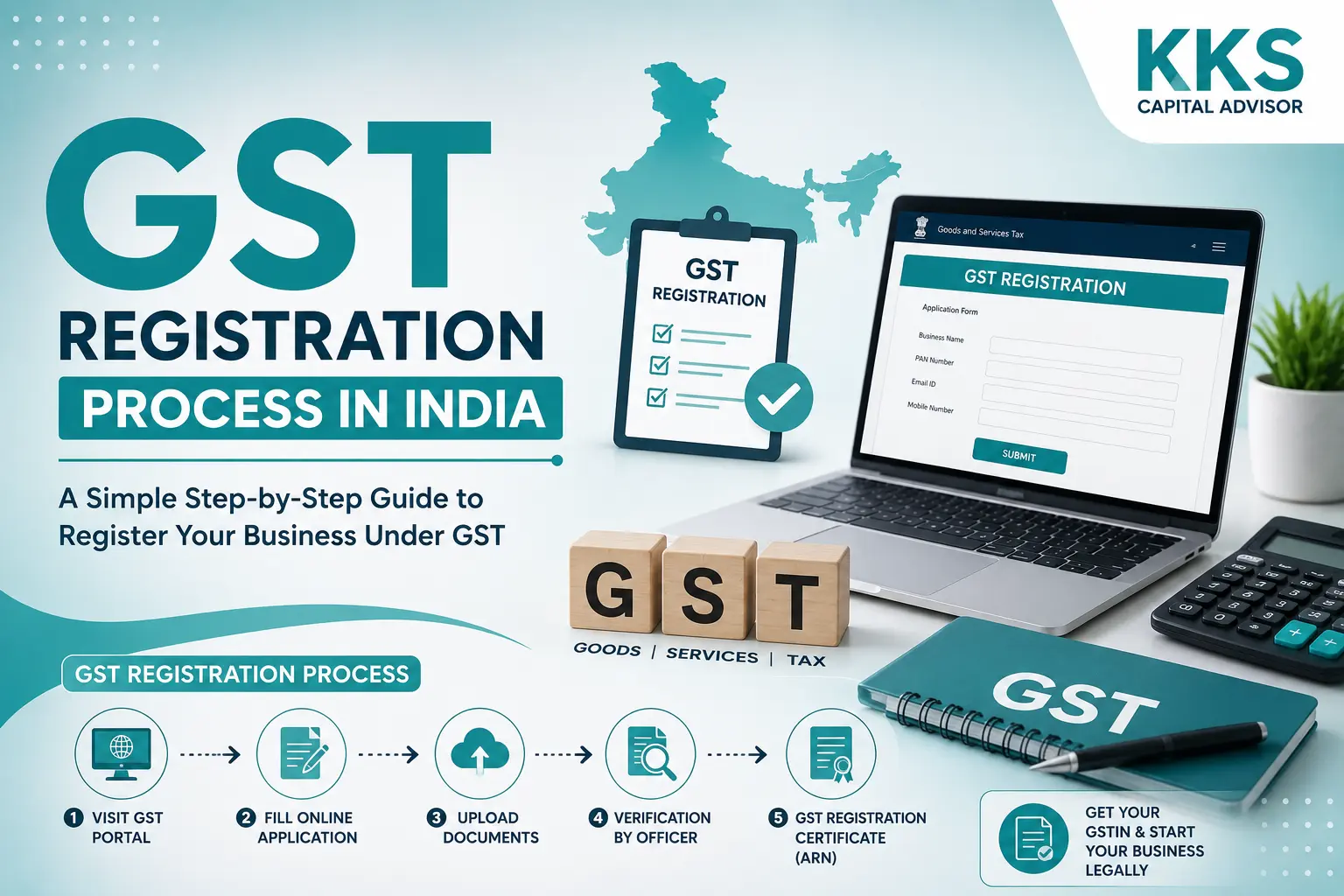
GST Registration Process in India (2026): Step-by-Step Guide with Documents, Fees & Timelines

Getting your GST registration right is the foundation of clean compliance. A wrong PAN mapping, the wrong constitution of business, or a mismatched address proof can delay approval by weeks or trigger a query from the officer. In this guide, the Chartered Accountants at KKS Capital Advisor walk you through the complete GST registration process in India for 2026 – who must register, the exact documents required, the government fees, the step-by-step online process, and how long it takes – based on hundreds of registrations we have filed for startups, traders, manufacturers and service firms.

What this guide covers

  • Who must register for GST (turnover thresholds and special cases)
  • Types of GST registration
  • Documents required for GST registration
  • GST registration fees – government vs professional
  • Step-by-step online GST registration process
  • How long GST registration takes in 2026
  • Penalty for not registering under GST
  • How KKS Capital Advisor makes registration hassle-free
  • Frequently asked questions

Who must register for GST in India?

GST registration is mandatory in the following situations, whether you are an individual, firm, LLP or company:

Category

Registration threshold / trigger

Supplier of goods (normal states)

Aggregate turnover exceeds ₹40 lakh in a financial year

Supplier of services (normal states)

Aggregate turnover exceeds ₹20 lakh in a financial year

Special-category states

₹20 lakh (goods) / ₹10 lakh (services) in many cases

Inter-state supply of goods

Mandatory from ₹1 – no threshold

E-commerce sellers (Amazon, Flipkart, etc.)

Mandatory irrespective of turnover

Casual / seasonal taxable persons

Mandatory before starting supply

Non-resident taxable persons

Mandatory before starting supply

Persons liable under reverse charge

Mandatory

Input service distributors / TDS-TCS deductors

Mandatory

Even if you are below the threshold, voluntary GST registration is often worth it – it lets you claim input tax credit, sell on marketplaces, and appear more credible to B2B customers who want a GST invoice.

Types of GST registration

Type of taxpayer

Who it is for

Key feature

Normal / Regular

Most businesses above threshold

No deposit, unlimited validity

Composition scheme

Small businesses within turnover limit

Flat lower rate, no ITC

Casual taxable person

Occasional / exhibition suppliers

Valid ~90 days, advance deposit

Non-resident taxable person

Foreign suppliers in India

Valid ~90 days, advance deposit

SEZ unit / developer, TDS, TCS, ISD

Specific categories

Category-specific rules

Documents required for GST registration

The exact GST registration documents depend on your business constitution. Below is the complete checklist our team uses so nothing is missed.

A. Proprietorship / individual

  • PAN card and Aadhaar card of the proprietor
  • Passport-size photograph
  • Proof of principal place of business (electricity bill / rent agreement + NOC / property tax receipt)
  • Bank details (cancelled cheque, passbook or bank statement)

B. Partnership firm / LLP

  • PAN of the firm/LLP and partnership deed / LLP agreement
  • PAN, Aadhaar and photographs of all partners
  • Authorised signatory proof and board/authorisation letter
  • Proof of principal place of business and bank details
  • LLP incorporation certificate (for LLPs)

C. Private limited / public company

  • Certificate of incorporation (MCA) and company PAN
  • MOA / AOA
  • PAN, Aadhaar and photographs of directors and authorised signatory
  • Board resolution / authorisation letter for the authorised signatory
  • Digital Signature Certificate (DSC) of the authorised signatory
  • Proof of principal place of business and bank details

Tip on address proof

If the premises are rented, keep a valid rent agreement plus a No-Objection Certificate (NOC) from the owner and a recent utility bill. Mismatched or old address proof is the single most common reason for a registration query.

GST registration fees in India

There is no government fee for GST registration – the GST portal does not charge anything to apply. What you may pay is a professional fee if you engage a Chartered Accountant or consultant to prepare and file the application, respond to queries, and get it approved without errors. Casual and non-resident taxable persons are different: they must deposit an advance GST equal to their estimated tax liability for the registration period.

Cost head

Amount

Government portal fee

₹0 (free)

Professional / CA fee (optional)

Varies by complexity of the case

Advance tax deposit (casual / NR only)

Equal to estimated GST liability

Step-by-step online GST registration process

Here is exactly how to register for GST on the GST portal. The application has two parts – Part A (TRN generation) and Part B (full application).

Part A – Generate your TRN

  1. Go to the GST portal and choose Services › Registration › New Registration.
  2. Select ‘Taxpayer’, choose your state and district, and enter the legal name of business exactly as per PAN.
  3. Enter PAN, email and mobile number.
  4. Verify the OTPs sent to your email and mobile.
  5. You receive a Temporary Reference Number (TRN).

Part B – Complete the application

  1. Log in again using the TRN and a fresh OTP.
  2. Fill in business details – constitution, date of commencement, reason for registration.
  3. Add promoter / partner / director details.
  4. Add the authorised signatory and their details.
  5. Enter the principal place of business with ownership/tenancy proof; add additional places if any.
  6. List your top goods / services with HSN / SAC codes.
  7. Enter bank account details (can be added later if needed).
  8. Upload all supporting documents in the prescribed format and size.
  9. Verify and submit using DSC (mandatory for companies/LLPs), e-Sign or EVC (Aadhaar OTP).

On successful submission you get an Application Reference Number (ARN) to track status. Under the 2026 process, Aadhaar-authenticated, low-risk applicants can get near-automatic approval within about three working days, while others are approved after officer verification, generally within seven working days.

How long does GST registration take in 2026?

  • Aadhaar-authenticated, low-risk applicants: often approved within ~3 working days under the simplified/automatic route.
  • Standard cases: GSTIN and certificate typically issued within ~7 working days of ARN, if no query is raised.
  • If a query (Form GST REG-03) is raised: you must respond in REG-04 within the prescribed time, after which approval follows.

Penalty for not registering under GST

Operating without registration when you are liable is costly. Under Section 122 of the CGST Act, failure to register can attract a penalty of ₹10,000 or the amount of tax evaded, whichever is higher. You also lose the right to collect GST from customers and to claim input tax credit for the unregistered period. Timely registration is always cheaper than a penalty plus interest.

Benefits of GST registration

Beyond legal compliance, a valid GSTIN unlocks real commercial advantages. Whether you are just crossing the threshold or registering voluntarily, these are the benefits our clients value most:

  • Input tax credit: You can claim credit of GST paid on your purchases and expenses, reducing your effective tax cost.
  • Legal right to collect GST: Only a registered person can charge GST on invoices and issue a valid tax invoice.
  • Sell on e-commerce and to large buyers: Marketplaces and most corporate customers require a GSTIN before they onboard you.
  • Inter-state and pan-India expansion: Registration lets you supply across state borders without turnover restrictions.
  • Credibility and access to finance: A GSTIN and regular filings build a compliance trail that lenders and investors look for.
  • Government tenders and contracts: Most tenders require GST registration as a basic eligibility condition.

Aadhaar authentication and biometric verification

Aadhaar authentication has become central to faster approvals. When the primary authorised signatory and one promoter successfully complete Aadhaar-based e-KYC, low-risk applications can be approved on a largely automatic, time-bound basis. If Aadhaar authentication is not opted for, or the case is flagged as higher risk, the application may be routed for physical verification of the place of business before the GSTIN is granted. In some states, biometric Aadhaar authentication at a designated centre is also required. Choosing Aadhaar authentication upfront is therefore the single easiest way to speed up your registration.

Common reasons GST registration gets rejected or delayed

From the applications we review, most queries and rejections come down to a short list of avoidable errors:

  • Legal name of business not matching the PAN database exactly
  • Weak or mismatched address proof – old utility bill, no rent agreement, or missing NOC from the owner
  • Blurred, oversized, or wrong-format document uploads
  • Selecting the wrong constitution of business or reason for registration
  • Authorised signatory details not matching the board resolution or authorisation letter
  • Not responding to the officer’s query (Form REG-03) within the given time

How to avoid a query

Match every detail to your PAN and constitution documents, keep address proof recent and complete (bill + agreement + NOC), and complete Aadhaar authentication. A clean first submission is almost always faster than a corrected one.

Post-registration compliance you must not miss

Registration is the start, not the finish. Once you have a GSTIN, the following obligations begin – and non-compliance carries late fees and interest:

  • Display your GSTIN: Show the registration certificate and GSTIN at your principal place of business.
  • Issue GST-compliant invoices: With correct GSTIN, HSN/SAC, place of supply and tax split (CGST/SGST or IGST).
  • File returns on time: GSTR-1 and GSTR-3B (monthly or under QRMP), and GSTR-9 annual return where applicable.
  • Reconcile input tax credit: Match your purchases with GSTR-2B to claim only eligible ITC.
  • E-invoicing / e-way bills: Comply if you cross the applicable turnover limits or move goods above the threshold value.

How KKS Capital Advisor makes GST registration hassle-free

KKS Capital Advisor handles the entire registration end-to-end—verifying eligibility, choosing the correct registration type, assembling documents in the right format, filing Part A and Part B, and responding to any officer query so your GSTIN is approved the first time. We also set up your post-registration compliance: invoice formats, HSN mapping, and the return-filing calendar. For businesses in Gurgaon and across India, this means you start billing legally and claiming ITC without avoidable delays.

Ready to register for GST? Let the chartered accountants at KKS Capital Advisors file it correctly the first time. Visit kkscapital.com to get started.

Key takeaways

  • GST registration is online and free of government fees on gst.gov.in.
  • Mandatory above ₹40 lakh (goods) / ₹20 lakh (services) and for e-commerce and inter-state suppliers regardless of turnover.
  • Documents vary by business type – PAN, Aadhaar, address proof, bank proof, and constitution documents are core.
  • You get an ARN immediately; GSTIN typically within 3–7 working days.
  • Not registering when liable can cost ₹10,000 or the tax evaded, whichever is higher.

FAQ'S

What is the GST registration process in India?

It is a fully online process on the GST portal: generate a TRN using PAN, email and mobile (Part A), then complete Part B with business, promoter, place-of-business and bank details, upload documents, and verify with DSC or Aadhaar OTP. You receive an ARN instantly and your GSTIN and certificate after verification, usually within 3–7 working days.

No. The GST portal charges nothing for registration. You only pay a professional fee if you hire a CA or consultant. Casual and non-resident taxable persons must, however, deposit advance tax equal to their estimated liability.

Core documents are PAN and Aadhaar of the owner/partners/directors, a photograph, proof of principal place of business (utility bill / rent agreement + NOC), bank proof (cancelled cheque or statement), and constitution documents such as the partnership deed or certificate of incorporation. Companies and LLPs also need a DSC and board resolution.

Broadly, ₹40 lakh for suppliers of goods and ₹20 lakh for suppliers of services in normal states, with lower limits in some special-category states. Inter-state suppliers and e-commerce sellers must register from the first rupee, regardless of turnover.

Aadhaar-authenticated low-risk applicants can be approved in about three working days under the simplified route; standard cases are usually approved within seven working days of ARN if no query is raised.

Yes. Even below the threshold you can register voluntarily to claim input tax credit, sell on e-commerce platforms, and issue GST invoices to B2B customers. Once registered, you must comply with all return-filing obligations.

Under Section 122 of the CGST Act, failure to register when liable can attract a penalty of ₹10,000 or the amount of tax evaded, whichever is higher, plus loss of input tax credit for the unregistered period.

Yes. GST is state-specific. If you have a place of business in more than one state, you need a separate GST registration for each state under the same PAN.

Read More

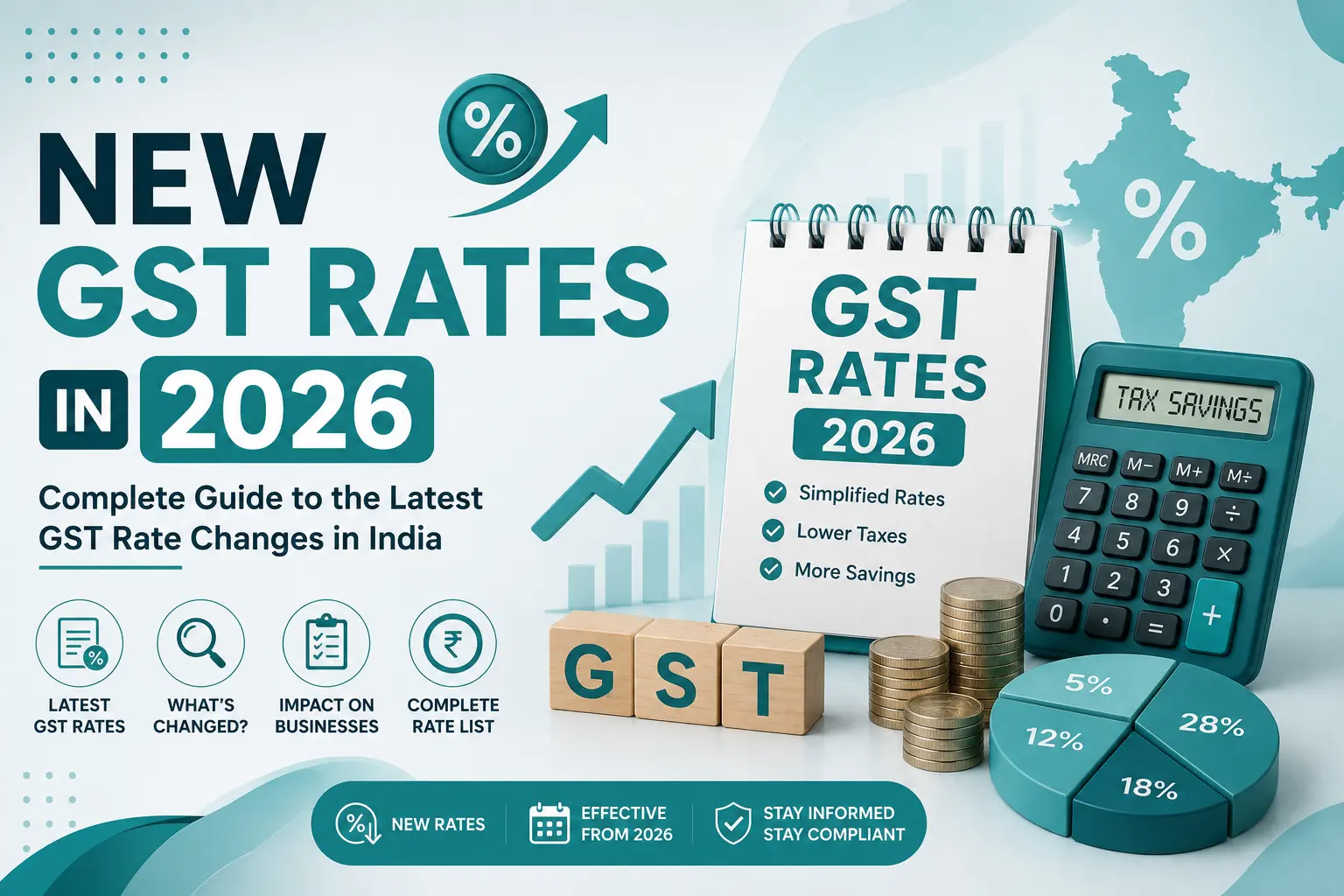
New GST Rate in 2026: The Complete GST 2.0 Slab List (Nil, 5%, 18% & 40%)

Reviewed by the GST advisory team at KKS Capital Advisor (Chartered Accountants, Gurgaon)  •  Last updated: 18 August 2026

Quick answer

Under GST 2.0, effective 22 September 2025, India moved from four main slabs (5%, 12%, 18%, 28%) to a simpler two-rate structure of 5% (merit rate) and 18% (standard rate), plus a special 40% de-merit rate for luxury and ‘sin’ goods. A Nil (0%) category continues for essentials, and niche rates of 3%, 1.5% and 0.25% remain for gold, diamonds and a few special cases. The old 12% and 28% slabs have been removed and their items re-distributed into 5% or 18%. So in 2026 the effective GST rate list you work with is: 0%, 5%, 18% and 40%.

If you run a business, manage accounts, or simply want to understand your bills, the new GST rate in 2026 is the single biggest indirect-tax change India has seen since GST launched in 2017. The 56th GST Council meeting, chaired by the Union Finance Minister, approved a sweeping rate rationalisation now popularly called “GST 2.0.” The goal was simple: fewer slabs, fewer classification disputes, lower tax on everyday essentials, and a clear premium rate on luxury and harmful products.

At KKS Capital Advisor, our Chartered Accountants have spent the last year re-mapping HSN codes, re-pricing invoices and updating billing systems for clients across manufacturing, retail, hospitality and services. This guide distils that hands-on experience into one plain-English reference so you can see exactly what the GST 2.0 slabs in India look like, what changed, and how it affects your prices, margins and compliance.

What this guide covers

  • The new GST slab structure in 2026 at a glance
  • The full revised GST slab list – Nil, 5%, 18% and 40% items
  • Special rates that still exist (3%, 1.5%, 0.25%)
  • Old vs new GST rates – what got cheaper and what got costlier
  • Sector-by-sector impact for businesses and consumers
  • The effective date, transition rules and compliance checklist
  • How KKS Capital Advisor helps you stay compliant
  • Frequently asked questions

The new GST slab structure in 2026 at a glance

The clearest way to understand the GST rate changes 2026 is to compare the old and new structures side by side. Before GST 2.0 there were four principal rates. Now there are effectively two working rates plus a special rate and the Nil category.

GST structure

Slabs (before)

Slabs (now – 2026)

Merit / essentials

0% and 5%

0% (Nil) and 5%

Lower standard

12%

Merged into 5% or 18%

Standard

18%

18% (main standard rate)

Higher standard

28%

Merged into 18%

Luxury / sin goods

28% + cess

40% (single de-merit rate)

Special rates

3%, 1.5%, 0.25%

3%, 1.5%, 0.25% (retained)

In short: the revised GST slab list for 2026 is 0%, 5%, 18% and 40%, with a handful of special rates for precious metals and specific goods. This is why GST 2.0 is described as a “two-slab” regime – the 5% and 18% rates now carry the vast majority of goods and services.

Nil (0%) GST rate items in 2026

The Nil-rated basket was expanded under GST 2.0 to make essentials and socially important goods and services fully tax-free. Key items now at 0% include:

  • Individual life and health insurance policies (reduced from 18% to Nil) – one of the most talked-about reliefs
  • 33 specified life-saving drugs and medicines moved to Nil
  • Educational supplies – notebooks, exercise books, pencils, crayons, sharpeners, erasers, maps and charts
  • Basic unbranded food staples that were already exempt (fresh produce, milk, unpacked cereals, etc.)
  • UHT / ultra-high-temperature milk and paneer (pre-packaged and labelled) moved to Nil

5% GST rate items (the merit rate)

The 5% “merit” rate is designed for mass-consumption goods and everyday services. Many items that used to sit at 12% or 18% were pulled down to 5% – this is where most household savings come from under the new GST rate in 2026.

Common goods at 5%

  • Personal care: hair oil, shampoo, toothpaste, toothbrushes, soap, shaving cream
  • Dairy and packaged foods: butter, ghee, cheese, pre-packaged namkeens, packaged snacks
  • Kitchen and home: tableware, kitchenware, utensils, baby feeding bottles
  • Health devices: spectacles, glucometers, thermometers, diagnostic kits, medical-grade oxygen
  • Agriculture: tractors, tractor tyres and parts, drip-irrigation systems, bio-pesticides, agricultural machinery

Common services at 5%

  • Hotel accommodation with tariff up to ₹7,500 per night (reduced from 12% to 5%)
  • Gyms, fitness centres, salons, barbers, yoga and wellness services (reduced from 18% to 5%)

18% GST rate items (the standard rate)

18% is now the main standard rate. Crucially, most goods that were at 28% (excluding luxury/sin categories) have moved down to 18%, so several big-ticket consumer durables became cheaper. Typical 18% items include:

  • Consumer electronics: televisions (including large-screen), air-conditioners, dishwashers, monitors
  • Automobiles: small cars and most two-wheelers up to 350cc (moved from 28% to 18%)
  • Cement and many construction inputs (a long-standing demand, reduced from 28% to 18%)
  • Apparel and footwear priced above the concessional threshold
  • Most industrial machinery, capital goods, IT hardware and business services
  • Auto components, packaged branded goods and general manufactured products

40% GST rate items (the de-merit / luxury rate)

The single 40% de-merit rate replaces the old 28% + compensation cess structure for luxury and ‘sin’ products. It keeps the effective tax burden high on items the government wants to discourage or treat as premium, while simplifying the maths. Items in the 40% slab include:

  • Pan masala, aerated / carbonated soft drinks and caffeinated / energy beverages
  • Large motor cars, SUVs and high-capacity motorcycles above 350cc
  • Aircraft and yachts for personal use
  • Revolvers, pistols and similar arms
  • Casino entry, betting, online money-gaming, lottery and race-club activities

Important note on tobacco

Tobacco, cigarettes, gutkha and pan masala with tobacco continue at 28% + compensation cess for a transition period – they will move to the new framework only after existing compensation-cess loan liabilities are cleared. Always confirm the live rate for these products before invoicing.

Special GST rates that still exist

Rate

Applies to

0.25%

Rough / unworked diamonds and precious stones

1.5%

Cut and polished diamonds; certain composition-scheme cases

3%

Gold, silver, platinum and jewellery

These rates were deliberately left untouched so that the bullion and jewellery trade continues under its existing, well-understood structure.

Old vs new GST rates: what got cheaper and what got costlier

The headline of the GST rate changes 2026 is affordability. The vast majority of movements were rate cuts. Here is a representative comparison our team uses when explaining GST 2.0 to clients:

Item / category

Old rate

New rate (2026)

Direction

Individual health & life insurance

18%

Nil

Cheaper

Hair oil, soap, shampoo, toothpaste

18%

5%

Cheaper

Butter, ghee, cheese, namkeens

12%

5%

Cheaper

Televisions, ACs, dishwashers

28%

18%

Cheaper

Small cars & bikes (≤350cc)

28%

18%

Cheaper

Cement

28%

18%

Cheaper

Hotel stays up to ₹7,500/night

12%

5%

Cheaper

Salon, gym, yoga services

18%

5%

Cheaper

Tractors & farm equipment

12%

5%

Cheaper

Aerated / caffeinated drinks

28% + cess

40%

Costlier / same

Luxury cars, bikes >350cc

28% + cess

40%

Restructured

What GST 2.0 means for your business

Lower rates are welcome, but rate rationalisation is never a ‘do-nothing’ event. From our client work at KKS Capital Advisor, these are the areas that need attention:

1. Re-price and re-configure your billing

Every product mapped to a changed rate must be updated in your ERP, POS and invoicing software before you raise the next invoice. A single mismatched HSN-to-rate mapping can trigger short-payment notices or wrong ITC for your customers.

2. Manage transition and stock in hand

Goods purchased at old rates but sold after 22 September 2025 need careful treatment of input tax credit and pricing. Anti-profiteering expectations mean genuine rate cuts should be passed on to consumers – keep documentation showing you did.

3. Watch the inverted duty structure

When your inputs are taxed at 18% but your output is at 5%, you accumulate input tax credit. The good news: GST 2.0 introduced faster, largely automated provisional refunds (up to 90%) for inverted-duty and zero-rated cases from November 2025 – but you must file cleanly to benefit.

4. Update contracts and quotations

Long-term contracts, AMC quotations and price lists that quote GST-inclusive figures should be revised, and ‘plus GST as applicable’ clauses reviewed so neither side absorbs an unexpected cost.

What GST 2.0 means for consumers

For households, the direction is clearly positive. Daily-use personal-care items, packaged foods, dairy, medicines and insurance are cheaper, and several aspirational purchases – televisions, air-conditioners, small cars and cement for home construction – dropped from 28% to 18%. The clean-up of slabs also reduces the classification confusion that used to make similar products carry different rates.

Effective date and transition timeline

  • 22 September 2025: New GST 2.0 rates (Nil, 5%, 18%, 40%) came into force for most goods and services.
  • Tobacco & pan masala with tobacco: Continue at 28% + cess until compensation-cess liabilities are cleared.
  • 1 November 2025: 90% provisional refunds for inverted-duty and zero-rated supplies operationalised.
  • 2026 onwards: The 0% / 5% / 18% / 40% structure is the working GST rate list for the financial year.

Your GST 2.0 compliance checklist

  1. Re-map every HSN/SAC code to its correct 2026 rate.
  2. Update ERP / POS / e-invoicing masters and test a few invoices before going live.
  3. Reconcile stock purchased at old rates against sales at new rates.
  4. Revise printed price lists, catalogs, menus, and website prices.
  5. Pass on genuine rate cuts to customers and keep evidence.
  6. Review inverted-duty exposure and plan your refund filings.
  7. Re-check contract clauses that quote GST-inclusive amounts.
  8. Train your billing and accounts team on the new slabs.

How KKS Capital Advisor helps you get GST 2.0 right

KKS Capital Advisor is a Gurgaon-based chartered accountant firm offering end-to-end GST services – registration, rate mapping, return filing, ITC optimization, audits, refunds, and departmental representation. When rate structures change, our team reclassifies your product catalog, updates your billing configuration, and reconciles transition stock so you neither overcharge customers nor under-report tax. If you have received a notice, or you are unsure whether an item sits at 5%, 18%, or 40%, we give you a written, defensible position.

Need help re-mapping your GST rates for 2026? Talk to the GST team at KKS Capital Advisor for a review of your HSN mapping, invoices, and ITC position. Visit kkscapital.com to get in touch.

Key takeaways

  • GST 2.0 (effective 22 September 2025) simplified India’s GST to two main slabs – 5% and 18% – plus a 40% de-merit rate and the Nil category.
  • The old 12% and 28% slabs were removed; their items moved to 5% or 18%.
  • Most essentials, personal care, dairy, medicines and insurance became cheaper; several 28% durables dropped to 18%.
  • Luxury and ‘sin’ goods now attract a single 40% rate instead of 28% + cess.
  • Special rates of 0.25%, 1.5% and 3% for diamonds and precious metals continue.
  • Businesses must re-map HSN codes, update billing systems and pass on genuine rate cuts.

FAQ'S

Q. What is the new GST rate in 2026?

In 2026 the working GST rate list is 0% (Nil), 5%, 18% and 40%, following the GST 2.0 rationalisation effective 22 September 2025. The 5% and 18% slabs carry most goods and services, 40% applies to luxury and sin goods, and special rates of 0.25%, 1.5% and 3% remain for diamonds and precious metals.

There are two principal working slabs – 5% and 18% – along with a Nil (0%) category and a special 40% de-merit rate. A few niche rates (0.25%, 1.5%, 3%) continue for specific items, so in practice you deal with four main rates: 0%, 5%, 18% and 40%.

Under GST 2.0 the 12% and 28% slabs were abolished. Items earlier taxed at 12% mostly moved to 5% (and a few to 18%), while items at 28% moved to 18%, except luxury and sin goods which now sit at the special 40% rate.

Personal-care items (soap, shampoo, hair oil, toothpaste), dairy (butter, ghee, cheese), packaged namkeens, many medicines, individual health and life insurance, televisions, air-conditioners, small cars, cement and farm equipment all became cheaper due to rate cuts.

The 40% rate is a single de-merit rate for luxury and harmful goods – pan masala, aerated and caffeinated drinks, large cars and bikes above 350cc, yachts, personal aircraft, firearms, and betting/gaming/casino activities. It replaces the earlier 28% + compensation cess for these categories.

The new rates apply from 22 September 2025 for most goods and services. Tobacco and pan-masala-with-tobacco products continue at 28% + cess for a transition period until compensation-cess liabilities are settled.

Yes. You must update HSN/SAC-to-rate mapping in your billing, ERP and e-invoicing systems, revise price lists, and reconcile stock bought at old rates but sold at new rates. KKS Capital Advisor can carry out this re-mapping and verification for you.

Yes. Gold, silver and platinum jewellery remain at 3%, cut and polished diamonds at 1.5%, and rough diamonds at 0.25%. These special rates were deliberately retained under GST 2.0.

Read More

NRI Income Tax in India: Rules, ITR Filing & Taxable Income Explained (2026)

An NRI in Dubai sells an old flat in Gurgaon and watches the buyer deduct a massive chunk as TDS. Another in the US receives a notice for interest income he never knew was taxable in India. NRI income tax in India problems rarely come from evasion — they come from not knowing which income India taxes and which it does not.

This guide explains how NRI income tax works for AY 2026-27: how residential status is decided, what income is taxable in India, how NRE and NRO accounts differ, the TDS rules that bite hardest, DTAA relief, and the correct way to file your Indian return from abroad.

Who Is an NRI for Income Tax? Residential Status Rules

Your tax liability in India depends on residential status under Section 6, tested every financial year. You are a resident if you spend 182 days or more in India during the year, or 60 days or more in that year plus 365 days or more across the preceding four years. Fail both tests, and you are a non-resident (NRI) for that year.

Important carve-outs modify the 60-day rule: for an Indian citizen leaving for employment abroad or as a crew member, and for citizens/PIOs visiting India, the threshold extends to 182 days — though for visiting citizens/PIOs with India-sourced income above ₹15 lakh, the limit tightens to 120 days. High-income citizens not taxed in any other country can also be “deemed residents” in specific cases.

Count your days carefully every year, with passport stamps as evidence. Status drives everything that follows.

What Income Is Taxable in India for NRIs?

The principle is simple: NRIs are taxed in India only on income received or accruing in India. Global income stays outside the Indian net (unlike residents).

Income Type

Taxable for NRI in India?

Notes

Salary for services rendered in India

Yes

Taxed even if paid abroad

Rent from property in India

Yes

Tenant deducts TDS; standard deduction available

Capital gains on Indian assets

Yes

Property, shares, mutual funds — buyer/broker-level TDS applies

Interest on NRO account

Yes

TDS at 30% (plus cess) is common

Interest on NRE and FCNR deposits

No (exempt)

Exempt while you qualify as NRI under FEMA conditions

Foreign salary and foreign business income

No

Outside Indian tax net for NRIs

TDS Rules Every NRI Must Know

  • Property sale (Section 195): buyers must deduct TDS on payments to NRIs at rates linked to the capital gains tax — far higher than the 1% for residents. Apply to the assessing officer for a lower/nil deduction certificate before the sale to avoid locking up funds.
  • Rent: tenants paying rent to an NRI landlord must deduct TDS under Section 195 at the applicable rate.
  • NRO interest: banks deduct TDS at 30% plus cess by default; DTAA can lower this with the right paperwork.
  • Shares and mutual funds: capital gains TDS applies at prescribed rates when NRIs redeem or sell.

Because TDS often exceeds the actual final tax, filing an Indian ITR is frequently the only way an NRI recovers the excess as a refund.

DTAA: How NRIs Avoid Double Taxation

India has Double Taxation Avoidance Agreements with dozens of countries, including the UAE, USA, UK, Singapore and Australia. DTAA either taxes an income in one country only or allows credit in your home country for tax paid in India.

To claim treaty benefits, obtain a Tax Residency Certificate (TRC) from your country of residence and furnish Form 10F along with prescribed details. Without these documents, banks and payers apply full domestic TDS rates.

How NRIs Should File ITR in India: Step-by-Step

  1. Determine your residential status for the year. Count India days precisely; borderline years deserve professional confirmation.
  2. Check whether filing is required. File if Indian taxable income exceeds the basic exemption limit — or file voluntarily to claim TDS refunds and carry forward capital losses.
  3. Choose the correct form. NRIs generally file ITR-2 (or ITR-3 with business income in India); ITR-1 is not available to non-residents.
  4. Reconcile with Form 26AS and AIS. Every TDS entry and reported transaction should match your return.
  5. Report exempt income and apply DTAA correctly. Disclose NRE interest as exempt where applicable and claim treaty relief with TRC/Form 10F.
  6. Pre-validate an Indian bank account for refunds. An active NRO account works for refund credit.
  7. File and e-verify from anywhere. Aadhaar OTP, net banking or other e-verification completes the process fully online — no India visit needed.

Common NRI Income Tax Mistakes

  • Continuing to use a resident savings account after becoming an NRI instead of re-designating it as NRO — a FEMA compliance issue.
  • Assuming NRO interest is exempt like NRE interest and skipping the return.
  • Selling property without a lower-TDS certificate and waiting a year for a large refund.
  • Ignoring the 120-day rule after taking up substantial India-sourced income, and accidentally becoming a resident.
  • Missing DTAA paperwork (TRC/Form 10F) and paying avoidable higher TDS.
  • Not reporting Indian capital gains from mutual funds because ‘the money never left India’.

Smart Tax Planning Tips for NRIs

  • Keep deposits in NRE/FCNR while you qualify — the interest is tax-free in India.
  • Plan property sales: gain computation, lower-deduction certificate, and Section 54/54EC reinvestment options can transform the outcome.
  • Maintain a simple day-count tracker for India visits, especially in years of relocation.
  • Review status every year around March if you travel frequently — one extra fortnight in India can flip your status.
  • Use a professional for the transition years (leaving or returning to India); these are where the costliest mistakes occur.

Conclusion

NRI income tax follows one clean principle — India taxes what arises in India — surrounded by details that matter: day-count rules, NRE-versus-NRO treatment, steep Section 195 TDS, DTAA paperwork and the right ITR form. Master the details, and Indian compliance from abroad becomes a two-hour annual task with refunds arriving on time.

Ignore them, and TDS, notices and locked-up money follow you across borders.

Living abroad with income in India? KKS Capital Advisors specializes in NRI tax filing, lower-TDS certificates, DTAA relief and property sale planning — handled remotely, end to end. Schedule a virtual consultation with our NRI tax experts today.

This guide breaks down exactly who needs a tax audit for AY 2026-27, the current turnover limits with the digital-transaction relaxation, the forms involved, due dates, penalties for default, and how to prepare so the audit is a formality rather than a fire drill.

What Is a Tax Audit Under Section 44AB?

A tax audit under Section 44AB is a mandatory examination of a taxpayer’s books of account by a practising Chartered Accountant, required when business turnover or professional receipts cross specified limits. The CA verifies that books are properly maintained and reports prescribed particulars to the Income Tax Department in Form 3CA/3CB along with the detailed statement in Form 3CD.

Its purpose is simple: give the department assurance that income is computed correctly under the Income-tax Act, and flag disallowances, TDS defaults and reporting gaps in a standard format.

Tax Audit Applicability: Turnover Limits for AY 2026-27

Taxpayer Category

Threshold for Tax Audit

Key Condition

Business (general rule)

Turnover above ₹1 crore

Standard limit under Section 44AB(a)

Business (digital-heavy)

Turnover above ₹10 crore

Cash receipts AND cash payments each ≤ 5% of totals

Profession

Gross receipts above ₹50 lakh

Doctors, lawyers, architects, consultants and other specified professionals

Presumptive business (44AD) opt-out

Audit required despite lower turnover

Declaring profit below the presumptive rate while income exceeds the basic exemption limit

Presumptive profession (44ADA) opt-out

Audit required despite lower receipts

Declaring profit below 50% of receipts while income exceeds the exemption limit

The ₹10 crore relaxation is a genuine reward for going digital: if your cash receipts and cash payments are each within 5% of the respective totals, no audit is needed until ₹10 crore turnover. Keep banking trails clean and this benefit is yours.

Forms 3CA, 3CB and 3CD: What Gets Filed

  • Form 3CA: used when your accounts are already audited under another law — for example, a company audited under the Companies Act.
  • Form 3CB: used when there is no other statutory audit — typical for proprietorships, partnerships and professionals.
  • Form 3CD: the heart of the tax audit — a detailed statement of particulars covering depreciation, disallowances under 40(a)/40A/43B, TDS compliance, loans and deposits, GST turnover reconciliation and much more.

The auditor uploads these electronically, and you approve them through your e-filing account. Only then is the tax audit complete.

Tax Audit Due Date and Penalty for Default

For AY 2026-27, the tax audit report is ordinarily due by 30 September 2026, and the ITR for audited cases by 31 October 2026 (transfer-pricing cases get later dates). Watch for official extensions, but never plan around them.

Missing the audit invites a penalty under Section 271B: 0.5% of turnover or gross receipts, capped at ₹1,50,000. The penalty can be waived for reasonable cause, but prevention is infinitely cheaper than pleading.

How to Prepare for a Tax Audit: Step-by-Step

  1. Close and reconcile your books early. Bank reconciliations, debtor/creditor confirmations and stock records should be ready by the first quarter after year-end.
  2. Reconcile turnover with GST returns. Differences between books, GSTR-1 and GSTR-3B are the first thing every auditor — and the department — checks.
  3. Compile TDS compliance. Match expense-wise TDS deducted, deposited and returns filed; defaults trigger disallowances under 40(a)(ia).
  4. Organize loan and cash-transaction records. Sections 269SS/269ST compliance on cash loans and receipts is a standard 3CD reporting point.
  5. Fix the fixed asset register. Additions, deletions and depreciation as per Income-tax rules must be documentable.
  6. Engage your CA well before the deadline. August engagement beats September panic — quality of audit and of tax positions both improve.
  7. Review the draft 3CD before approval. Every clause you approve becomes departmental record; read it, question it, then accept it.

Tax Audit vs Statutory Audit: Don’t Confuse the Two

A statutory audit under the Companies Act applies to every company regardless of size, and examines whether financial statements show a true and fair view for shareholders. A tax audit under Section 44AB applies based on turnover or receipts thresholds — to companies, firms, proprietors and professionals alike — and reports income-tax-specific particulars to the department.

A private limited company crossing the 44AB threshold therefore undergoes both audits: the statutory audit first, and the tax audit reported in Form 3CA-3CD relying on those audited accounts. A proprietorship crossing the threshold undergoes only the tax audit, in Form 3CB-3CD.

Knowing which audit you need — and sequencing them correctly — avoids duplicated work and missed deadlines.

Common Mistakes Businesses Make Around Tax Audits

  • Measuring only turnover and ignoring the cash-percentage test that decides between the ₹1 crore and ₹10 crore limits.
  • Opting out of presumptive taxation with low declared profits and not realizing an audit has become mandatory.
  • Treating F&O trading casually — derivatives turnover is business turnover and can trigger audit obligations.
  • Leaving GST-vs-books turnover mismatches unexplained, gifting the department an easy notice.
  • Approving Form 3CD without reading it, then being surprised by what was reported.
  • Starting the audit in the last week of September, forcing rushed positions that cost real tax.

Benefits of a Well-Run Tax Audit (Beyond Compliance)

  • Early error detection: TDS gaps and disallowance risks get fixed before they become demands.
  • Cleaner funding conversations: banks and investors trust audited numbers.
  • Notice resistance: a robust 3CD trail closes most scrutiny questions quickly.
  • Better systems: the discipline of audit-readiness upgrades your accounting hygiene all year.

Conclusion

Tax audit under Section 44AB is triggered by more than a single number: the ₹1 crore/₹10 crore business limits with the 5% cash test, the ₹50 lakh professional limit, and the presumptive opt-out traps under 44AD/44ADA. Know which gate applies to you, prepare books early, reconcile with GST, and file Forms 3CA/3CB-3CD before 30 September.

Handled early, a tax audit is a routine health check. Handled late, it is a penalty magnet.

Crossed the audit threshold or unsure if you have? KKS Capital Advisors conducts end-to-end tax audits—book reviews, 3CD preparation, and filing—for businesses and professionals in Gurgaon. Book your audit consultation before the September rush.

FAQ'S

Q. Do NRIs have to pay tax in India?

Yes, but only on income received or accruing in India — such as rent from Indian property, capital gains on Indian assets, NRO interest and salary for services rendered in India. Foreign salary and overseas business income of an NRI are not taxed in India.

No. Interest on NRE and FCNR deposits is exempt from Indian income tax as long as you qualify as a non-resident under the applicable exchange-control conditions. Interest on NRO accounts, by contrast, is fully taxable and typically suffers 30% TDS plus cess.

NRIs generally file ITR-2. If the NRI has business or professional income in India, ITR-3 applies. ITR-1 (Sahaj) is not available to non-residents, even for simple salary or one-house-property situations.

Apply to the jurisdictional assessing officer for a lower or nil deduction certificate under Section 197 before the sale, based on the actual capital gains computation. With the certificate, the buyer deducts TDS at the approved lower rate instead of the steep default rates under Section 195.

You need a Tax Residency Certificate (TRC) from your country of residence for the relevant year, along with Form 10F and any self-declarations the payer requires. Without these, banks and other payers apply full domestic TDS rates instead of the treaty rate.

Read More

Tax Audit Under Section 44AB: Applicability, Turnover Limits & Due Dates (AY 2026-27)

Tax Audit Under Section 44AB: Applicability, Turnover Limits & Due Dates (AY 2026-27)

“My turnover crossed one crore — do I need a tax audit?” Every September, this question floods CA offices, usually days before the deadline. The answer depends on more than turnover: cash percentages, presumptive schemes, and declared profit rates all decide whether a tax audit under Section 44AB applies to you.

This guide breaks down exactly who needs a tax audit for AY 2026-27, the current turnover limits with the digital-transaction relaxation, the forms involved, due dates, penalties for default, and how to prepare so the audit is a formality rather than a fire drill.

What Is a Tax Audit Under Section 44AB?

A tax audit under Section 44AB is a mandatory examination of a taxpayer’s books of account by a practising Chartered Accountant, required when business turnover or professional receipts cross specified limits. The CA verifies that books are properly maintained and reports prescribed particulars to the Income Tax Department in Form 3CA/3CB along with the detailed statement in Form 3CD.

Its purpose is simple: give the department assurance that income is computed correctly under the Income-tax Act, and flag disallowances, TDS defaults and reporting gaps in a standard format.

Tax Audit Applicability: Turnover Limits for AY 2026-27

Taxpayer Category

Threshold for Tax Audit

Key Condition

Business (general rule)

Turnover above ₹1 crore

Standard limit under Section 44AB(a)

Business (digital-heavy)

Turnover above ₹10 crore

Cash receipts AND cash payments each ≤ 5% of totals

Profession

Gross receipts above ₹50 lakh

Doctors, lawyers, architects, consultants and other specified professionals

Presumptive business (44AD) opt-out

Audit required despite lower turnover

Declaring profit below the presumptive rate while income exceeds the basic exemption limit

Presumptive profession (44ADA) opt-out

Audit required despite lower receipts

Declaring profit below 50% of receipts while income exceeds the exemption limit

The ₹10 crore relaxation is a genuine reward for going digital: if your cash receipts and cash payments are each within 5% of the respective totals, no audit is needed until ₹10 crore turnover. Keep banking trails clean and this benefit is yours.

Forms 3CA, 3CB and 3CD: What Gets Filed

  • Form 3CA: used when your accounts are already audited under another law — for example, a company audited under the Companies Act.
  • Form 3CB: used when there is no other statutory audit — typical for proprietorships, partnerships and professionals.
  • Form 3CD: the heart of the tax audit — a detailed statement of particulars covering depreciation, disallowances under 40(a)/40A/43B, TDS compliance, loans and deposits, GST turnover reconciliation and much more.

The auditor uploads these electronically, and you approve them through your e-filing account. Only then is the tax audit complete.

Tax Audit Due Date and Penalty for Default

For AY 2026-27, the tax audit report is ordinarily due by 30 September 2026, and the ITR for audited cases by 31 October 2026 (transfer-pricing cases get later dates). Watch for official extensions, but never plan around them.

Missing the audit invites a penalty under Section 271B: 0.5% of turnover or gross receipts, capped at ₹1,50,000. The penalty can be waived for reasonable cause, but prevention is infinitely cheaper than pleading.

How to Prepare for a Tax Audit: Step-by-Step

  1. Close and reconcile your books early. Bank reconciliations, debtor/creditor confirmations and stock records should be ready by the first quarter after year-end.
  2. Reconcile turnover with GST returns. Differences between books, GSTR-1 and GSTR-3B are the first thing every auditor — and the department — checks.
  3. Compile TDS compliance. Match expense-wise TDS deducted, deposited and returns filed; defaults trigger disallowances under 40(a)(ia).
  4. Organize loan and cash-transaction records. Sections 269SS/269ST compliance on cash loans and receipts is a standard 3CD reporting point.
  5. Fix the fixed asset register. Additions, deletions and depreciation as per Income-tax rules must be documentable.
  6. Engage your CA well before the deadline. August engagement beats September panic — quality of audit and of tax positions both improve.
  7. Review the draft 3CD before approval. Every clause you approve becomes departmental record; read it, question it, then accept it.

Tax Audit vs Statutory Audit: Don’t Confuse the Two

A statutory audit under the Companies Act applies to every company regardless of size, and examines whether financial statements show a true and fair view for shareholders. A tax audit under Section 44AB applies based on turnover or receipts thresholds — to companies, firms, proprietors and professionals alike — and reports income-tax-specific particulars to the department.

A private limited company crossing the 44AB threshold therefore undergoes both audits: the statutory audit first, and the tax audit reported in Form 3CA-3CD relying on those audited accounts. A proprietorship crossing the threshold undergoes only the tax audit, in Form 3CB-3CD.

Knowing which audit you need — and sequencing them correctly — avoids duplicated work and missed deadlines.

Common Mistakes Businesses Make Around Tax Audits

  • Measuring only turnover and ignoring the cash-percentage test that decides between the ₹1 crore and ₹10 crore limits.
  • Opting out of presumptive taxation with low declared profits and not realizing an audit has become mandatory.
  • Treating F&O trading casually — derivatives turnover is business turnover and can trigger audit obligations.
  • Leaving GST-vs-books turnover mismatches unexplained, gifting the department an easy notice.
  • Approving Form 3CD without reading it, then being surprised by what was reported.
  • Starting the audit in the last week of September, forcing rushed positions that cost real tax.

Benefits of a Well-Run Tax Audit (Beyond Compliance)

  • Early error detection: TDS gaps and disallowance risks get fixed before they become demands.
  • Cleaner funding conversations: banks and investors trust audited numbers.
  • Notice resistance: a robust 3CD trail closes most scrutiny questions quickly.
  • Better systems: the discipline of audit-readiness upgrades your accounting hygiene all year.

Conclusion

Tax audit under Section 44AB is triggered by more than a single number: the ₹1 crore/₹10 crore business limits with the 5% cash test, the ₹50 lakh professional limit, and the presumptive opt-out traps under 44AD/44ADA. Know which gate applies to you, prepare books early, reconcile with GST, and file Forms 3CA/3CB-3CD before 30 September.

Handled early, a tax audit is a routine health check. Handled late, it is a penalty magnet.

Crossed the audit threshold or unsure if you have? KKS Capital Advisors conducts end-to-end tax audits — books review, 3CD preparation and filing — for businesses and professionals in Gurgaon. Book your audit consultation before the September rush.

FAQ'S

Q. What is the tax audit limit for AY 2026-27?

For businesses, audit applies above ₹1 crore turnover — extended to ₹10 crore when cash receipts and cash payments are each within 5% of totals. For professionals, the limit is gross receipts above ₹50 lakh. Presumptive opt-out cases can require audit even below these limits.

The tax audit report is ordinarily due by 30 September 2026, and the income tax return for audited cases by 31 October 2026, unless officially extended. Transfer-pricing cases have later statutory dates. Plan for the standard dates rather than hoping for extensions.

Section 271B prescribes a penalty of 0.5% of turnover or gross receipts, subject to a maximum of ₹1,50,000. The penalty may be dropped if you demonstrate reasonable cause for the failure, but avoiding default altogether is far safer and cheaper.

F&O trading is treated as business income, so the business audit limits apply to its turnover, computed per prescribed methods. Many active traders also fall into audit through the presumptive opt-out route when declaring profits below 6%/8% with income above the exemption limit.

Form 3CA is used when the taxpayer’s accounts are already audited under another law, such as a company under the Companies Act. Form 3CB applies when there is no other statutory audit — typical for proprietorships and firms. Both are accompanied by the detailed Form 3CD.

Read More

Advance Tax in India: Due Dates, Calculation & Interest Explained (FY 2026-27)

Advance Tax in India: Due Dates, Calculation & Interest Explained (FY 2026-27)

Freelancers, consultants, traders, and business owners often get their first shock at ITR time: the tax is paid, but the department still charges thousands in interest. The culprit is almost always missed advance tax — the pay-as-you-earn system most people discover only after the penalty-like interest hits.

This guide explains who must pay advance tax in India, the exact due dates and percentages for FY 2026-27, how to calculate each instalment, the interest under Sections 234B and 234C, and simple habits that keep you permanently interest-free.

What Is Advance Tax and Who Must Pay It?

Advance tax is income tax paid in instalments during the financial year itself, instead of one lump sum at return-filing time. It applies to every taxpayer — salaried, self-employed, or corporate — whose estimated tax liability for the year, after TDS, is ₹10,000 or more.

Salaried employees usually escape it because employer TDS covers their liability. The obligation typically bites people with income beyond salary: freelance or professional fees, business profits, capital gains, interest, dividends and rent.

One useful relief: resident senior citizens (60+) with no business or professional income are exempt from advance tax altogether.

Advance Tax Due Dates for FY 2026-27

Due Date

Cumulative Advance Tax Payable

Applies To

15 June 2026

15% of total estimated tax

All liable taxpayers

15 September 2026

45% of total estimated tax

All liable taxpayers

15 December 2026

75% of total estimated tax

All liable taxpayers

15 March 2027

100% of total estimated tax

All liable taxpayers

15 March 2027

100% in a single instalment

Presumptive taxpayers under 44AD / 44ADA

Note the special rule: businesses and professionals under the presumptive schemes (Sections 44AD and 44ADA) can skip the quarterly grind and pay the entire advance tax in one shot by 15 March.

How to Calculate Advance Tax: Step-by-Step

  1. Estimate your total income for the year. Include salary, business or professional income, capital gains, interest, dividends and rent.
  2. Apply deductions and pick your regime. Compute taxable income under the regime (old or new) you actually plan to use.
  3. Compute total tax including cess. Apply the slab rates plus 4% health and education cess, and surcharge if applicable.
  4. Subtract TDS and TCS. Reduce the tax already being deducted at source during the year.
  5. Check the ₹10,000 threshold. If the balance is ₹10,000 or more, advance tax applies.
  6. Pay as per the instalment schedule. Use the e-Pay Tax facility on the income tax portal; select the correct assessment year and challan (advance tax).
  7. Revise estimates every quarter. Income changes — a big project, a property sale, a market gain. Re-estimate before each due date and adjust the next instalment.

Interest for Missing Advance Tax: Sections 234B and 234C

Two separate interest charges apply, and they stack:

  • Section 234C — deferment interest: 1% per month for shortfalls in individual instalments, calculated against the 15/45/75/100 milestones (with limited tolerance margins for the first two instalments).
  • Section 234B — overall shortfall interest: if you pay less than 90% of your final tax by 31 March, 1% per month runs from 1 April until you clear the balance.

A helpful nuance: for instalment shortfalls caused purely by hard-to-predict income like capital gains or lottery winnings, 234C interest is spared if you pay the tax in the instalments falling due after the income arises.

A Quick Worked Example

Meera is a freelance designer in Gurgaon expecting ₹18 lakh of professional receipts in FY 2026-27. Opting for presumptive taxation under Section 44ADA, she offers 50% — ₹9 lakh — as income. Under the new regime, her estimated tax works out to roughly ₹40,000 after the applicable rebate structure and cess.

Since she is a 44ADA taxpayer, she can pay the entire estimated amount in a single instalment by 15 March 2027 — no June, September or December deadlines to track. If a large project doubles her receipts mid-year, she simply recomputes in February and pays the revised figure by 15 March.

Had Meera been a regular (non-presumptive) professional, the same tax would be split as ₹6,000 by June, ₹18,000 by September, ₹30,000 by December and ₹40,000 by March, on a cumulative basis.

Why Paying Advance Tax on Time Is Worth It

  • Zero interest drag: every skipped instalment converts into a silent 12% annualized cost.
  • Smoother cash flow: four smaller payments hurt far less than one giant March or July outflow.
  • Cleaner compliance profile: consistent advance tax history supports loan applications and reduces scrutiny triggers.
  • No refund lock-in: accurate estimates mean your money is neither stuck with the department nor short at year-end.

Common Advance Tax Mistakes to Avoid

  • Assuming salary TDS covers everything while side income from consulting, interest or trading quietly builds a liability.
  • Ignoring capital gains during the year and getting hit at the March instalment.
  • Estimating once in June and never revising, even after income doubles.
  • Paying under the wrong assessment year or challan head, then struggling to get credit.
  • Presumptive taxpayers forgetting the single 15 March deadline and walking into 234C.
  • Waiting for 31 March evening payments that fail due to bank cutoffs — pay a few days early.

Practical Tips to Stay Ahead of Advance Tax

  • Set calendar alerts one week before each due date: 15 June, 15 September, 15 December, 15 March.
  • Keep a simple running income tracker; fifteen minutes per quarter is enough for a solid estimate.
  • Move roughly 20–30% of every freelance or business receipt into a separate “tax” bank account.
  • After any windfall — property sale, bonus, big market gain — recompute immediately and pay in the next instalment.
  • If your income pattern is complex, have a CA prepare quarterly estimates; the fee is trivial against 234B/234C interest.

Conclusion

Advance tax is not an extra tax — it is the same tax, paid on time. The system is simple: estimate, pay 15/45/75/100 percent by the four due dates, revise every quarter, and Sections 234B and 234C never touch you.

The taxpayers who suffer are the ones who ignore it until July. A one-page quarterly estimate is all it takes to stay permanently interest-free.

Want your advance tax estimated and managed professionally? KKS Capital Advisors prepares quarterly tax estimates and handles payments for professionals, traders and businesses. Talk to our tax experts in Gurgaon today.

FAQ'S

Q. Who is required to pay advance tax in India?

Any taxpayer whose estimated tax liability for the year, after TDS, is ₹10,000 or more must pay advance tax — including freelancers, professionals, businesses and salaried individuals with significant non-salary income. Resident senior citizens without business income are exempt.

The instalments are 15% by 15 June 2026, 45% by 15 September 2026, 75% by 15 December 2026 and 100% by 15 March 2027 (cumulative). Presumptive taxpayers under Sections 44AD and 44ADA can pay the entire amount in one instalment by 15 March 2027.

Interest applies under Section 234C at 1% per month for the shortfall in that instalment, and under Section 234B at 1% per month from April if total payments fall below 90% of the final tax. The interest is automatic and added when you file your return.

Usually not, because employer TDS covers salary tax. But if you earn additional income — freelance fees, large interest, dividends, rent or capital gains — and the balance tax after TDS is ₹10,000 or more, advance tax applies on that portion.

Use the e-Pay Tax facility on incometax.gov.in: log in or enter PAN, select the correct assessment year, choose ‘Advance Tax’ as the payment type, and pay via net banking, UPI or debit card. Save the challan; it auto-reflects in your Form 26AS/AIS.

Read More

Input Tax Credit Under GST: Rules, Conditions & How to Claim ITC Correctly (2026)

Input Tax Credit Under GST: Rules, Conditions & How to Claim ITC Correctly (2026)

For most businesses, the single biggest hidden leak in GST is not the tax they pay — it is the credit they fail to claim. Input tax credit under GST can offset a huge share of your output tax, yet mismatched invoices, careless vendors and missed deadlines quietly destroy that benefit every month.

This guide explains what input tax credit (ITC) is, the exact conditions under Section 16, how GSTR-2B matching works, which credits are permanently blocked, and a practical monthly process to claim every rupee you are entitled to.

What Is Input Tax Credit Under GST?

Input tax credit under GST is the mechanism that lets a registered business reduce its output tax liability by the GST already paid on purchases of goods and services used for business. In simple terms: you collect GST on sales, subtract the GST you paid on eligible purchases, and deposit only the difference with the government.

This credit chain is the heart of GST. It removes the cascading “tax on tax” of the old regime — but only for businesses whose compliance is clean enough to keep the chain unbroken.

Conditions to Claim ITC: The Section 16 Checklist

You can claim input tax credit only when all of these conditions are satisfied:

  • Valid tax invoice or debit note: issued by a registered supplier with your correct GSTIN.
  • Receipt of goods or services: credit arrives only when you actually receive the supply (for goods in lots, on the last lot).
  • Invoice appears in your GSTR-2B: the supplier must have reported the invoice in their GSTR-1; unreported invoices give you no credit.
  • Tax actually paid by the supplier: the supplier must deposit the tax with the government.
  • You have filed your return: ITC is claimed through your GSTR-3B.
  • Payment to supplier within 180 days: fail to pay the supplier within 180 days of the invoice and the credit must be reversed with interest until you pay.

There is also a hard deadline: ITC for a financial year must be claimed by 30 November of the following year or the date of filing the annual return, whichever is earlier. Miss it, and the credit is gone forever.

How to Claim Input Tax Credit: Monthly Process

  1. Collect and verify purchase invoices. Check GSTIN, invoice number, tax amounts and your business name on every document.
  2. Download GSTR-2B after the 14th of each month. This auto-drafted statement lists the invoices your suppliers actually reported.
  3. Reconcile books vs GSTR-2B. Match every purchase entry; flag invoices missing from 2B and excess entries in 2B.
  4. Chase defaulting vendors immediately. Ask suppliers to report missed invoices in their next GSTR-1 — the earlier you chase, the higher the recovery.
  5. Claim eligible ITC in GSTR-3B. Claim only 2B-backed, eligible credit; park doubtful items until resolved.
  6. Reverse where required. Reverse credit for exempt-use, personal-use, 180-day payment failures and blocked categories.
  7. Document everything. Keep the reconciliation working — it is your first defence in any GST audit or notice.

Blocked Credits: Where ITC Is Not Allowed (Section 17(5))

Category

ITC Position

Key Exception

Motor vehicles for personal/staff use (seating ≤ 13)

Blocked

Allowed for resale, transport business, driving schools

Food, beverages, catering, club memberships

Blocked

Allowed if used to make the same category of outward supply, or where statutorily obligatory for employees

Works contract / construction of immovable property

Blocked

Allowed for plant & machinery and for further supply of works contract service

Goods lost, stolen, destroyed or given as free samples

Blocked

No general exception

Personal consumption purchases

Blocked

No exception


Claiming blocked credit is one of the fastest ways to attract a GST demand with interest and penalty. When a category looks grey, get a professional view before claiming.

Why Healthy ITC Management Directly Improves Profit

  • Cash flow: every rupee of matched credit is a rupee you do not pay in cash with GSTR-3B.
  • Pricing power: clean credit chains let you quote sharper prices than competitors leaking ITC.
  • Audit safety: reconciled ITC means fewer notices, faster closures and no panic at year-end.
  • Vendor discipline: monitoring 2B forces your supplier ecosystem to stay compliant.

ITC on Imports and Reverse Charge: Two Special Cases

Imports of goods carry IGST paid at customs, and that IGST is creditable like any other input tax — the bill of entry acts as your credit document, and the details flow into GSTR-2B from ICEGATE. Importers should reconcile customs data with 2B just as carefully as domestic purchases.

Under reverse charge (RCM), you pay the tax yourself on notified supplies — such as services from a goods transport agency or an advocate — and then claim credit of that very tax, provided the supply is used for business. The catch: RCM liability must be paid in cash, not by using existing credit, before the corresponding ITC becomes available.

Both cases reward good documentation. A missing bill of entry or an unrecorded RCM self-invoice is credit lost for no reason.

Common ITC Mistakes That Cost Businesses Money

  • Claiming credit from books instead of GSTR-2B, then facing mismatch notices.
  • Ignoring the 180-day supplier payment rule and skipping the required reversal.
  • Missing the 30 November cutoff for previous-year invoices during reconciliation.
  • Continuing to buy from vendors who habitually fail to file GSTR-1.
  • Claiming ITC on blocked categories like staff cars, canteen bills and office construction.
  • Not reversing proportionate credit when making both taxable and exempt supplies (Rule 42/43).

Best Practices to Maximize Input Tax Credit Under GST

  • Make monthly GSTR-2B reconciliation a fixed calendar ritual, not a year-end scramble.
  • Add a GST-compliance clause in vendor agreements — payment linked to invoice appearing in 2B.
  • Grade vendors by filing behaviour and shift volume toward compliant ones.
  • Automate matching with accounting software for volumes beyond a few hundred invoices.
  • Do a quarterly review of blocked-credit and reversal positions with your CA so year-end holds no surprises.

Conclusion

Input tax credit under GST rewards disciplined businesses and punishes casual ones. The rules are strict — Section 16 conditions, GSTR-2B matching, the 180-day payment rule, blocked categories and the 30 November deadline — but a simple monthly reconciliation routine converts all of that into real, recurring cash savings.

Treat ITC as a profit line, not a compliance chore, and it will behave like one.

Suspect ITC leakage in your business? KKS Capital Advisors runs complete ITC health checks, GSTR-2B reconciliations, and vendor compliance reviews for businesses in Gurgaon and across India. Book your GST consultation today.

FAQ'S

Q. What is the time limit to claim input tax credit under GST?

ITC for invoices of a financial year must be claimed by 30 November of the following financial year or the date of filing the annual return, whichever is earlier. Credit not claimed by this deadline lapses permanently, so year-end reconciliation is critical.

No. Credit is available only for invoices appearing in your GSTR-2B, which is generated from suppliers’ GSTR-1 filings. If a supplier fails to report your invoice, follow up and have them include it in a subsequent GSTR-1; until then, that credit cannot be claimed.

If you do not pay your supplier the invoice value plus tax within 180 days of the invoice date, the ITC claimed must be reversed along with interest. The credit can be re-claimed later once you actually make the payment to the supplier.

Section 17(5) blocks credit on items like motor vehicles for personal or employee use (with limited exceptions), food and catering, club memberships, construction of immovable property (other than plant and machinery), goods lost or given as free samples, and personal consumption purchases.

Yes, GST paid on capital goods used for business and taxable supplies is creditable in full when conditions of Section 16 are met. However, if you also claim income-tax depreciation on the GST component of the asset’s cost, ITC on that tax amount is not allowed.

Read More

Capital Gains Tax on Sale of Property in India: Rates, Exemptions & How to Save (2026)

Capital Gains Tax on Sale of Property in India: 2026 Guide

A property seller in Gurgaon recently discovered, after signing the sale deed, that nearly ₹30 lakh of his profit was headed straight to tax — money he could have legally saved with two weeks of planning. Stories like this repeat every day because most people learn about capital gains tax on sale of property only after the deal is done.

This guide explains how property sale gains are taxed in India in 2026, the current rates after the 2024 rule changes, every major exemption under Sections 54, 54F and 54EC, and the planning steps that protect your profit. Read it before you sell, not after.

What Is Capital Gains Tax on Sale of Property?

Capital gains tax on sale of property is the income tax charged on the profit you make when you sell land, a house, or any immovable property for more than its purchase cost. The gain is classified as short-term if you held the property for 24 months or less, and long-term if you held it for more than 24 months — and each is taxed differently.

Short-term capital gains (STCG) are added to your total income and taxed at your normal slab rate. Long-term capital gains (LTCG) enjoy concessional rates and, more importantly, powerful exemptions if you reinvest correctly.

Capital Gains Tax Rates on Property: What Applies in 2026

Budget 2024 changed the LTCG landscape for real estate. For property sold on or after 23 July 2024, the standard LTCG rate is 12.5% without indexation. However, resident individuals and HUFs selling property acquired before 23 July 2024 get a choice: pay 12.5% without indexation or 20% with indexation — whichever produces the lower tax.

Scenario

Holding Period

Tax Treatment

Short-term gain

Up to 24 months

Added to income; taxed at your slab rate

Long-term gain (general rule)

More than 24 months

12.5% without indexation

Long-term gain, property bought before 23 Jul 2024 (resident individual/HUF)

More than 24 months

Lower of 12.5% without indexation or 20% with indexation

Buyer-side TDS on purchase

Any (value ≥ ₹50 lakh)

Buyer deducts 1% TDS under Section 194-IA

This grandfathering choice is exactly where professional computation pays for itself. For old properties bought cheap, indexation at 20% often wins; for recent purchases, the flat 12.5% is usually better. Run both before you file.

How to Calculate Capital Gains on Property: Step-by-Step

  1. Start with the full sale consideration. Note that if the sale price is below the stamp duty (circle) value beyond the permitted tolerance, the stamp duty value can be treated as your sale price under Section 50C.
  2. Deduct transfer expenses. Brokerage, legal fees and other costs directly linked to the sale reduce your gain.
  3. Deduct the cost of acquisition. Your purchase price — indexed using the Cost Inflation Index if you choose the 20% indexation route for eligible property.
  4. Deduct the cost of improvement. Documented capital expenses like construction of a floor or major renovation (not routine repairs).
  5. Arrive at the capital gain. Classify it as short-term or long-term based on the 24-month holding rule.
  6. Apply exemptions before computing tax. Sections 54, 54F, 54EC and the Capital Gains Account Scheme can reduce the taxable gain — often to zero.

Capital Gains Exemptions: How to Legally Save Tax on Property Sale

Section 54 — Sell a house, buy a house

If you sell a residential house and reinvest the long-term gain in another residential house in India, the reinvested gain is exempt. Buy within one year before or two years after the sale, or construct within three years. If your gain is up to ₹2 crore, you can even invest in two houses — a once-in-a-lifetime option. Exemption is capped at ₹10 crore.

Section 54F — Sell any asset, buy a house

Selling a plot, commercial property or other long-term asset? Invest the net sale consideration in one residential house and claim proportionate exemption, subject to conditions like not owning more than one other house on the sale date.

Section 54EC — Invest in specified bonds

Invest up to ₹50 lakh of your gains in specified bonds (such as REC or NHAI/notified issuers) within six months of sale. The bonds carry a five-year lock-in, and the invested gain becomes exempt — a clean option when you do not want another property.

Capital Gains Account Scheme (CGAS)

Cannot finalize the new property before your ITR due date? Park the unutilized gain in a CGAS account with an authorized bank to preserve the exemption while you complete the purchase or construction within the allowed window.

Common Mistakes That Inflate Capital Gains Tax on Property

  • Ignoring Section 50C: selling below circle rate and getting taxed on a price you never received.
  • Missing the reinvestment deadlines under Section 54/54F, which cancels the exemption retroactively.
  • Forgetting improvement costs because bills were never preserved — keep every construction invoice.
  • Not comparing the 12.5% vs 20%-with-indexation options on pre-July 2024 property.
  • Overlooking the buyer’s 1% TDS under 194-IA while planning cash flows and refunds.
  • Splitting sale proceeds informally among family members without legal basis, inviting clubbing and scrutiny.

Smart Tips Before You Sell Property

  • Plan the sale date: crossing the 24-month holding mark can convert a slab-rate gain into a concessional long-term gain.
  • Get a tax computation done before signing the agreement, not at ITR time.
  • If reinvesting, match your exemption route (54, 54F, 54EC) to your actual life plans — do not buy a house you do not want just to save tax.
  • Report the transaction correctly in your ITR (Schedule CG); property deals are auto-reported to the department through registrars.
  • NRIs face different TDS rules on sale (deduction under Section 195 at higher rates) — plan for lower-deduction certificates in advance.

Conclusion

Capital gains tax on sale of property is one of the largest single tax events in most people’s lives — and also one of the most controllable. Know your holding period, compute the gain correctly, choose wisely between 12.5% and the indexation route where you have the option, and use Sections 54, 54F or 54EC before the deadlines lapse.

The difference between a planned sale and an unplanned one routinely runs into lakhs. Plan first, sign later.

Selling a property this year? Get a pre-sale capital gains computation and exemption plan from the chartered accountants at KKS Capital Advisors, Gurgaon. Book a consultation today and keep more of your profit — legally.

FAQ'S

Q. How much is capital gains tax on sale of property in India?

Long-term gains (property held over 24 months) are taxed at 12.5% without indexation; for property bought before 23 July 2024, resident individuals and HUFs can instead choose 20% with indexation if that is lower. Short-term gains are taxed at your normal slab rates.

Reinvest the long-term gain in another residential house under Section 54 (within the prescribed timelines), invest up to ₹50 lakh in Section 54EC bonds within six months, or use Section 54F when selling non-residential assets. Unutilized amounts can be parked in a Capital Gains Account Scheme before the ITR due date.

Yes. For resident sellers, the buyer deducts 1% TDS under Section 194-IA when the sale value is ₹50 lakh or more. For NRI sellers, the buyer deducts under Section 195 at much higher rates linked to capital gains tax, unless a lower-deduction certificate is obtained.

Immovable property qualifies as a long-term capital asset when held for more than 24 months from the date of acquisition. Selling at or before 24 months makes the gain short-term, taxed at slab rates without concessional treatment or major reinvestment exemptions.

Yes, the exemptions can be combined for the same sale. You may reinvest part of the gain in a residential house under Section 54 and up to ₹50 lakh in specified bonds under Section 54EC, reducing the taxable gain by both amounts, subject to each section’s conditions.

Read More

Section 194I of Income Tax Act, Everything You Need to Know in 2026

Section 194I of Income Tax Act, Everything You Need to Know in 2026

If you pay rent for an office, a shop, or machinery, this rule affects you directly. Section 194I of the Income Tax Act says that certain people must deduct tax before they pay rent. Miss it, and you could face interest, penalties, and disallowed expenses. The good news is that the rule is simple once you understand it.

This guide breaks down TDS under Section 194I in plain English. You will learn who must deduct, the current rates, the threshold limit, and a clear example. By the end, you will know exactly how to stay compliant.

What Is Section 194I of the Income Tax Act?

Section 194I of the Income Tax Act requires any person, except an individual or HUF not under tax audit, to deduct TDS on rent paid to a resident. TDS is deducted when the rent crosses the yearly threshold. The deducted tax is then deposited with the government on the landlord’s behalf.

In short, the rule brings rental income into the tax net. It helps the government track payments and reduces tax evasion. Tenants act as collecting agents and pass the tax to the department.

The provision applies to rent on land, buildings, machinery, plant, equipment, furniture, and fittings. So it covers far more than just a house or shop.

Who Must Deduct TDS Under Section 194I?

Not everyone has to deduct tax on rent. The rule targets businesses and larger taxpayers. Here is who falls under Section 194I TDS.

  •       Companies, firms, trusts, and societies paying rent to a resident
  •       Individuals and HUFs whose accounts need a tax audit under Section 44AB
  •       Local authorities, government bodies, and co-operative societies

Individuals and HUFs not under tax audit are not covered here. Instead, they may fall under Section 194IB, which is a separate provision for personal rent payments above ₹50,000 a month.

This split matters in real life. A salaried person renting a flat usually does not deal with Section 194I at all. But the moment a business pays rent above the limit, the rule kicks in. So your status decides which section applies to you.

TDS Rates Under Section 194I

The rate depends on what is being rented. Movable assets attract a lower rate than land and buildings. Here is the current rate chart for TDS on rent under Section 194I.

Rent type

TDS rate

Notes

Plant, machinery, equipment

2%

Lower rate for movable assets

Land or building

10%

Includes factory buildings

Furniture or fittings

10%

Applies when let out with property

No PAN given by landlord

20%

Higher rate under Section 206AA

Tip: No surcharge or cess is added to these rates for resident landlords. The plain rate applies.

Threshold Limit for TDS on Rent

You only deduct tax once rent crosses the limit. For FY 2025-26, the threshold under Section 194I is ₹50,000 per month, which works out to ₹6 lakh a year. This was raised from the earlier limit of ₹2.4 lakh a year.

If the rent stays below this limit, no TDS is needed. Once it crosses, you deduct tax on the full rent amount, not just the part above the limit. Always check the monthly figure carefully.

Keep one more thing in mind. The limit applies per landlord, per year. If you pay rent to two different owners, you check each one against the threshold on its own. The building and the furniture may even be owned by different people, and you treat each payment separately.

Section 194I of Income Tax Act With Example

Let us make this practical. Here is a simple example of how TDS under Section 194I works.

Example:

ABC Pvt Ltd rents an office from Mr. Sharma for ₹80,000 per month. The yearly rent is ₹9,60,000, which is above the ₹6 lakh threshold. So TDS applies.

Since this is a building, the rate is 10%. ABC Pvt Ltd deducts ₹8,000 each month (10% of ₹80,000). It pays Mr. Sharma ₹72,000 and deposits ₹8,000 with the government. Over the year, the company deducts ₹96,000 as TDS.

Mr. Sharma can claim credit for this ₹96,000 when he files his income tax return. So he is not taxed twice.

When and How to Deposit the TDS

Timing matters. You deduct TDS at the earlier of two events: when you credit the rent to the landlord’s account, or when you actually pay it.

  1.     Deduct TDS at the time of credit or payment, whichever is earlier.
  2.     Deposit the tax with the government by the 7th of the next month.
  3.     For rent credited in March, deposit by 30th April.
  4.     File the quarterly TDS return and issue Form 16A to the landlord.

Benefits of Following Section 194I

  •       You avoid interest and penalties for non-deduction
  •       You keep your rent expense deductible in your books
  •       Your landlord gets clean tax credit and fewer disputes
  •       You stay audit-ready and compliant all year

Common Mistakes to Avoid

Small errors in TDS can cost a lot. Watch out for these frequent slip-ups.

  •       Forgetting to collect the landlord’s PAN, which triggers 20% TDS
  •       Deducting only on the amount above the threshold instead of the full rent
  •       Mixing up Section 194I with Section 194IB for personal rent
  •       Missing the monthly deposit deadline and paying interest
  •       Deducting TDS on a refundable security deposit, which is not required

FAQ'S

Q1. What is the TDS rate under Section 194I?

TDS under Section 194I is 2% on rent for plant, machinery, and equipment, and 10% on rent for land, buildings, and furniture. If the landlord does not provide a PAN, the rate rises to 20%.

For FY 2025-26, TDS under Section 194I applies when rent exceeds ₹50,000 per month, or ₹6 lakh per year. Below this limit, no TDS is required. Once crossed, tax is deducted on the full rent.

Companies, firms, trusts, and individuals or HUFs under tax audit must deduct TDS on rent paid to residents. Individuals and HUFs not under tax audit are covered separately by Section 194IB.

No. If GST is shown separately in the invoice, TDS under Section 194I is deducted only on the rent, not on the GST. If rent and GST are not split, TDS applies to the full amount.

If you skip TDS under Section 194I, you may face interest, penalties, and disallowance of the rent expense. This raises your taxable income. It is best to deduct and deposit on time.

Conclusion: Stay Compliant With Section 194I

Section 194I of the Income Tax Act is easy to follow once you know the rate, the threshold, and the deadlines. Deduct at the right rate, collect the PAN, and deposit on time. That keeps you safe from interest and penalties.

Tax rules change often, so it helps to have an expert by your side. KKS Capital Advisors can manage your TDS, rent compliance, and filings end to end. Contact KKS Capital Advisors today for a quick consultation and stay worry-free.

Read More