
How to Save Tax for Salary Above 12 Lakhs: Smart Planning for Salaried Employees

How to Save Tax for Salary Above 12 Lakhs: Smart Planning for Salaried Employees

If your annual salary is above 12 lakhs, you are likely in a higher tax bracket. Knowing how to save tax for salary above 12 lakhs is crucial to keep more of your hard‑earned money instead of paying more in income tax. With the right tax‑saving tools and smart planning, you can reduce your taxable income, lower your tax liability, and even grow your savings at the same time.

This article explains the best, practical ways to save tax for a 12‑lakh salary and beyond, using simple language and clear steps you can follow.

Why tax savings matter for 12‑lakh salary

When your salary is above 12 lakhs, income tax can feel heavy. At this income level, effective tax planning is no longer optional—it becomes a necessity.

Smart tax saving helps you:

  • Reduce your taxable income under Section 80C, 80D, and other deductions.
  • Lower your effective tax rate instead of paying more to the department.
  • Build long‑term wealth through eligible investments like PPF, ELSS, NPS, and more.
  • Avoid last‑minute rush and missed opportunities in the financial year.

Understanding tax calculation for 12 lakh salary will also help you plan better and choose the best tax‑saving options for salaried employees.

Know your tax bracket first

Before you plan how to save tax for salary above 12 lakhs, check which tax slab you fall into under the new tax regime (most salaried people use this now).

Here is a quick overview of tax slabs (approximate, subject to the latest budget changes):

           Income Range (₹)

             Tax Rate

                0 – 3,00,000

                Nil

               3,00,001 – 6,00,000

                5%

                6,00,001 – 9,00,000

                10%

              9,00,001 – 12,00,000

                15%

                 12,00,001 – 15,00,000

               20%

              Above 15,00,000

                30%

A 12‑lakh salary is usually in the 15–20% effective tax band, depending on cess, surcharge, and deductions. If you can reduce taxable income close to or below 12 lakhs, you can often save several thousand rupees in tax every year.

Best tax saving options for salaried employees
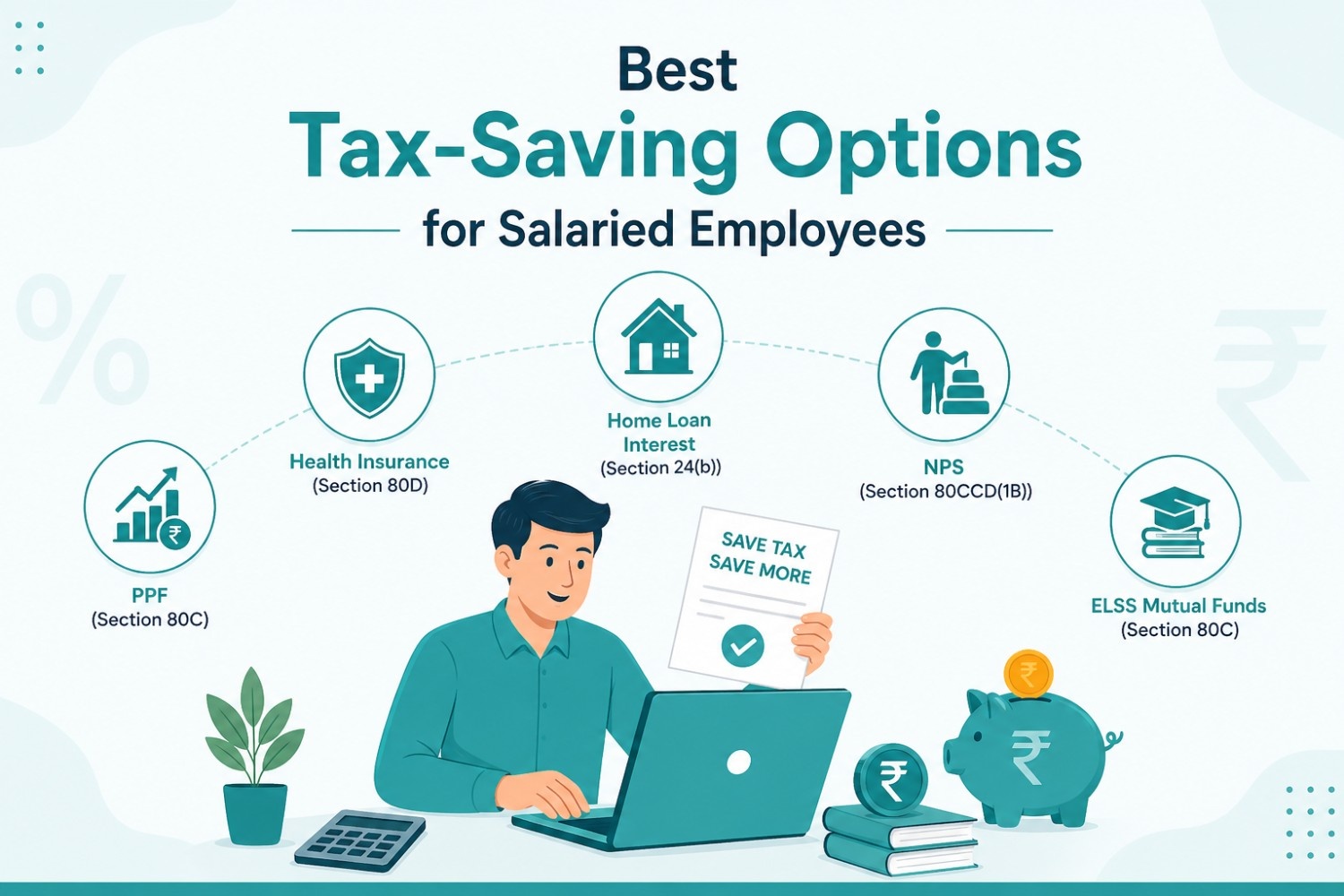
tax-saving options for salaried employees

To know how to save tax for salary above 12 lakhs, start with the most popular and safe options under the Income Tax Act.

1. Use Section 80C deductions (up to ₹1.5 lakh)

Section 80C offers many ways to reduce taxable income. You can invest up to ₹1.5 lakh here.

Best options for salaried employees:

  • EPF (Employee Provident Fund): Your monthly PF contribution is automatically eligible for 80C.
  • PPF (Public Provident Fund): Safe, long‑term saving with interest and tax‑free maturity.
  • ELSS (Equity Linked Savings Scheme): Tax‑saving mutual funds with 3‑year lock‑in but higher return potential.
  • Life Insurance premiums on eligible plans (your own or spouse/children).
  • Children’s tuition fees for up to 2 children.
  • 5‑year tax‑saving fixed deposits with banks.

2. Save tax through Section 80D (Health insurance)

You can claim up to ₹25,000–₹75,000 under Section 80D, depending on age and dependents.

  • Up to ₹25,000 for self, spouse, and children.
  • Extra ₹25,000 for parents (if below 60).
  • Extra ₹50,000 for senior citizen parents (60+).

This not only helps reduce tax liability but also builds health cover for your family.

3. HRA and rent for tax saving

If you are not living in your own house, you can claim House Rent Allowance (HRA) and also file rent receipts with your employer.

Key points:

  • HRA is exempt from tax up to a certain limit (least of: actual HRA, 50% of basic for metro / 40% for non‑metro, or actual rent minus 10% of basic).
  • If you live in a rented house, keep the rent receipts and PAN of the landlord (if rent > ₹50,000 per month).
  • You can also claim home loan interest under Section 24 (up to ₹2 lakh per year) if you own a house.

4. NPS – Extra tax saving option

The National Pension System (NPS) under Section 80CCD(1B) allows an extra deduction of ₹50,000 beyond the usual 80C limit.

  • Pushes your total tax saving above ₹1.5 lakh.
  • Builds a retirement corpus with government‑backed security.
  • Good option if you want long‑term tax saving for 12 lakhs salary and higher.

Step-by-step guide: How to save tax for salary above 12 lakhs

Follow this simple plan to design your tax strategy:

Step 1: Check your Form 16 and salary breakup

  • Note your basic salary, HRA, special allowance, and other components.
  • See what deductions your employer already uses (PF, 80C investments reported, etc.).

Step 2: Plan your 80C investments

  • Decide how to split your ₹1.5 lakh 80C limit between:
    • EPF (through your salary).
    • PPF (₹50,000–75,000 per year).
    • ELSS (₹25,000–50,000 per year).

Step 3: Buy or review health insurance

  • Ensure at least one family health insurance policy.
  • Add top‑up or critical illness cover if needed.
  • Claim Section 80D with proper bills and policy details.

Step 4: Claim HRA and rent

  • If you pay rent, submit rent receipts and landlord details to your HR.
  • If you own a house, plan for home loan interest and property tax deductions.

Step 5: Use NPS for extra savings

  • Open an NPS account (Tier‑I) and invest ₹50,000 per year.
  • Claim an extra ₹50,000 deduction under 80CCD (1B).

Step 6: Save interest from savings accounts

  • Use Section 80TTA/80TTB to claim up to ₹10,000 in interest deductions from savings accounts (if applicable).

Step 7: Declare all eligible deductions

  • Submit proofs to your company on time.
  • If you missed some, file ITR and claim missing deductions.

Common mistakes when saving tax on a 12‑lakh salary

Here are frequent errors people make:

  • Delaying investments till March: Many wait till the last month, then buy unsuitable or low‑return options.
  • Ignoring NPS and HRA: Missing out on extra ₹50,000 under NPS and HRA exemptions can cost you tax savings.
  • Not updating declarations: New job, new rent, or new insurance? Not updating your employer cuts your real tax savings.
  • Mixing tax saving with returns: Some buy expensive insurance or unknown schemes just for tax saving. Focus on safe lock-in, and returns, RNS too.

ALSO READ: TDS Section 194S of Income Tax Act

Tips and best practices for maximum savings

To really know how to save tax for a salary above 12 lakhs, keep these tips in mind:

  • Plan early in the year: Start May–June, not March.
  • Spread investments: Use PPF for safety, ELSS for growth, and NPS for extra deduction.
  • Talk to a tax advisor: Experts such as KKS Capital Advisor can help you choose the right mix of tax savings for a 12 lakh salary and retirement planning.
  • Review every year: Your salary, family, and liabilities change; your tax plan should also change.
  • Use online tools: Many tax calculators help you see the tax calculation for a 12 lakh salary and how much you can save with each option.

Conclusion: Take smart action this year

Understanding how to save tax for a salary above 12 lakhs can make a big difference in how much you keep every year. By using Section 80C, 80D, HRA, NPS, and other legal deductions, you can lower your tax, build a safety net, and grow your wealth.

If you are not sure about the best mix for your income and goals, consult a qualified tax advisor or financial planner like KKS Capital Advisor and get a customized plan.

Got a 12‑lakh salary and higher? Start planning your tax‑saving investments this month instead of next March. Use this guide to create your own tax-saving checklist for salaried employees and keep more of your income legally and safely.
FAQ'S

How much tax will I pay on a 12‑lakh salary?

For a 12‑lakh salary, your effective tax rate is usually around 15–20% after deductions. The exact amount depends on your deductions under 80C, 80D, HRA, and other sections plus cess.

The top options are EPF, PPF, ELSS, NPS, health insurance under 80D, and HRA/rent deductions. A mix of safety and growth‑oriented tools works best.

Yes. Even if you live in your own house, you can claim home loan interest deduction under Section 24 and, if you have health insurance, Section 80D. NPS and 80C investments are also available.

Yes. NPS under Section 80CCD(1B) gives an extra ₹50,000 deduction beyond the 1.5‑lakh 80C limit. It is especially useful for salaried employees earning above 12 lakhs who want higher deductions and a retirement fund.

Yes. A tax advisor or financial planner can give you a clear view of your tax calculation for 12 lakh salary and suggest the best tax‑saving mix based on your expenses, family, and goals.

Read More

GST Registration Under Rule 14A: A Complete Guide for Small Taxpayers

GST Registration Under Rule 14A: A Complete Guide for Small Taxpayers

Introduction

GST registration under Rule 14A is a fast‑track option for small taxpayers who want a simpler, digital‑only way to get GST registration. Introduced through the CGST (Fourth Amendment) Rules, 2025, this scheme lets eligible businesses get GST registration approval within about three working days, without long‑drawn manual checks or physical verification.

If your monthly output tax liability on supplies to registered persons is not high and you use Aadhaar-based authentication, you can choose this fast-track option instead of the normal registration route. This article explains the conditions, step-by-step process, benefits, and common mistakes so you can decide whether this route suits your business.

What is GST Registration Under Rule 14A?

Rule 14A of the CGST Rules, 2017, creates a special electronic registration channel for small, low‑risk taxpayers. It doesn’t create a new tax system; it just alters the application process and speeds up GSTIN issuance.

Key points about Rule 14A GST registration:

  • Optional: You can still use the normal GST registration process if you do not meet Rule 14A conditions.
  • Time‑bound: Registration under Rule 14A must be granted within three working days from the date of submitting Form GST REG‑01, if all conditions are met.
  • Fully digital: There is no physical verification; Aadhaar authentication and system‑based risk checks replace manual scrutiny.

In simple terms, this is a “fast lane” for small businesses that sell mainly to other registered persons and have low monthly tax liability.

GST Registration Under Rule 14A Conditions

To qualify for GST registration under rule 14a, you must meet specific conditions laid down in the CGST Rules. These conditions are meant to keep the scheme for genuine, low‑risk taxpayers.

Main eligibility criteria

  • Monthly output tax limit: Your total output tax liability on supplies to registered persons (B2B) must not exceed ₹2.5 lakh per month. This includes CGST, SGST/UTGST, IGST, and Compensation Cess.
  • No large B2B exposure: The limit is based on tax payable, not on overall turnover. If your B2B tax grows above ₹2.5 lakh in any one month, you should exit Rule 14A and move to normal registration.
  • One GSTIN per State/UT under same PAN: You cannot hold more than one registration under the same PAN in a State or Union Territory under Rule 14A.
  • Aadhaar authentication:
    • The primary authorised signatory must complete Aadhaar authentication (OTP or biometric).
    • At least one promoter or partner must also complete Aadhaar authentication, unless they fall under an exempt category under Section‑25(6D).
  • No pending risk or fraud history:
    • No cancellation or amendment proceedings should be pending against your existing registration.
    • The system should not flag your application as high‑risk based on past compliance or other data checks.

If you meet all these conditions for GST registration under Rule 14a, you can opt for this simplified route when you fill in Form GST REG‑01.

ALSO READ: Income Tax Demand Notice Reply Format

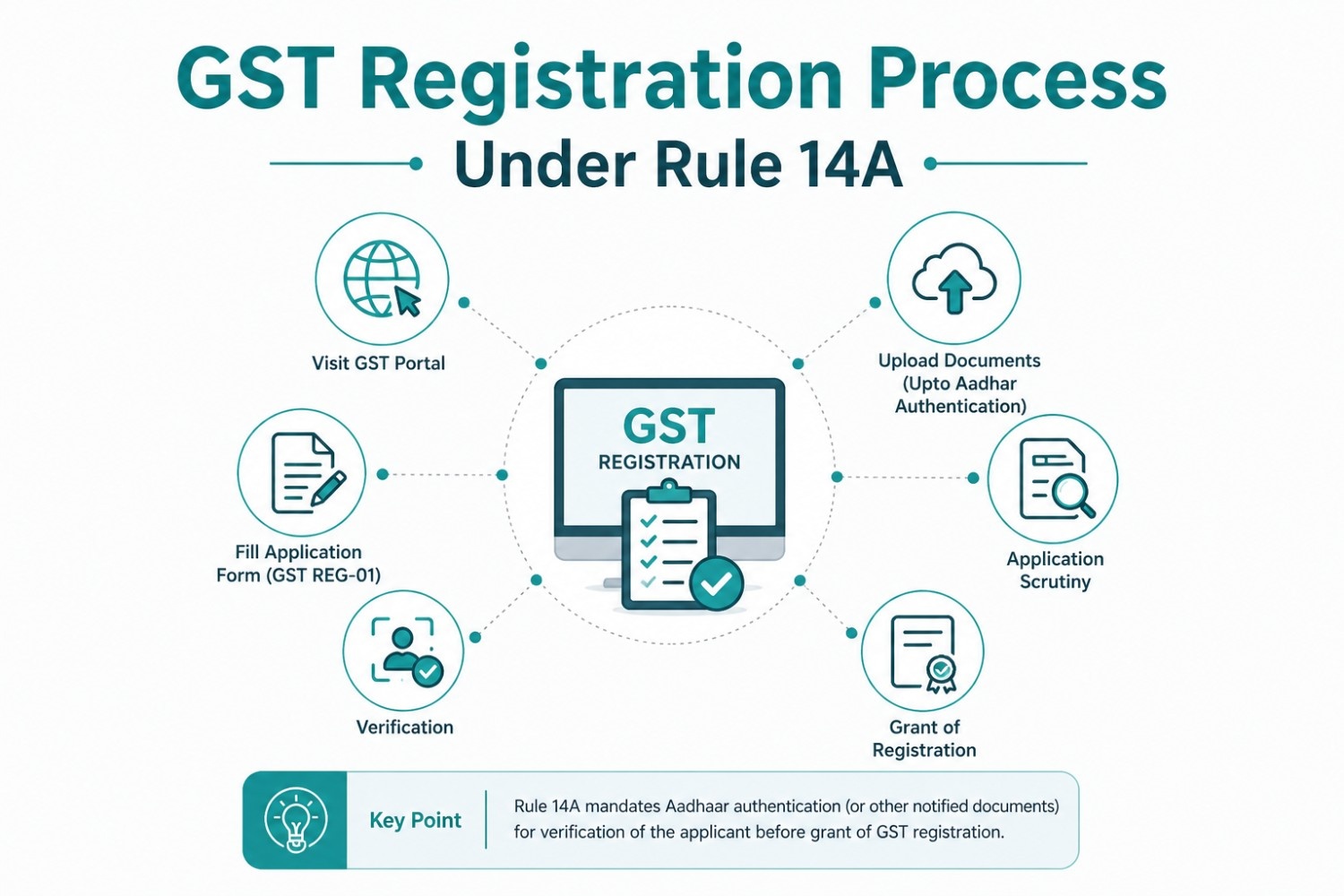
GST Registration Process Under Rule 14A

GST registration under Rule 14A

The gst registration process under rule 14a is almost the same as normal GST registration, except for one important check in the form and the reliance on Aadhaar authentication. Here is a simple step‑by‑step guide:

Step 1: Check eligibility and prepare documents

Before starting, ask:

  • Will your monthly output tax on B2B supplies stay under ₹2.5 lakh?
  • Do you have valid PAN and Aadhaar details of the authorised signatory and at least one partner?

Common documents you usually need:

  • PAN of the business and authorised signatory
  • Proof of business constitution (PAN‑based for proprietorship, partnership deed, incorporation certificate, etc.)
  • Address proof of the principal place of business
  • Mobile number and email for the GST portal

Step 2: Start Form GST REG‑01 on the GST portal

  • Go to the GST common portal (https://www.gst.gov.in/).
  • Click Services → Registration → New Registration.
  • Fill Part A of Form GST REG‑01 (basic details like PAN, mobile, email, State, etc.).
  • After submitting Part A, you will get a TRN (Temporary Reference Number).

Step 3: Fill Part B and choose Rule 14A

  • Log in using the TRN and open Form GST REG‑01 Part B.
  • In the relevant section, select “Yes” for “Option for registration under Rule 14A”.
  • Declare that your monthly output tax liability on supplies to registered persons is within the ₹2.5 lakh limit.

At this stage, you are clearly opting for GST registration under Rule 14A instead of the regular route.

Step 4: Complete Aadhaar authentication

  • The GST portal will prompt you to complete Aadhaar authentication for the authorised signatory and one partner.
  • You can choose OTP or biometric mode.
  • If Aadhaar authentication fails or is not completed, you cannot proceed under Rule 14A and must apply through normal registration rules.

Step 5: Submit and wait for electronic approval

  • After submitting the form, the system will run automated risk checks based on Aadhaar, PAN, and other data.
  • If the system finds your application low‑risk and all conditions are met, your GST registration certificate (Form GST REG‑06) will be issued electronically within three working days.

If risk parameters are triggered, the application may be shifted to the normal verification route (Rule 9/9A), which can take longer and may involve officer queries or document checks.

Benefits and Importance of GST Registration Under Rule 14A

Choosing GST registration under Rule 14A has several advantages for small businesses and professionals.

Key benefits

  • Faster approval: You can get GST registration within three working days, compared to the longer normal process that may involve physical verification.
  • Less paperwork: No physical verification of business premises is required for eligible applicants.
  • Digital‑only workflow: From Aadhaar authentication to certificate generation, the entire gst registration process under rule 14a is online, which suits tech‑savvy startups and freelancers.
  • Good for low-B2B businesses: Small traders, service providers, and professionals primarily supplying to registered persons with low monthly tax can use this route.

When it is useful

  • New businesses are testing the market.
  • Professionals like consultants, freelancers, and small service providers.
  • Small traders maintain controlled and predictable B2B tax exposure.

If you are unsure whether you meet the eligibility conditions, firms like KKS Capital Advisor can review your numbers and help you choose the right registration route.

Common Mistakes and How to Avoid Them

Even though the process looks simple, applicants often make mistakes that delay or block registration under Rule 14A.

Typical errors

  • Incorrect tax liability estimate:
    • Some taxpayers assume the limit is based on turnover, but Rule 14A uses output tax liability.
    • If your B2B tax exceeds ₹2.5 lakh in any month, you must exit Rule 14A and apply for normal registration.
  • Not completing Aadhaar authentication:
    • Skipping or failing Aadhaar checks makes you ineligible for Rule 14A. You then have to restart via normal registration.
  • Using multiple PAN‑State combinations under Rule 14A:
    • Rule 14A restricts one registration per State/UT under the same PAN. Trying to create another such registration can cause rejection or compliance issues.
  • Fake or mismatched details:
    • Wrong PAN, address, or business‑activity details can trigger system alerts and shift your application to manual scrutiny.

Best practices

  • Double‑check your B2B tax liability for each month and keep a simple record.
  • Use Aadhaar only through the GST portal; never share OTPs or biometric details with third parties.
  • Get help from a GST consultant (for example, KKS Capital Advisor) if you are new to GST or have complex business structures.

Table: Rule 14A vs Normal GST Registration

AspectGST Registration Under Rule 14ANormal GST Registration
TimelineUp to 3 working days once Aadhaar is done and there are no risk flags. No fixed timeline; may take longer due to manual checks. 
Manual verificationNot required for low‑risk cases. Possible physical verification or officer queries. 
Aadhaar authenticationMandatory for the authorised signatory and one partner. Optional or not required in some cases. 
EligibilityOnly for low‑B2B tax liability (<₹2.5 lakh/month). Open to all taxpayers, including high‑turnover businesses. 
Use caseSmall, low‑risk, digital‑first businesses. Large businesses, complex operations, or those exceeding Rule 14A conditions. 

Conclusion 

GST registration under Rule 14A is a smart choice for small taxpayers who want a quick, digital, and low‑hassle GST registration process. As long as your monthly output tax liability on B2B supplies stays under ₹2.5 lakh and you complete Aadhaar authentication correctly, you can enjoy faster approval and fewer manual checks.

However, the scheme is not automatic or risk‑free. You must monitor your tax liability, keep records clean, and exit Rule 14A in time if your business grows.

If you want to avoid common mistakes and ensure your GST registration under Rule 14a conditions are met, you can consult a professional firm like KKS Capital Advisor to guide you through the application and beyond.

Need help with GST Registration in Gurgaon under Rule 14A or regular GST compliance? Contact KKS Capital Advisor today for expert support tailored to your business size and sector.

FAQ'S

1. What does GST registration under Rule 14A mean?

GST registration under Rule 14A is a fast‑track, electronic registration option for small taxpayers whose monthly output tax liability on B2B supplies does not exceed ₹2.5 lakh.

Small businesses or professionals whose total monthly output tax on supplies to registered persons is within ₹2.5 lakh and who complete Aadhaar authentication of the authorised signatory and one partner can apply under Rule 14A.

If all conditions are met and Aadhaar authentication is successful, the law provides that registration must be granted within three working days from the date of submitting Form GST REG‑01.

Yes. Aadhaar authentication of the authorised signatory (and one promoter/partner) is mandatory to use the gst registration under rule 14a route.

Yes. If your monthly output tax liability on B2B supplies exceeds ₹2.5 lakh, you must withdraw from Rule 14A by filing Form GST REG‑32 and then fall under normal GST registration rules.

Read More