Reviewed by the GST advisory team at KKS Capital Advisor (Chartered Accountants, Gurgaon) • Last updated: 18 August 2026
Table of Contents
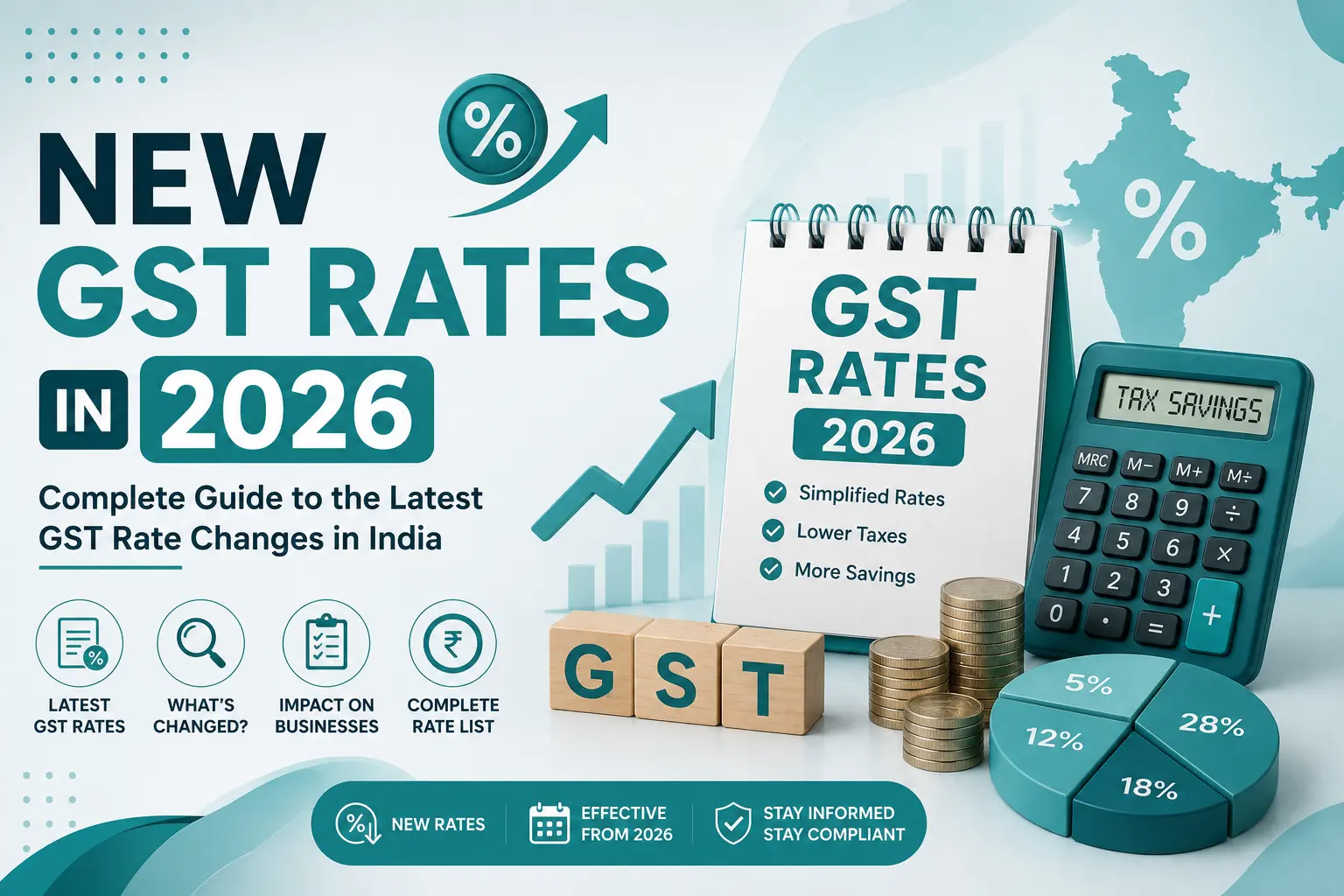
ToggleQuick answer Under GST 2.0, effective 22 September 2025, India moved from four main slabs (5%, 12%, 18%, 28%) to a simpler two-rate structure of 5% (merit rate) and 18% (standard rate), plus a special 40% de-merit rate for luxury and ‘sin’ goods. A Nil (0%) category continues for essentials, and niche rates of 3%, 1.5% and 0.25% remain for gold, diamonds and a few special cases. The old 12% and 28% slabs have been removed and their items re-distributed into 5% or 18%. So in 2026 the effective GST rate list you work with is: 0%, 5%, 18% and 40%. |
If you run a business, manage accounts, or simply want to understand your bills, the new GST rate in 2026 is the single biggest indirect-tax change India has seen since GST launched in 2017. The 56th GST Council meeting, chaired by the Union Finance Minister, approved a sweeping rate rationalisation now popularly called “GST 2.0.” The goal was simple: fewer slabs, fewer classification disputes, lower tax on everyday essentials, and a clear premium rate on luxury and harmful products.
At KKS Capital Advisor, our Chartered Accountants have spent the last year re-mapping HSN codes, re-pricing invoices and updating billing systems for clients across manufacturing, retail, hospitality and services. This guide distils that hands-on experience into one plain-English reference so you can see exactly what the GST 2.0 slabs in India look like, what changed, and how it affects your prices, margins and compliance.
What this guide covers
- The new GST slab structure in 2026 at a glance
- The full revised GST slab list – Nil, 5%, 18% and 40% items
- Special rates that still exist (3%, 1.5%, 0.25%)
- Old vs new GST rates – what got cheaper and what got costlier
- Sector-by-sector impact for businesses and consumers
- The effective date, transition rules and compliance checklist
- How KKS Capital Advisor helps you stay compliant
- Frequently asked questions
The new GST slab structure in 2026 at a glance
The clearest way to understand the GST rate changes 2026 is to compare the old and new structures side by side. Before GST 2.0 there were four principal rates. Now there are effectively two working rates plus a special rate and the Nil category.
GST structure | Slabs (before) | Slabs (now – 2026) |
Merit / essentials | 0% and 5% | 0% (Nil) and 5% |
Lower standard | 12% | Merged into 5% or 18% |
Standard | 18% | 18% (main standard rate) |
Higher standard | 28% | Merged into 18% |
Luxury / sin goods | 28% + cess | 40% (single de-merit rate) |
Special rates | 3%, 1.5%, 0.25% | 3%, 1.5%, 0.25% (retained) |
In short: the revised GST slab list for 2026 is 0%, 5%, 18% and 40%, with a handful of special rates for precious metals and specific goods. This is why GST 2.0 is described as a “two-slab” regime – the 5% and 18% rates now carry the vast majority of goods and services.
Nil (0%) GST rate items in 2026
The Nil-rated basket was expanded under GST 2.0 to make essentials and socially important goods and services fully tax-free. Key items now at 0% include:
- Individual life and health insurance policies (reduced from 18% to Nil) – one of the most talked-about reliefs
- 33 specified life-saving drugs and medicines moved to Nil
- Educational supplies – notebooks, exercise books, pencils, crayons, sharpeners, erasers, maps and charts
- Basic unbranded food staples that were already exempt (fresh produce, milk, unpacked cereals, etc.)
- UHT / ultra-high-temperature milk and paneer (pre-packaged and labelled) moved to Nil
5% GST rate items (the merit rate)
The 5% “merit” rate is designed for mass-consumption goods and everyday services. Many items that used to sit at 12% or 18% were pulled down to 5% – this is where most household savings come from under the new GST rate in 2026.
Common goods at 5%
- Personal care: hair oil, shampoo, toothpaste, toothbrushes, soap, shaving cream
- Dairy and packaged foods: butter, ghee, cheese, pre-packaged namkeens, packaged snacks
- Kitchen and home: tableware, kitchenware, utensils, baby feeding bottles
- Health devices: spectacles, glucometers, thermometers, diagnostic kits, medical-grade oxygen
- Agriculture: tractors, tractor tyres and parts, drip-irrigation systems, bio-pesticides, agricultural machinery
Common services at 5%
- Hotel accommodation with tariff up to ₹7,500 per night (reduced from 12% to 5%)
- Gyms, fitness centres, salons, barbers, yoga and wellness services (reduced from 18% to 5%)
18% GST rate items (the standard rate)
18% is now the main standard rate. Crucially, most goods that were at 28% (excluding luxury/sin categories) have moved down to 18%, so several big-ticket consumer durables became cheaper. Typical 18% items include:
- Consumer electronics: televisions (including large-screen), air-conditioners, dishwashers, monitors
- Automobiles: small cars and most two-wheelers up to 350cc (moved from 28% to 18%)
- Cement and many construction inputs (a long-standing demand, reduced from 28% to 18%)
- Apparel and footwear priced above the concessional threshold
- Most industrial machinery, capital goods, IT hardware and business services
- Auto components, packaged branded goods and general manufactured products
40% GST rate items (the de-merit / luxury rate)
The single 40% de-merit rate replaces the old 28% + compensation cess structure for luxury and ‘sin’ products. It keeps the effective tax burden high on items the government wants to discourage or treat as premium, while simplifying the maths. Items in the 40% slab include:
- Pan masala, aerated / carbonated soft drinks and caffeinated / energy beverages
- Large motor cars, SUVs and high-capacity motorcycles above 350cc
- Aircraft and yachts for personal use
- Revolvers, pistols and similar arms
- Casino entry, betting, online money-gaming, lottery and race-club activities
Important note on tobacco Tobacco, cigarettes, gutkha and pan masala with tobacco continue at 28% + compensation cess for a transition period – they will move to the new framework only after existing compensation-cess loan liabilities are cleared. Always confirm the live rate for these products before invoicing. |
Special GST rates that still exist
Rate | Applies to |
0.25% | Rough / unworked diamonds and precious stones |
1.5% | Cut and polished diamonds; certain composition-scheme cases |
3% | Gold, silver, platinum and jewellery |
These rates were deliberately left untouched so that the bullion and jewellery trade continues under its existing, well-understood structure.
Old vs new GST rates: what got cheaper and what got costlier
The headline of the GST rate changes 2026 is affordability. The vast majority of movements were rate cuts. Here is a representative comparison our team uses when explaining GST 2.0 to clients:
Item / category | Old rate | New rate (2026) | Direction |
Individual health & life insurance | 18% | Nil | Cheaper |
Hair oil, soap, shampoo, toothpaste | 18% | 5% | Cheaper |
Butter, ghee, cheese, namkeens | 12% | 5% | Cheaper |
Televisions, ACs, dishwashers | 28% | 18% | Cheaper |
Small cars & bikes (≤350cc) | 28% | 18% | Cheaper |
Cement | 28% | 18% | Cheaper |
Hotel stays up to ₹7,500/night | 12% | 5% | Cheaper |
Salon, gym, yoga services | 18% | 5% | Cheaper |
Tractors & farm equipment | 12% | 5% | Cheaper |
Aerated / caffeinated drinks | 28% + cess | 40% | Costlier / same |
Luxury cars, bikes >350cc | 28% + cess | 40% | Restructured |
What GST 2.0 means for your business
Lower rates are welcome, but rate rationalisation is never a ‘do-nothing’ event. From our client work at KKS Capital Advisor, these are the areas that need attention:
1. Re-price and re-configure your billing
Every product mapped to a changed rate must be updated in your ERP, POS and invoicing software before you raise the next invoice. A single mismatched HSN-to-rate mapping can trigger short-payment notices or wrong ITC for your customers.
2. Manage transition and stock in hand
Goods purchased at old rates but sold after 22 September 2025 need careful treatment of input tax credit and pricing. Anti-profiteering expectations mean genuine rate cuts should be passed on to consumers – keep documentation showing you did.
3. Watch the inverted duty structure
When your inputs are taxed at 18% but your output is at 5%, you accumulate input tax credit. The good news: GST 2.0 introduced faster, largely automated provisional refunds (up to 90%) for inverted-duty and zero-rated cases from November 2025 – but you must file cleanly to benefit.
4. Update contracts and quotations
Long-term contracts, AMC quotations and price lists that quote GST-inclusive figures should be revised, and ‘plus GST as applicable’ clauses reviewed so neither side absorbs an unexpected cost.
What GST 2.0 means for consumers
For households, the direction is clearly positive. Daily-use personal-care items, packaged foods, dairy, medicines and insurance are cheaper, and several aspirational purchases – televisions, air-conditioners, small cars and cement for home construction – dropped from 28% to 18%. The clean-up of slabs also reduces the classification confusion that used to make similar products carry different rates.
Effective date and transition timeline
- 22 September 2025: New GST 2.0 rates (Nil, 5%, 18%, 40%) came into force for most goods and services.
- Tobacco & pan masala with tobacco: Continue at 28% + cess until compensation-cess liabilities are cleared.
- 1 November 2025: 90% provisional refunds for inverted-duty and zero-rated supplies operationalised.
- 2026 onwards: The 0% / 5% / 18% / 40% structure is the working GST rate list for the financial year.
Your GST 2.0 compliance checklist
- Re-map every HSN/SAC code to its correct 2026 rate.
- Update ERP / POS / e-invoicing masters and test a few invoices before going live.
- Reconcile stock purchased at old rates against sales at new rates.
- Revise printed price lists, catalogs, menus, and website prices.
- Pass on genuine rate cuts to customers and keep evidence.
- Review inverted-duty exposure and plan your refund filings.
- Re-check contract clauses that quote GST-inclusive amounts.
- Train your billing and accounts team on the new slabs.
How KKS Capital Advisor helps you get GST 2.0 right
KKS Capital Advisor is a Gurgaon-based chartered accountant firm offering end-to-end GST services – registration, rate mapping, return filing, ITC optimization, audits, refunds, and departmental representation. When rate structures change, our team reclassifies your product catalog, updates your billing configuration, and reconciles transition stock so you neither overcharge customers nor under-report tax. If you have received a notice, or you are unsure whether an item sits at 5%, 18%, or 40%, we give you a written, defensible position.
Need help re-mapping your GST rates for 2026? Talk to the GST team at KKS Capital Advisor for a review of your HSN mapping, invoices, and ITC position. Visit kkscapital.com to get in touch. |
Key takeaways
- GST 2.0 (effective 22 September 2025) simplified India’s GST to two main slabs – 5% and 18% – plus a 40% de-merit rate and the Nil category.
- The old 12% and 28% slabs were removed; their items moved to 5% or 18%.
- Most essentials, personal care, dairy, medicines and insurance became cheaper; several 28% durables dropped to 18%.
- Luxury and ‘sin’ goods now attract a single 40% rate instead of 28% + cess.
- Special rates of 0.25%, 1.5% and 3% for diamonds and precious metals continue.
- Businesses must re-map HSN codes, update billing systems and pass on genuine rate cuts.
FAQ'S
Q. What is the new GST rate in 2026?
In 2026 the working GST rate list is 0% (Nil), 5%, 18% and 40%, following the GST 2.0 rationalisation effective 22 September 2025. The 5% and 18% slabs carry most goods and services, 40% applies to luxury and sin goods, and special rates of 0.25%, 1.5% and 3% remain for diamonds and precious metals.
Q. How many GST slabs are there now?
There are two principal working slabs – 5% and 18% – along with a Nil (0%) category and a special 40% de-merit rate. A few niche rates (0.25%, 1.5%, 3%) continue for specific items, so in practice you deal with four main rates: 0%, 5%, 18% and 40%.
Q. What happened to the 12% and 28% GST slabs?
Under GST 2.0 the 12% and 28% slabs were abolished. Items earlier taxed at 12% mostly moved to 5% (and a few to 18%), while items at 28% moved to 18%, except luxury and sin goods which now sit at the special 40% rate.
Q. Which products became cheaper under GST 2.0?
Personal-care items (soap, shampoo, hair oil, toothpaste), dairy (butter, ghee, cheese), packaged namkeens, many medicines, individual health and life insurance, televisions, air-conditioners, small cars, cement and farm equipment all became cheaper due to rate cuts.
Q. What is the 40% GST rate for?
The 40% rate is a single de-merit rate for luxury and harmful goods – pan masala, aerated and caffeinated drinks, large cars and bikes above 350cc, yachts, personal aircraft, firearms, and betting/gaming/casino activities. It replaces the earlier 28% + compensation cess for these categories.
Q. From when are the new GST rates applicable?
The new rates apply from 22 September 2025 for most goods and services. Tobacco and pan-masala-with-tobacco products continue at 28% + cess for a transition period until compensation-cess liabilities are settled.
Q. Do I need to change my invoices and accounting software?
Yes. You must update HSN/SAC-to-rate mapping in your billing, ERP and e-invoicing systems, revise price lists, and reconcile stock bought at old rates but sold at new rates. KKS Capital Advisor can carry out this re-mapping and verification for you.
Q. Is there still a GST on gold and diamonds?
Yes. Gold, silver and platinum jewellery remain at 3%, cut and polished diamonds at 1.5%, and rough diamonds at 0.25%. These special rates were deliberately retained under GST 2.0.