A private limited company is the most popular business structure for startups and growing SMEs in India. If you are wondering how to register a private company in India, the process offers limited liability, a separate legal identity, easier access to funding, and strong credibility with customers, banks, and investors. But the company incorporation process in India involves several linked forms and approvals, and one avoidable error, such as a name clash, an incorrect document, or an unsigned form, can push your timeline back by weeks.
Table of Contents
ToggleIn this guide, the Chartered Accountants at KKS Capital Advisor explain exactly how to register a private company in India in 2026 – the eligibility, the full SPICe+ process step by step, the documents required, the real Pvt Ltd registration cost in India, the timeline, and the compliance you must complete immediately after incorporation.
|
Quick answer To register a private limited company in India, you apply online through the MCA’s SPICe+ (INC-32) integrated form. The process is: obtain a Digital Signature Certificate (DSC) for the directors, reserve the company name in SPICe+ Part A, file SPICe+ Part B with the MOA (INC-33), AOA (INC-34), INC-9 declaration and AGILE-PRO-S (for PAN, TAN, GST, EPFO, ESIC and bank account), and pay the fees. You need at least 2 directors and 2 shareholders, a registered office, and there is no minimum paid-up capital. Total cost typically ranges from ₹7,000 to ₹25,000 (state-dependent), and incorporation usually completes in 5 to 10 working days with clean documents. You then get the Certificate of Incorporation with CIN, PAN and TAN. |
What this guide covers
- Why choose a private limited company
- Eligibility and minimum requirements
- Documents required for company registration
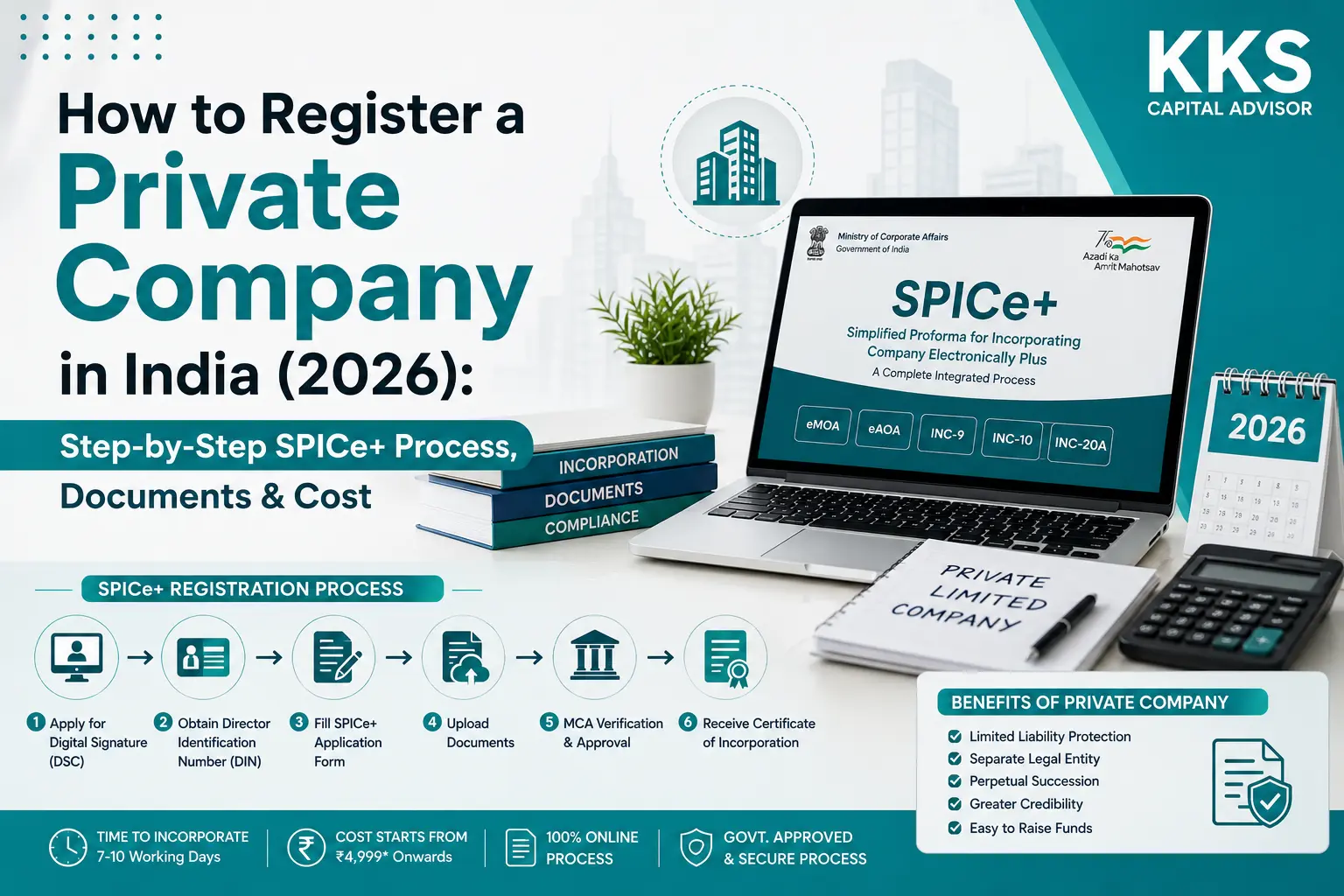
- The step-by-step SPICe+ registration process
- Pvt Ltd registration cost in India (fee breakdown)
- How long does company registration take in 2026
- Post-incorporation compliance you must not miss
- How KKS Capital Advisor helps you incorporate smoothly
- Frequently asked questions
Why choose a private limited company?
Before the process, it helps to know why this structure is so widely chosen:
- Limited liability: Shareholders’ personal assets are protected; liability is limited to their shareholding.
- Separate legal entity: The company can own assets, sue and be sued in its own name, independent of its owners.
- Easier fundraising: Venture capital, angel investors and banks strongly prefer to fund private limited companies.
- Perpetual succession: The company continues to exist regardless of changes in ownership or directors.
- Credibility: A registered ‘Pvt Ltd’ builds trust with customers, vendors and partners.
Private limited vs other business structures
Before you register, it is worth confirming that a private limited company is the right vehicle for you. Here is how it compares with the common alternatives:
|
Structure |
Best for |
Liability |
Key limitation |
|
Private Limited Company |
Startups seeking funding & scale |
Limited |
Higher compliance |
|
One Person Company (OPC) |
Solo founders wanting a company |
Limited |
One member; conversion rules apply |
|
Limited Liability Partnership (LLP) |
Professional & service firms |
Limited |
Harder to raise equity funding |
|
Partnership Firm |
Small traditional businesses |
Unlimited |
No separate legal identity |
|
Sole Proprietorship |
Very small / single-owner setups |
Unlimited |
Limited credibility & funding |
For most founders who intend to raise capital, onboard co-founders, or build a credible brand, the private limited company remains the default choice despite its slightly higher compliance.
Eligibility and minimum requirements
|
Requirement |
Minimum condition (2026) |
|
Directors |
Minimum 2, maximum 15; at least one must be resident in India |
|
Shareholders (members) |
Minimum 2, maximum 200 |
|
Director + shareholder overlap |
A person can be both a director and a shareholder |
|
Paid-up capital |
No minimum; can start with any amount (e.g., ₹1 lakh authorised capital is common) |
|
DIN & DSC |
Every director needs a DIN (allotted via SPICe+) and a Class-3 DSC |
|
Registered office |
A valid address in India with proof and owner’s NOC |
|
Unique name |
Name must not resemble an existing company or a registered trademark |
Documents required for company registration
For each director and shareholder
- PAN card (mandatory for Indian nationals)
- Aadhaar card and one more identity proof (passport / voter ID / driving licence)
- Address proof not older than 2 months (bank statement / utility bill / mobile bill)
- Passport-size photograph
- Passport (mandatory for foreign nationals, notarised/apostilled)
For the registered office
- Latest utility bill (electricity / water / gas) not older than 2 months
- Rent agreement (if rented) plus a No-Objection Certificate (NOC) from the owner
- Sale deed / property document (if owned)
Registered office requirements
Every company must have a registered office in India from the date of incorporation (or within 30 days), and it must be capable of receiving official communication. It does not have to be a commercial space – a residential address can be used, provided you have valid proof and permission. You need a recent utility bill in the owner’s name, and if the premises are rented or borrowed, a No-Objection Certificate (NOC) from the owner along with the rent agreement. The registered office address appears on your Certificate of Incorporation and all official records, so choose it carefully; changing it later requires additional filings. Many founders use a professional or virtual office in the early stage, which is acceptable as long as statutory documents can be served there.
Step-by-step private limited company registration process
The entire private limited company registration process runs through the MCA portal using the integrated SPICe+ (Simplified Proforma for Incorporating Company Electronically Plus) form. Here is the sequence our team follows.
Step 1 – Obtain Digital Signature Certificates (DSC)
Every proposed director and subscriber must have a Class-3 DSC to sign the e-forms. This is the first practical step and takes a day or two with video KYC.
Step 2 – Reserve the company name (SPICe+ Part A)
Apply for name reservation in SPICe+ Part A with up to two proposed names in order of preference. Check availability on both the MCA name search and the trademark registry to avoid rejection. A reserved name is valid for a limited period, within which you must complete incorporation.
Step 3 – File SPICe+ Part B (incorporation details)
Part B captures the company’s details: registered office address, authorised and paid-up capital, and the particulars of directors and shareholders. DINs for up to three directors are allotted through this form itself.
Step 4 – Prepare and attach MOA, AOA and declarations
- e-MOA (INC-33): Memorandum of Association – the company’s objects and constitution.
- e-AOA (INC-34): Articles of Association – the internal rules of management.
- INC-9: Auto-generated declaration by directors and subscribers.
Step 5 – File AGILE-PRO-S (linked form)
This linked application registers the company for PAN, TAN, GST (optional), EPFO, ESIC, Profession Tax (where applicable) and opens a bank account – all in one integrated filing.
Step 6 – Pay fees and submit
Pay the government fees and applicable stamp duty, then submit the forms signed with the DSCs. The Central Registration Centre (CRC) processes the application.
Step 7 – Receive Certificate of Incorporation
On approval, the Registrar issues the Certificate of Incorporation containing the Corporate Identity Number (CIN), along with the company’s PAN and TAN. Your company is now legally born.
What you receive after registration
Once your company is incorporated, you receive a complete set of legal documents and identifiers that let you start operating, open a bank account and sign contracts:
- Certificate of Incorporation (COI): The official proof of your company’s existence, carrying the CIN.
- Corporate Identity Number (CIN): A unique 21-character number identifying your company with the ROC.
- Company PAN and TAN: Issued automatically through the SPICe+ process for tax purposes.
- MOA and AOA: Your registered charter documents defining objects and internal rules.
- DINs for directors: Director Identification Numbers allotted during incorporation.
- EPFO, ESIC and (optional) GST registration: Set up through the AGILE-PRO-S linked form.
Pvt Ltd registration cost in India (2026)
The Pvt Ltd registration cost in India depends mainly on your state (stamp duty varies), the number of directors (DSC cost), and professional fees. Government processing fees for small-capital companies are largely nominal or zero. Here is a realistic breakdown:
|
Cost component |
Typical range (2026) |
|
Digital Signature Certificate (per director) |
₹800 – ₹2,500 |
|
Government / MCA filing fee (small capital) |
Nominal to nil |
|
Stamp duty on MOA/AOA (state-dependent) |
₹200 – ₹12,600 |
|
Professional / CA fee |
₹5,000 – ₹15,000 |
|
Approximate total |
₹7,000 – ₹25,000 |
Note: costs rise with higher authorised capital and in states with higher stamp duty. Optional add-ons like a trademark application or a virtual office also affect the total.
How long does company registration take in 2026?
- DSC: 1–2 working days.
- Name reservation (Part A): typically 1–3 working days.
- Incorporation (Part B + attachments): 2–5 working days after name approval.
- Total: about 5–10 working days with clean, complete documentation. A resubmission or query can extend this to a few weeks.
Post-incorporation compliance you must not miss
Incorporation is the beginning of your compliance calendar, not the end. Missing these early steps invites penalties:
- INC-20A (commencement of business): File within 180 days of incorporation after depositing the subscribed capital.
- Open a current bank account and bring in the shareholders’ subscription money.
- Appoint an auditor: Within 30 days of incorporation via Form ADT-1.
- Maintain statutory registers and issue share certificates within 60 days.
- Annual filings: Form AOC-4 (financials) and MGT-7/7A (annual return), plus income-tax return and board meetings/AGM.
- DIN KYC: Every director must file DIR-3 KYC annually.
Common mistakes to avoid during registration
From the incorporations we handle, these avoidable errors cause most delays and rejections:
- Choosing a company name that clashes with an existing company or a registered trademark
- Submitting address proof older than two months, or a registered office without a proper NOC
- Mismatches between PAN, Aadhaar and the details entered in SPICe+
- Vague or overly narrow object clause in the MOA that limits future business activities
- Forgetting the ₹0 authorised capital myth – set an authorised capital that suits your plans
- Missing INC-20A within 180 days, which can lead to penalties and even strike-off
How KKS Capital Advisor helps you incorporate smoothly
KKS Capital Advisor handles the full company incorporation process end-to-end—from choosing the right structure and reserving a clash-free name to drafting your MOA and AOA, filing SPICe+ and AGILE-PRO-S, and obtaining your CIN, PAN, TAN, and GST. Through our business incubation and online legal consultancy services, we also set up your post-incorporation compliance calendar—INC-20A, auditor appointment, share certificates, and annual filings—so you never miss a deadline in year one. For founders in Gurgaon and across India, that means you launch on a clean legal footing and can focus on building the business.
|
Ready to register your private limited company? Let the chartered accountants at KKS Capital Advisor incorporate it correctly and on time. Consult an expert or visit kkscapital to get started. |
Key takeaways
- Private limited companies are registered online via the MCA SPICe+ form (Part A for name, Part B for incorporation).
- You need at least 2 directors and 2 shareholders, one India-resident director, and a registered office; there is no minimum capital.
- Core forms: DSC, DIN, SPICe+, e-MOA (INC-33), e-AOA (INC-34), INC-9, and AGILE-PRO-S.
- Cost typically ranges from ₹7,000 to ₹25,000 depending on state stamp duty, DSCs, and professional fees.
- Incorporation usually takes 5–10 working days with clean documents.
- File INC-20A within 180 days and appoint an auditor within 30 days to stay compliant.
FAQ'S
Q. Do NRIs have to pay tax in India?
Yes, but only on income received or accruing in India — such as rent from Indian property, capital gains on Indian assets, NRO interest and salary for services rendered in India. Foreign salary and overseas business income of an NRI are not taxed in India.
Q. Is NRE account interest taxable in India?
No. Interest on NRE and FCNR deposits is exempt from Indian income tax as long as you qualify as a non-resident under the applicable exchange-control conditions. Interest on NRO accounts, by contrast, is fully taxable and typically suffers 30% TDS plus cess.
Q. Which ITR form should an NRI file?
NRIs generally file ITR-2. If the NRI has business or professional income in India, ITR-3 applies. ITR-1 (Sahaj) is not available to non-residents, even for simple salary or one-house-property situations.
Q. How can an NRI reduce TDS on property sale in India?
Apply to the jurisdictional assessing officer for a lower or nil deduction certificate under Section 197 before the sale, based on the actual capital gains computation. With the certificate, the buyer deducts TDS at the approved lower rate instead of the steep default rates under Section 195.
Q. What documents are needed to claim DTAA benefits?
You need a Tax Residency Certificate (TRC) from your country of residence for the relevant year, along with Form 10F and any self-declarations the payer requires. Without these, banks and other payers apply full domestic TDS rates instead of the treaty rate.