Getting your GST registration right is the foundation of clean compliance. A wrong PAN mapping, the wrong constitution of business, or a mismatched address proof can delay approval by weeks or trigger a query from the officer. In this guide, the Chartered Accountants at KKS Capital Advisor walk you through the complete GST registration process in India for 2026 – who must register, the exact documents required, the government fees, the step-by-step online process, and how long it takes – based on hundreds of registrations we have filed for startups, traders, manufacturers and service firms.
Table of Contents
ToggleWhat this guide covers
- Who must register for GST (turnover thresholds and special cases)
- Types of GST registration
- Documents required for GST registration
- GST registration fees – government vs professional
- Step-by-step online GST registration process
- How long GST registration takes in 2026
- Penalty for not registering under GST
- How KKS Capital Advisor makes registration hassle-free
- Frequently asked questions
Who must register for GST in India?
GST registration is mandatory in the following situations, whether you are an individual, firm, LLP or company:
Category | Registration threshold / trigger |
Supplier of goods (normal states) | Aggregate turnover exceeds ₹40 lakh in a financial year |
Supplier of services (normal states) | Aggregate turnover exceeds ₹20 lakh in a financial year |
Special-category states | ₹20 lakh (goods) / ₹10 lakh (services) in many cases |
Inter-state supply of goods | Mandatory from ₹1 – no threshold |
E-commerce sellers (Amazon, Flipkart, etc.) | Mandatory irrespective of turnover |
Casual / seasonal taxable persons | Mandatory before starting supply |
Non-resident taxable persons | Mandatory before starting supply |
Persons liable under reverse charge | Mandatory |
Input service distributors / TDS-TCS deductors | Mandatory |
Even if you are below the threshold, voluntary GST registration is often worth it – it lets you claim input tax credit, sell on marketplaces, and appear more credible to B2B customers who want a GST invoice.
Types of GST registration
Type of taxpayer | Who it is for | Key feature |
Normal / Regular | Most businesses above threshold | No deposit, unlimited validity |
Composition scheme | Small businesses within turnover limit | Flat lower rate, no ITC |
Casual taxable person | Occasional / exhibition suppliers | Valid ~90 days, advance deposit |
Non-resident taxable person | Foreign suppliers in India | Valid ~90 days, advance deposit |
SEZ unit / developer, TDS, TCS, ISD | Specific categories | Category-specific rules |
Documents required for GST registration
The exact GST registration documents depend on your business constitution. Below is the complete checklist our team uses so nothing is missed.
A. Proprietorship / individual
- PAN card and Aadhaar card of the proprietor
- Passport-size photograph
- Proof of principal place of business (electricity bill / rent agreement + NOC / property tax receipt)
- Bank details (cancelled cheque, passbook or bank statement)
B. Partnership firm / LLP
- PAN of the firm/LLP and partnership deed / LLP agreement
- PAN, Aadhaar and photographs of all partners
- Authorised signatory proof and board/authorisation letter
- Proof of principal place of business and bank details
- LLP incorporation certificate (for LLPs)
C. Private limited / public company
- Certificate of incorporation (MCA) and company PAN
- MOA / AOA
- PAN, Aadhaar and photographs of directors and authorised signatory
- Board resolution / authorisation letter for the authorised signatory
- Digital Signature Certificate (DSC) of the authorised signatory
- Proof of principal place of business and bank details
Tip on address proof If the premises are rented, keep a valid rent agreement plus a No-Objection Certificate (NOC) from the owner and a recent utility bill. Mismatched or old address proof is the single most common reason for a registration query. |
GST registration fees in India
There is no government fee for GST registration – the GST portal does not charge anything to apply. What you may pay is a professional fee if you engage a Chartered Accountant or consultant to prepare and file the application, respond to queries, and get it approved without errors. Casual and non-resident taxable persons are different: they must deposit an advance GST equal to their estimated tax liability for the registration period.
Cost head | Amount |
Government portal fee | ₹0 (free) |
Professional / CA fee (optional) | Varies by complexity of the case |
Advance tax deposit (casual / NR only) | Equal to estimated GST liability |
Step-by-step online GST registration process
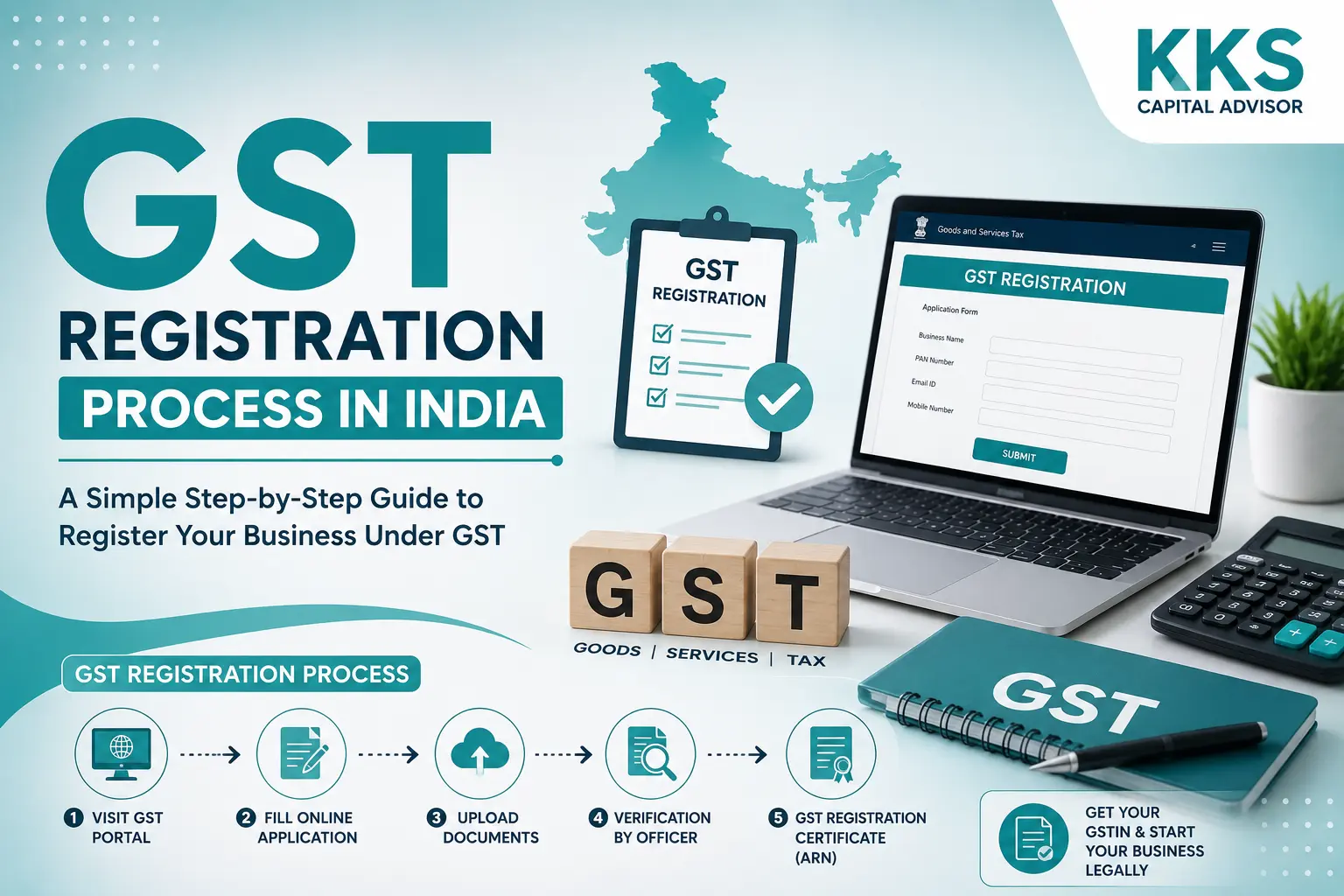
Here is exactly how to register for GST on the GST portal. The application has two parts – Part A (TRN generation) and Part B (full application).
Part A – Generate your TRN
- Go to the GST portal and choose Services › Registration › New Registration.
- Select ‘Taxpayer’, choose your state and district, and enter the legal name of business exactly as per PAN.
- Enter PAN, email and mobile number.
- Verify the OTPs sent to your email and mobile.
- You receive a Temporary Reference Number (TRN).
Part B – Complete the application
- Log in again using the TRN and a fresh OTP.
- Fill in business details – constitution, date of commencement, reason for registration.
- Add promoter / partner / director details.
- Add the authorised signatory and their details.
- Enter the principal place of business with ownership/tenancy proof; add additional places if any.
- List your top goods / services with HSN / SAC codes.
- Enter bank account details (can be added later if needed).
- Upload all supporting documents in the prescribed format and size.
- Verify and submit using DSC (mandatory for companies/LLPs), e-Sign or EVC (Aadhaar OTP).
On successful submission you get an Application Reference Number (ARN) to track status. Under the 2026 process, Aadhaar-authenticated, low-risk applicants can get near-automatic approval within about three working days, while others are approved after officer verification, generally within seven working days.
How long does GST registration take in 2026?
- Aadhaar-authenticated, low-risk applicants: often approved within ~3 working days under the simplified/automatic route.
- Standard cases: GSTIN and certificate typically issued within ~7 working days of ARN, if no query is raised.
- If a query (Form GST REG-03) is raised: you must respond in REG-04 within the prescribed time, after which approval follows.
Penalty for not registering under GST
Operating without registration when you are liable is costly. Under Section 122 of the CGST Act, failure to register can attract a penalty of ₹10,000 or the amount of tax evaded, whichever is higher. You also lose the right to collect GST from customers and to claim input tax credit for the unregistered period. Timely registration is always cheaper than a penalty plus interest.
Benefits of GST registration
Beyond legal compliance, a valid GSTIN unlocks real commercial advantages. Whether you are just crossing the threshold or registering voluntarily, these are the benefits our clients value most:
- Input tax credit: You can claim credit of GST paid on your purchases and expenses, reducing your effective tax cost.
- Legal right to collect GST: Only a registered person can charge GST on invoices and issue a valid tax invoice.
- Sell on e-commerce and to large buyers: Marketplaces and most corporate customers require a GSTIN before they onboard you.
- Inter-state and pan-India expansion: Registration lets you supply across state borders without turnover restrictions.
- Credibility and access to finance: A GSTIN and regular filings build a compliance trail that lenders and investors look for.
- Government tenders and contracts: Most tenders require GST registration as a basic eligibility condition.
Aadhaar authentication and biometric verification
Aadhaar authentication has become central to faster approvals. When the primary authorised signatory and one promoter successfully complete Aadhaar-based e-KYC, low-risk applications can be approved on a largely automatic, time-bound basis. If Aadhaar authentication is not opted for, or the case is flagged as higher risk, the application may be routed for physical verification of the place of business before the GSTIN is granted. In some states, biometric Aadhaar authentication at a designated centre is also required. Choosing Aadhaar authentication upfront is therefore the single easiest way to speed up your registration.
Common reasons GST registration gets rejected or delayed
From the applications we review, most queries and rejections come down to a short list of avoidable errors:
- Legal name of business not matching the PAN database exactly
- Weak or mismatched address proof – old utility bill, no rent agreement, or missing NOC from the owner
- Blurred, oversized, or wrong-format document uploads
- Selecting the wrong constitution of business or reason for registration
- Authorised signatory details not matching the board resolution or authorisation letter
- Not responding to the officer’s query (Form REG-03) within the given time
How to avoid a query Match every detail to your PAN and constitution documents, keep address proof recent and complete (bill + agreement + NOC), and complete Aadhaar authentication. A clean first submission is almost always faster than a corrected one. |
Post-registration compliance you must not miss
Registration is the start, not the finish. Once you have a GSTIN, the following obligations begin – and non-compliance carries late fees and interest:
- Display your GSTIN: Show the registration certificate and GSTIN at your principal place of business.
- Issue GST-compliant invoices: With correct GSTIN, HSN/SAC, place of supply and tax split (CGST/SGST or IGST).
- File returns on time: GSTR-1 and GSTR-3B (monthly or under QRMP), and GSTR-9 annual return where applicable.
- Reconcile input tax credit: Match your purchases with GSTR-2B to claim only eligible ITC.
- E-invoicing / e-way bills: Comply if you cross the applicable turnover limits or move goods above the threshold value.
How KKS Capital Advisor makes GST registration hassle-free
KKS Capital Advisor handles the entire registration end-to-end—verifying eligibility, choosing the correct registration type, assembling documents in the right format, filing Part A and Part B, and responding to any officer query so your GSTIN is approved the first time. We also set up your post-registration compliance: invoice formats, HSN mapping, and the return-filing calendar. For businesses in Gurgaon and across India, this means you start billing legally and claiming ITC without avoidable delays.
Ready to register for GST? Let the chartered accountants at KKS Capital Advisors file it correctly the first time. Visit kkscapital.com to get started. |
Key takeaways
- GST registration is online and free of government fees on gst.gov.in.
- Mandatory above ₹40 lakh (goods) / ₹20 lakh (services) and for e-commerce and inter-state suppliers regardless of turnover.
- Documents vary by business type – PAN, Aadhaar, address proof, bank proof, and constitution documents are core.
- You get an ARN immediately; GSTIN typically within 3–7 working days.
- Not registering when liable can cost ₹10,000 or the tax evaded, whichever is higher.
FAQ'S
What is the GST registration process in India?
It is a fully online process on the GST portal: generate a TRN using PAN, email and mobile (Part A), then complete Part B with business, promoter, place-of-business and bank details, upload documents, and verify with DSC or Aadhaar OTP. You receive an ARN instantly and your GSTIN and certificate after verification, usually within 3–7 working days.
Is there any government fee for GST registration?
No. The GST portal charges nothing for registration. You only pay a professional fee if you hire a CA or consultant. Casual and non-resident taxable persons must, however, deposit advance tax equal to their estimated liability.
What documents are required for GST registration?
Core documents are PAN and Aadhaar of the owner/partners/directors, a photograph, proof of principal place of business (utility bill / rent agreement + NOC), bank proof (cancelled cheque or statement), and constitution documents such as the partnership deed or certificate of incorporation. Companies and LLPs also need a DSC and board resolution.
What is the turnover limit for GST registration?
Broadly, ₹40 lakh for suppliers of goods and ₹20 lakh for suppliers of services in normal states, with lower limits in some special-category states. Inter-state suppliers and e-commerce sellers must register from the first rupee, regardless of turnover.
How long does it take to get a GSTIN?
Aadhaar-authenticated low-risk applicants can be approved in about three working days under the simplified route; standard cases are usually approved within seven working days of ARN if no query is raised.
Can I register for GST voluntarily?
Yes. Even below the threshold you can register voluntarily to claim input tax credit, sell on e-commerce platforms, and issue GST invoices to B2B customers. Once registered, you must comply with all return-filing obligations.
What is the penalty for not registering under GST?
Under Section 122 of the CGST Act, failure to register when liable can attract a penalty of ₹10,000 or the amount of tax evaded, whichever is higher, plus loss of input tax credit for the unregistered period.
Do I need separate GST registration for each state?
Yes. GST is state-specific. If you have a place of business in more than one state, you need a separate GST registration for each state under the same PAN.