Advance Tax in India: Due Dates, Calculation & Interest Explained (FY 2026-27)
Freelancers, consultants, traders, and business owners often get their first shock at ITR time: the tax is paid, but the department still charges thousands in interest. The culprit is almost always missed advance tax — the pay-as-you-earn system most people discover only after the penalty-like interest hits.
Table of Contents
ToggleThis guide explains who must pay advance tax in India, the exact due dates and percentages for FY 2026-27, how to calculate each instalment, the interest under Sections 234B and 234C, and simple habits that keep you permanently interest-free.
What Is Advance Tax and Who Must Pay It?
Advance tax is income tax paid in instalments during the financial year itself, instead of one lump sum at return-filing time. It applies to every taxpayer — salaried, self-employed, or corporate — whose estimated tax liability for the year, after TDS, is ₹10,000 or more.
Salaried employees usually escape it because employer TDS covers their liability. The obligation typically bites people with income beyond salary: freelance or professional fees, business profits, capital gains, interest, dividends and rent.
One useful relief: resident senior citizens (60+) with no business or professional income are exempt from advance tax altogether.
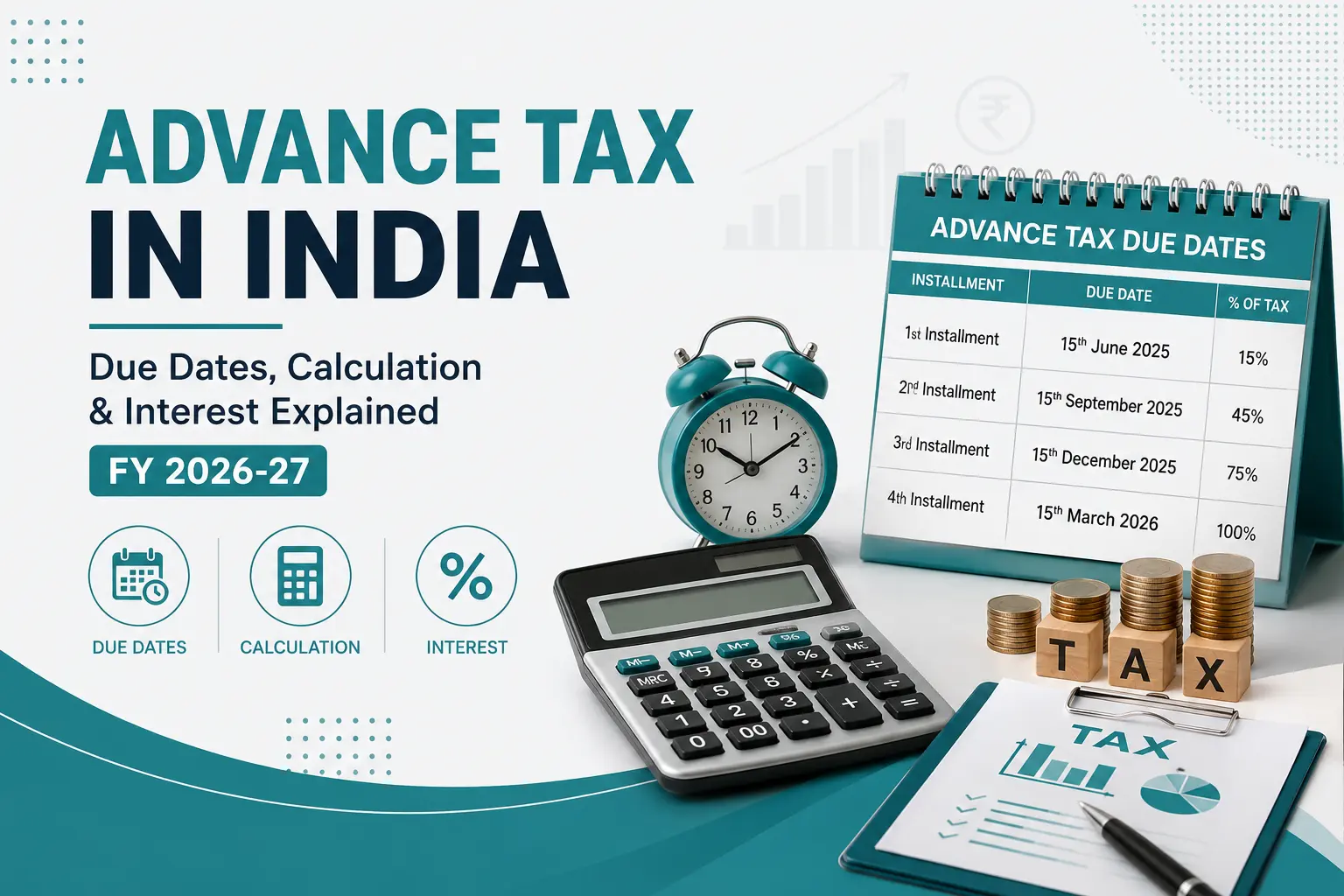
Advance Tax Due Dates for FY 2026-27
Due Date | Cumulative Advance Tax Payable | Applies To |
15 June 2026 | 15% of total estimated tax | All liable taxpayers |
15 September 2026 | 45% of total estimated tax | All liable taxpayers |
15 December 2026 | 75% of total estimated tax | All liable taxpayers |
15 March 2027 | 100% of total estimated tax | All liable taxpayers |
15 March 2027 | 100% in a single instalment | Presumptive taxpayers under 44AD / 44ADA |
Note the special rule: businesses and professionals under the presumptive schemes (Sections 44AD and 44ADA) can skip the quarterly grind and pay the entire advance tax in one shot by 15 March.
How to Calculate Advance Tax: Step-by-Step
- Estimate your total income for the year. Include salary, business or professional income, capital gains, interest, dividends and rent.
- Apply deductions and pick your regime. Compute taxable income under the regime (old or new) you actually plan to use.
- Compute total tax including cess. Apply the slab rates plus 4% health and education cess, and surcharge if applicable.
- Subtract TDS and TCS. Reduce the tax already being deducted at source during the year.
- Check the ₹10,000 threshold. If the balance is ₹10,000 or more, advance tax applies.
- Pay as per the instalment schedule. Use the e-Pay Tax facility on the income tax portal; select the correct assessment year and challan (advance tax).
- Revise estimates every quarter. Income changes — a big project, a property sale, a market gain. Re-estimate before each due date and adjust the next instalment.
Interest for Missing Advance Tax: Sections 234B and 234C
Two separate interest charges apply, and they stack:
- Section 234C — deferment interest: 1% per month for shortfalls in individual instalments, calculated against the 15/45/75/100 milestones (with limited tolerance margins for the first two instalments).
- Section 234B — overall shortfall interest: if you pay less than 90% of your final tax by 31 March, 1% per month runs from 1 April until you clear the balance.
A helpful nuance: for instalment shortfalls caused purely by hard-to-predict income like capital gains or lottery winnings, 234C interest is spared if you pay the tax in the instalments falling due after the income arises.
A Quick Worked Example
Meera is a freelance designer in Gurgaon expecting ₹18 lakh of professional receipts in FY 2026-27. Opting for presumptive taxation under Section 44ADA, she offers 50% — ₹9 lakh — as income. Under the new regime, her estimated tax works out to roughly ₹40,000 after the applicable rebate structure and cess.
Since she is a 44ADA taxpayer, she can pay the entire estimated amount in a single instalment by 15 March 2027 — no June, September or December deadlines to track. If a large project doubles her receipts mid-year, she simply recomputes in February and pays the revised figure by 15 March.
Had Meera been a regular (non-presumptive) professional, the same tax would be split as ₹6,000 by June, ₹18,000 by September, ₹30,000 by December and ₹40,000 by March, on a cumulative basis.
Why Paying Advance Tax on Time Is Worth It
- Zero interest drag: every skipped instalment converts into a silent 12% annualized cost.
- Smoother cash flow: four smaller payments hurt far less than one giant March or July outflow.
- Cleaner compliance profile: consistent advance tax history supports loan applications and reduces scrutiny triggers.
- No refund lock-in: accurate estimates mean your money is neither stuck with the department nor short at year-end.
Common Advance Tax Mistakes to Avoid
- Assuming salary TDS covers everything while side income from consulting, interest or trading quietly builds a liability.
- Ignoring capital gains during the year and getting hit at the March instalment.
- Estimating once in June and never revising, even after income doubles.
- Paying under the wrong assessment year or challan head, then struggling to get credit.
- Presumptive taxpayers forgetting the single 15 March deadline and walking into 234C.
- Waiting for 31 March evening payments that fail due to bank cutoffs — pay a few days early.
Practical Tips to Stay Ahead of Advance Tax
- Set calendar alerts one week before each due date: 15 June, 15 September, 15 December, 15 March.
- Keep a simple running income tracker; fifteen minutes per quarter is enough for a solid estimate.
- Move roughly 20–30% of every freelance or business receipt into a separate “tax” bank account.
- After any windfall — property sale, bonus, big market gain — recompute immediately and pay in the next instalment.
- If your income pattern is complex, have a CA prepare quarterly estimates; the fee is trivial against 234B/234C interest.
Conclusion
Advance tax is not an extra tax — it is the same tax, paid on time. The system is simple: estimate, pay 15/45/75/100 percent by the four due dates, revise every quarter, and Sections 234B and 234C never touch you.
The taxpayers who suffer are the ones who ignore it until July. A one-page quarterly estimate is all it takes to stay permanently interest-free.
Want your advance tax estimated and managed professionally? KKS Capital Advisors prepares quarterly tax estimates and handles payments for professionals, traders and businesses. Talk to our tax experts in Gurgaon today.
FAQ'S
Q. Who is required to pay advance tax in India?
Any taxpayer whose estimated tax liability for the year, after TDS, is ₹10,000 or more must pay advance tax — including freelancers, professionals, businesses and salaried individuals with significant non-salary income. Resident senior citizens without business income are exempt.
Q. What are the advance tax due dates for FY 2026-27?
The instalments are 15% by 15 June 2026, 45% by 15 September 2026, 75% by 15 December 2026 and 100% by 15 March 2027 (cumulative). Presumptive taxpayers under Sections 44AD and 44ADA can pay the entire amount in one instalment by 15 March 2027.
Q. What happens if I miss an advance tax instalment?
Interest applies under Section 234C at 1% per month for the shortfall in that instalment, and under Section 234B at 1% per month from April if total payments fall below 90% of the final tax. The interest is automatic and added when you file your return.
Q. Do salaried employees need to pay advance tax?
Usually not, because employer TDS covers salary tax. But if you earn additional income — freelance fees, large interest, dividends, rent or capital gains — and the balance tax after TDS is ₹10,000 or more, advance tax applies on that portion.
Q. How do I pay advance tax online?
Use the e-Pay Tax facility on incometax.gov.in: log in or enter PAN, select the correct assessment year, choose ‘Advance Tax’ as the payment type, and pay via net banking, UPI or debit card. Save the challan; it auto-reflects in your Form 26AS/AIS.