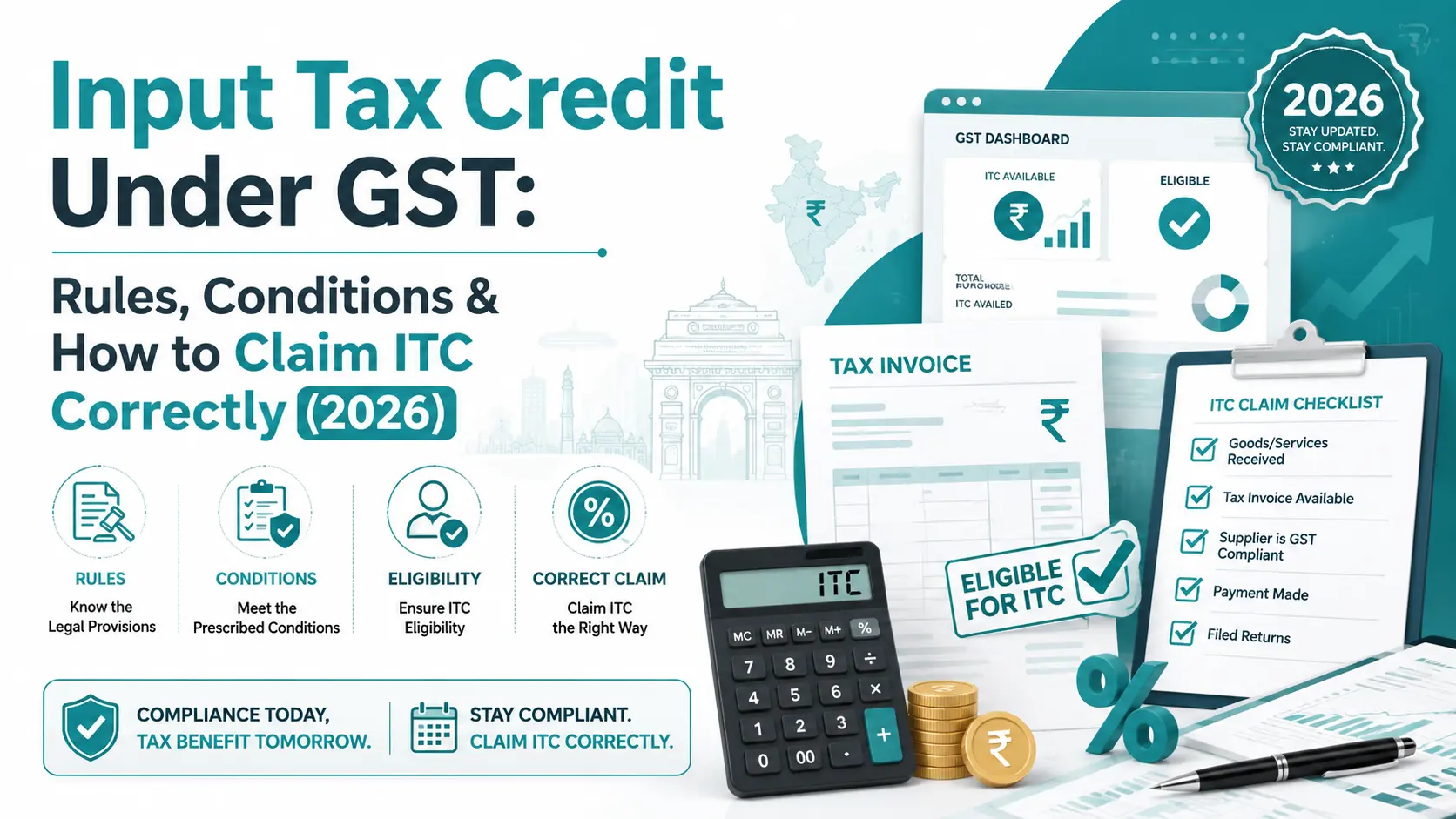
Input Tax Credit Under GST: Rules, Conditions & How to Claim ITC Correctly (2026)
For most businesses, the single biggest hidden leak in GST is not the tax they pay — it is the credit they fail to claim. Input tax credit under GST can offset a huge share of your output tax, yet mismatched invoices, careless vendors and missed deadlines quietly destroy that benefit every month.
Table of Contents
ToggleThis guide explains what input tax credit (ITC) is, the exact conditions under Section 16, how GSTR-2B matching works, which credits are permanently blocked, and a practical monthly process to claim every rupee you are entitled to.
What Is Input Tax Credit Under GST?
Input tax credit under GST is the mechanism that lets a registered business reduce its output tax liability by the GST already paid on purchases of goods and services used for business. In simple terms: you collect GST on sales, subtract the GST you paid on eligible purchases, and deposit only the difference with the government.
This credit chain is the heart of GST. It removes the cascading “tax on tax” of the old regime — but only for businesses whose compliance is clean enough to keep the chain unbroken.
Conditions to Claim ITC: The Section 16 Checklist
You can claim input tax credit only when all of these conditions are satisfied:
- Valid tax invoice or debit note: issued by a registered supplier with your correct GSTIN.
- Receipt of goods or services: credit arrives only when you actually receive the supply (for goods in lots, on the last lot).
- Invoice appears in your GSTR-2B: the supplier must have reported the invoice in their GSTR-1; unreported invoices give you no credit.
- Tax actually paid by the supplier: the supplier must deposit the tax with the government.
- You have filed your return: ITC is claimed through your GSTR-3B.
- Payment to supplier within 180 days: fail to pay the supplier within 180 days of the invoice and the credit must be reversed with interest until you pay.
There is also a hard deadline: ITC for a financial year must be claimed by 30 November of the following year or the date of filing the annual return, whichever is earlier. Miss it, and the credit is gone forever.
How to Claim Input Tax Credit: Monthly Process
- Collect and verify purchase invoices. Check GSTIN, invoice number, tax amounts and your business name on every document.
- Download GSTR-2B after the 14th of each month. This auto-drafted statement lists the invoices your suppliers actually reported.
- Reconcile books vs GSTR-2B. Match every purchase entry; flag invoices missing from 2B and excess entries in 2B.
- Chase defaulting vendors immediately. Ask suppliers to report missed invoices in their next GSTR-1 — the earlier you chase, the higher the recovery.
- Claim eligible ITC in GSTR-3B. Claim only 2B-backed, eligible credit; park doubtful items until resolved.
- Reverse where required. Reverse credit for exempt-use, personal-use, 180-day payment failures and blocked categories.
- Document everything. Keep the reconciliation working — it is your first defence in any GST audit or notice.
Blocked Credits: Where ITC Is Not Allowed (Section 17(5))
Category | ITC Position | Key Exception |
Motor vehicles for personal/staff use (seating ≤ 13) | Blocked | Allowed for resale, transport business, driving schools |
Food, beverages, catering, club memberships | Blocked | Allowed if used to make the same category of outward supply, or where statutorily obligatory for employees |
Works contract / construction of immovable property | Blocked | Allowed for plant & machinery and for further supply of works contract service |
Goods lost, stolen, destroyed or given as free samples | Blocked | No general exception |
Personal consumption purchases | Blocked | No exception |
Claiming blocked credit is one of the fastest ways to attract a GST demand with interest and penalty. When a category looks grey, get a professional view before claiming.
Why Healthy ITC Management Directly Improves Profit
- Cash flow: every rupee of matched credit is a rupee you do not pay in cash with GSTR-3B.
- Pricing power: clean credit chains let you quote sharper prices than competitors leaking ITC.
- Audit safety: reconciled ITC means fewer notices, faster closures and no panic at year-end.
- Vendor discipline: monitoring 2B forces your supplier ecosystem to stay compliant.
ITC on Imports and Reverse Charge: Two Special Cases
Imports of goods carry IGST paid at customs, and that IGST is creditable like any other input tax — the bill of entry acts as your credit document, and the details flow into GSTR-2B from ICEGATE. Importers should reconcile customs data with 2B just as carefully as domestic purchases.
Under reverse charge (RCM), you pay the tax yourself on notified supplies — such as services from a goods transport agency or an advocate — and then claim credit of that very tax, provided the supply is used for business. The catch: RCM liability must be paid in cash, not by using existing credit, before the corresponding ITC becomes available.
Both cases reward good documentation. A missing bill of entry or an unrecorded RCM self-invoice is credit lost for no reason.
Common ITC Mistakes That Cost Businesses Money
- Claiming credit from books instead of GSTR-2B, then facing mismatch notices.
- Ignoring the 180-day supplier payment rule and skipping the required reversal.
- Missing the 30 November cutoff for previous-year invoices during reconciliation.
- Continuing to buy from vendors who habitually fail to file GSTR-1.
- Claiming ITC on blocked categories like staff cars, canteen bills and office construction.
- Not reversing proportionate credit when making both taxable and exempt supplies (Rule 42/43).
Best Practices to Maximize Input Tax Credit Under GST
- Make monthly GSTR-2B reconciliation a fixed calendar ritual, not a year-end scramble.
- Add a GST-compliance clause in vendor agreements — payment linked to invoice appearing in 2B.
- Grade vendors by filing behaviour and shift volume toward compliant ones.
- Automate matching with accounting software for volumes beyond a few hundred invoices.
- Do a quarterly review of blocked-credit and reversal positions with your CA so year-end holds no surprises.
Conclusion
Input tax credit under GST rewards disciplined businesses and punishes casual ones. The rules are strict — Section 16 conditions, GSTR-2B matching, the 180-day payment rule, blocked categories and the 30 November deadline — but a simple monthly reconciliation routine converts all of that into real, recurring cash savings.
Treat ITC as a profit line, not a compliance chore, and it will behave like one.
Suspect ITC leakage in your business? KKS Capital Advisors runs complete ITC health checks, GSTR-2B reconciliations, and vendor compliance reviews for businesses in Gurgaon and across India. Book your GST consultation today.
FAQ'S
Q. What is the time limit to claim input tax credit under GST?
ITC for invoices of a financial year must be claimed by 30 November of the following financial year or the date of filing the annual return, whichever is earlier. Credit not claimed by this deadline lapses permanently, so year-end reconciliation is critical.
Q. Can I claim ITC if my supplier has not filed GSTR-1?
No. Credit is available only for invoices appearing in your GSTR-2B, which is generated from suppliers’ GSTR-1 filings. If a supplier fails to report your invoice, follow up and have them include it in a subsequent GSTR-1; until then, that credit cannot be claimed.
Q. What is the 180-day payment rule in ITC?
If you do not pay your supplier the invoice value plus tax within 180 days of the invoice date, the ITC claimed must be reversed along with interest. The credit can be re-claimed later once you actually make the payment to the supplier.
Q. On which expenses is ITC blocked under GST?
Section 17(5) blocks credit on items like motor vehicles for personal or employee use (with limited exceptions), food and catering, club memberships, construction of immovable property (other than plant and machinery), goods lost or given as free samples, and personal consumption purchases.
Q. Can ITC be claimed on capital goods?
Yes, GST paid on capital goods used for business and taxable supplies is creditable in full when conditions of Section 16 are met. However, if you also claim income-tax depreciation on the GST component of the asset’s cost, ITC on that tax amount is not allowed.