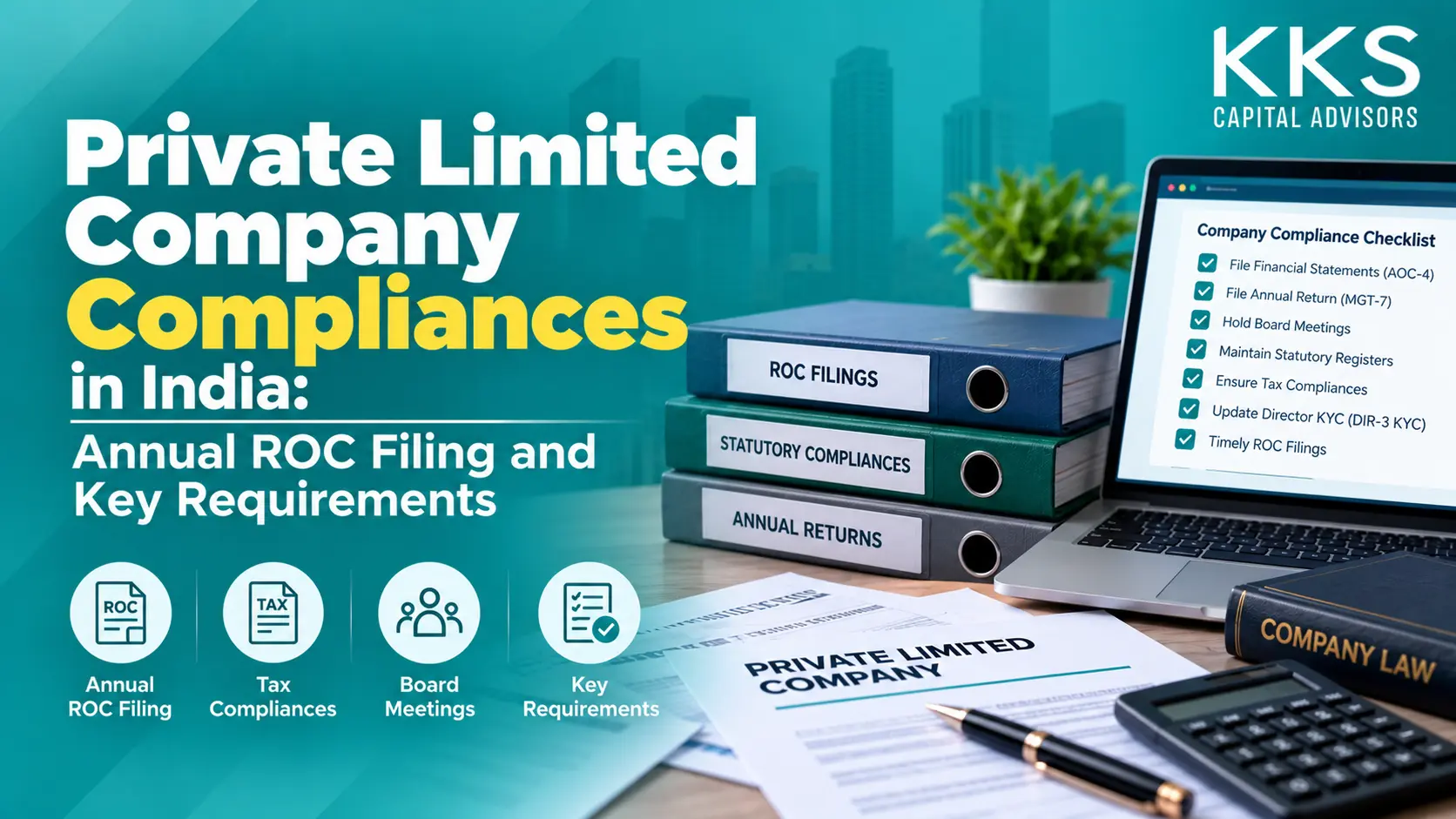
Running a private limited company in India involves several legal, financial, and regulatory responsibilities. Under the Companies Act, 2013, companies must maintain statutory records, conduct board meetings, complete annual filings, and comply with applicable tax regulations. These requirements apply even when a company has limited business activity or reports no profit, subject to specific exemptions.
Table of Contents
TogglePrivate limited company compliances include holding the Annual General Meeting (AGM), completing a statutory audit, filing financial statements through Form AOC-4, submitting the annual return through Form MGT-7 or MGT-7A, and completing applicable director KYC and tax filings. The Registrar of Companies (ROC), under the Ministry of Corporate Affairs (MCA), oversees corporate filings and statutory records.
Understanding these obligations helps business owners plan deadlines, maintain accurate records, and reduce the risk of additional filing fees and regulatory penalties.
What Are Private Limited Company Compliances?
Private limited company compliances are the legal and administrative requirements a company must meet after incorporation. They cover corporate governance, financial reporting, statutory audits, tax returns, director disclosures, and regulatory filings.
These obligations fall into three main categories.
- Annual compliances include the AGM, statutory audit, annual financial statements, and annual return.
- Periodic compliances include board meetings, director disclosures, applicable GST returns, and tax-related filings.
- Event-based compliances arise from specific transactions or changes, such as issuing shares, changing directors, creating charges, or receiving foreign investment.
The applicable requirements depend on the company’s size, business activities, transactions, and regulatory status. Companies should prepare a compliance calendar that reflects their specific obligations rather than relying on a generic deadline list.
What Are the Key Annual ROC Compliance Requirements?
ROC annual compliance requires companies to prepare and submit prescribed information to the Registrar of Companies. The main requirements include the following.
Annual General Meeting (AGM)
Most private limited companies must hold an AGM every year. The first AGM must generally take place within nine months from the close of the company’s first financial year. Subsequent AGMs must generally take place within six months from the close of the financial year, with no more than 15 months between two AGMs. Specific statutory exceptions apply to certain company categories.
During the AGM, shareholders consider matters such as the adoption of financial statements, the auditor’s report, and other applicable resolutions.
Companies should prepare the meeting notice, financial statements, relevant reports, and minutes according to the applicable legal requirements.
Statutory Audit of Financial Statements
A statutory audit examines whether a company’s financial statements comply with applicable accounting and legal requirements. Private limited companies are generally required to obtain an annual statutory audit, regardless of turnover or profitability.
A qualified auditor examines the company’s books, supporting documents, financial transactions, and reported balances. The audit report forms part of the financial reporting process.
Companies should maintain accurate accounting records throughout the year. This includes invoices, bank statements, expense records, payroll information, loan documents, and details of related-party transactions.
The first auditor of a non-government company must generally be appointed by its board within 30 days of registration. Subsequent auditor appointments follow the applicable requirements of the Companies Act, 2013.
Filing Financial Statements Through Form AOC-4
Form AOC-4 is used to file a company’s financial statements with the ROC. The filing generally includes the adopted financial statements and the prescribed supporting documents.
For an ordinary private limited company, the filing deadline is within 30 days of the AGM. A company must follow the applicable statutory procedure if its financial statements are not adopted at the meeting. One Person Companies follow a separate filing timeline.
Before submitting AOC-4, the company should verify:
- Whether the financial statements have been properly approved and adopted.
- Whether the auditor’s report and other required attachments are complete.
- Whether the prescribed form contains accurate financial and corporate information.
- Whether the required digital signatures and certifications are in place.
Errors or missing attachments can delay filing and create additional work for the company.
Filing the Annual Return Through Form MGT-7 or MGT-7A
The annual return records important information about a company as of the end of its financial year. It generally includes details of its registered office, shareholding, directors, members, and meetings.
Companies generally file Form MGT-7 within 60 days of the AGM. Eligible One Person Companies and small companies use Form MGT-7A, subject to the applicable rules.
The annual return should agree with the company’s statutory registers, shareholding records, director information, and other corporate documents.
Business owners should also check whether the annual return requires certification by a practising company secretary based on the company’s category and the applicable statutory provisions.
What Other Compliances Must Private Limited Companies Complete?
Annual ROC filing is only one part of corporate compliance. Companies must also meet other requirements throughout the financial year.
Board Meetings and Director Disclosures
Under Section 173 of the Companies Act, 2013, a company generally must hold its first board meeting within 30 days of incorporation. It must then hold at least four board meetings each year, with no more than 120 days between consecutive meetings. Certain company categories qualify for modified requirements.
The board discusses financial performance, operational matters, statutory obligations, and other significant company decisions.
Companies should maintain board meeting notices, agendas, attendance records, minutes, and resolutions. Directors must also provide applicable disclosures of interests and declarations concerning disqualification.
Director KYC Through DIR-3 KYC
Directors holding a Director Identification Number (DIN) must comply with applicable KYC requirements under MCA rules.
The annual KYC deadline is generally 30 September of the relevant year for directors required to complete the filing. The applicable form or web service depends on whether the director is filing KYC for the first time or updating information.
Companies should verify their directors’ KYC status and submit details before the applicable deadline.
Maintenance of Statutory Registers and Records
Companies must maintain prescribed statutory registers and records at the registered office or another permitted location. These records help document ownership, management decisions, and compliance with the Companies Act.
Depending on the company, records include:
- Register of members and shareholding information.
- Register of directors and key managerial personnel.
- Registers of contracts and arrangements, where applicable.
- Board and general meeting minutes.
- Share certificates, resolutions, and prescribed disclosures.
Keeping these records updated throughout the year makes annual filing and statutory reviews easier.
Income Tax Returns and Tax Audit
Corporate income tax compliance is separate from ROC filing. Companies must calculate their taxable income, meet applicable tax payment obligations, and file the prescribed income tax return.
A tax audit is required when the relevant statutory conditions apply. Its applicability and filing deadline depend on the company’s circumstances and the tax rules for the relevant period.
India’s Income-tax Act, 2025 took effect on 1 April 2026. Tax years beginning before that date remain subject to the relevant transitional provisions and the earlier law. Companies should therefore confirm which rules apply to each filing period instead of assuming that one set of tax deadlines applies to every financial year. (Source: Income Tax Department)
GST, TDS, and Other Applicable Filings
Companies registered under the Goods and Services Tax (GST) framework must complete the returns and tax payments applicable to their registration and filing scheme.
Businesses deducting tax at source (TDS) must comply with relevant deposit, return, and certificate requirements. Companies with employees may also have obligations under provident fund, employee insurance, and other applicable labour laws.
Additional corporate filings may arise from deposits, outstanding payments to micro and small enterprises, changes in directors, share allotments, charges, or foreign investment. These requirements depend on specific facts and statutory conditions.
Private Limited Company Compliance Calendar
The following table summarises common compliance timelines for planning purposes.
|
Compliance |
General deadline |
|
First board meeting |
Within 30 days of incorporation |
|
Subsequent board meetings |
Generally at least four meetings per year |
|
First AGM |
Within nine months of the first financial year’s close |
|
Subsequent AGMs |
Within six months of the financial year’s close |
|
AOC-4 financial statements |
Within 30 days of the AGM |
|
MGT-7 annual return |
Within 60 days of the AGM |
|
DIR-3 KYC |
Generally by 30 September, where applicable |
|
Income tax return |
Depends on the applicable tax year, audit status, and tax rules |
|
GST and TDS filings |
According to the relevant filing category and period |
These are general timelines, not a complete compliance calendar for every company. Special rules, company categories, filing requirements, and government extensions can change the applicable deadline. Check the latest MCA and Income Tax Department notifications before filing.
What Happens If a Company Misses Its Compliance Deadlines?
Missing a statutory deadline can result in additional filing fees, penalties, and other regulatory consequences. The impact depends on the type of filing, duration of the default, and applicable legal provisions.
For example, failure to file financial statements or the annual return within the prescribed period can expose the company and responsible officers to statutory penalties. Repeated or prolonged defaults also create complications during due diligence, fundraising, ownership changes, and other corporate transactions.
Companies should avoid treating annual filing as a last-minute task. Maintain a central calendar, assign responsibility for each filing, reconcile accounting records regularly, and review pending requirements before the due date.
How Can You Manage Private Limited Company Compliances Efficiently?
A structured compliance process helps businesses meet deadlines and maintain consistent records.
- Identify the company’s applicable requirements. Review its incorporation documents, company category, director details, tax registrations, financial activities, and any special regulatory obligations.
- Prepare a financial-year compliance calendar. Record AGM dates, board meetings, audit milestones, ROC filing deadlines, KYC requirements, and tax-related dates. Include the person responsible for each task.
- Keep accounting records updated during the year. Share the required documents with the auditor and compliance professional early enough to resolve discrepancies before filing.
- Review submissions after filing. Keep acknowledgement receipts, challans, signed statements, filed forms, and supporting documents in an organised repository.
Where the company has multiple directors, investors, business locations, or regulatory obligations, professional support helps coordinate these activities and identify missing requirements.
How Can KKS Capital Help With Company Compliance?
Managing private limited company compliances requires coordination across corporate law, accounting, auditing, and taxation. Businesses that lack an internal compliance team often need help understanding the obligations that apply to their circumstances.
KKS Capital provides legal and secretarial support, accounting and auditing services, tax advisory, and related business compliance services. Its team supports businesses with regulatory matters and company documentation.
Working with a compliance professional helps you organise records, prepare required documents, track statutory deadlines, and address filing issues. The appropriate scope of support depends on your company’s structure and requirements.
Visit KKS Capital Advisor to enquire about private limited company compliance, ROC annual filing, documentation, and ongoing statutory obligations.
Conclusion
Private limited company compliances in India involve annual ROC filing, statutory audits, AGMs, director disclosures, tax returns, and other applicable regulatory obligations. Businesses should monitor these requirements throughout the financial year rather than waiting until the annual filing period.
Maintain accurate records, follow the applicable deadlines, and verify current filing rules before submitting statutory forms. For help with company compliance and ROC annual filing, contact KKS Capital to discuss your requirements.
FAQ'S
Are private limited company compliances mandatory if the company has no business activity?
Generally, yes. A company with no revenue or business activity must still meet applicable statutory requirements unless a specific exemption or recognised status changes its obligations. Dormant or inactive status should not be assumed to remove every filing requirement.
What is the difference between AOC-4 and MGT-7?
AOC-4 is used to submit prescribed financial statements to the ROC. MGT-7 is the annual return containing details such as shareholding, directors, and company meetings. These forms serve different purposes and have separate filing deadlines.
What is the usual deadline for ROC annual filing?
For an ordinary private limited company, AOC-4 is generally due within 30 days of the AGM, while MGT-7 is generally due within 60 days. Special provisions apply to certain company categories, and current MCA rules should be checked before filing.
Does a private limited company need a professional for annual compliance?
The company must meet its applicable legal obligations whether or not it hires an external professional. A chartered accountant or company secretary helps with audit coordination, document preparation, filing requirements, deadline tracking, and regulatory interpretation.