Quick Answer
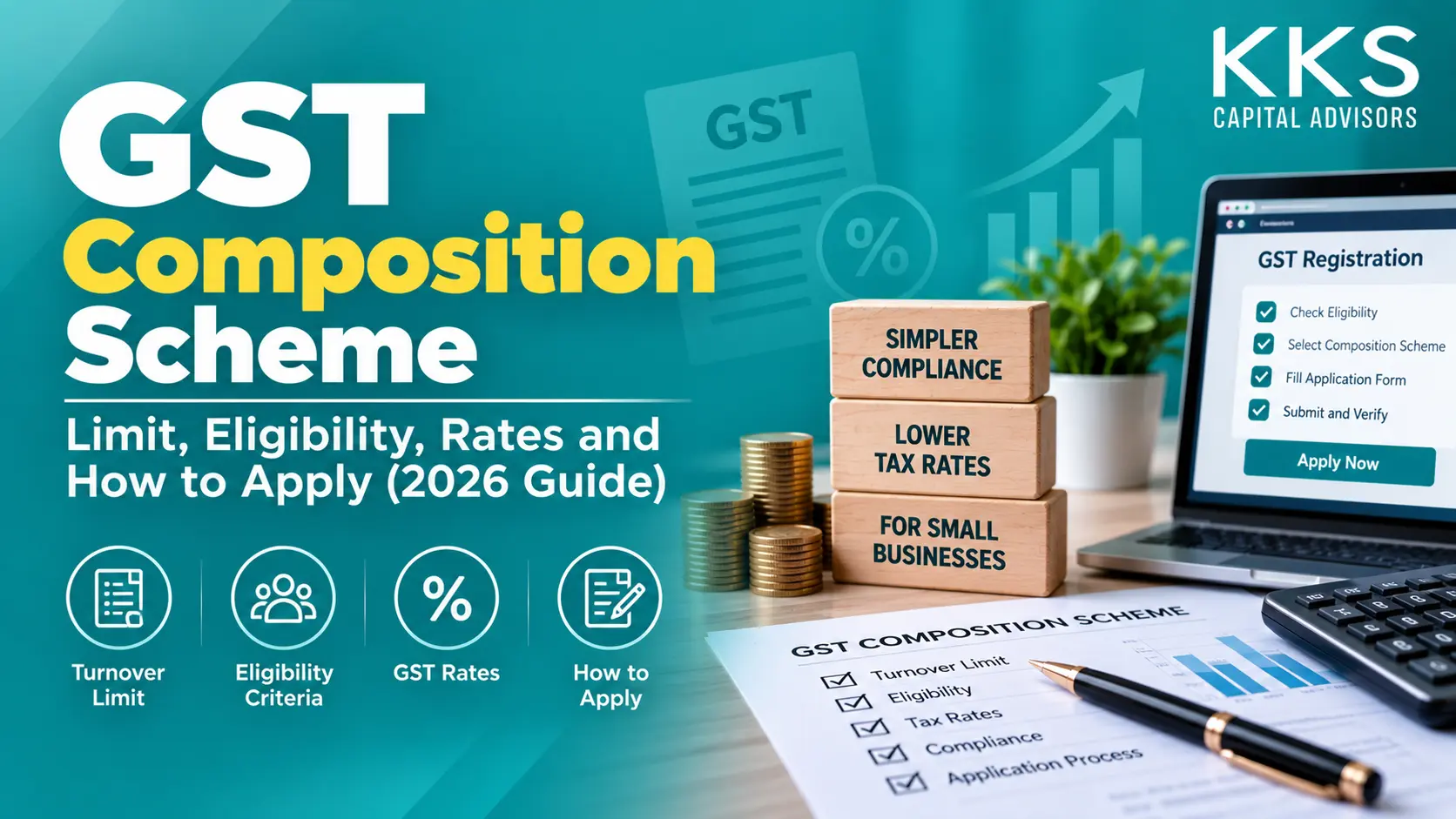
The GST composition scheme is a simple, optional tax plan for small businesses in India. Instead of filing many returns and charging GST on every bill, you pay a small flat tax on your turnover.
Table of Contents
Toggle- Turnover limit: up to ₹1.5 crore in the last financial year (₹75 lakh in special category states).
- Service providers: up to ₹50 lakh under a separate option.
- Tax rates: 1% for manufacturers and traders, 5% for restaurants (no alcohol), 6% for service providers.
- Returns: pay tax every quarter (CMP-08) and file one annual return (GSTR-4).
- Main catch: no input tax credit and no inter-state sales of goods.
What Is the GST Composition Scheme?
The composition scheme GST option comes from Section 10 of the CGST Act, 2017. It was made for small shopkeepers, manufacturers and restaurant owners who find regular GST compliance costly and confusing.
Under the regular GST system, a business files monthly returns, charges GST on every invoice and tracks input tax credit. Under the composition scheme, you simply pay a fixed percentage of your turnover. Less paperwork, lower tax rates and fewer filings.
Think of it like this: regular GST is like keeping a detailed diary of every rupee. The composition scheme is like paying a simple monthly fee and getting on with business.
GST Composition Scheme Limit (2026)
The GST composition scheme limit depends on your type of business and your state. The limit is checked on your aggregate turnover of the previous financial year, counted for all businesses under the same PAN across India.
Type of business | Turnover limit (previous FY) | Special category states |
|---|---|---|
Manufacturers of goods | ₹1.5 crore | ₹75 lakh |
Traders of goods | ₹1.5 crore | ₹75 lakh |
Restaurants (not serving alcohol) | ₹1.5 crore | ₹75 lakh |
Service providers and mixed suppliers (Section 10(2A)) | ₹50 lakh | ₹50 lakh |
Good to know:
- The limit was raised from ₹1 crore to ₹1.5 crore based on the GST Council’s 32nd meeting decisions (ICSI summary).
- A goods composition dealer can also supply services worth up to 10% of turnover or ₹5 lakh, whichever is higher.
- If your turnover crosses the limit during the year, you must leave the scheme from that day.
- Some websites claim the limit has gone up to ₹2.5 crore. As of October 2026, we have not seen an official CBIC notification confirming this. Always check the GST portal or ask your CA before deciding.
GST Composition Scheme Eligibility
Here is a simple checklist for GST composition scheme eligibility. You can opt in if:
- Your previous year’s turnover is within the limit above.
- You are a manufacturer, trader, restaurant owner or small service provider.
- You sell goods only within your own state (intra-state supply).
- All your businesses registered under the same PAN also opt for the scheme.
- You do not sell goods through e-commerce platforms that collect TCS.
Who Cannot Opt for the Composition Scheme?
You are not eligible if you:
- Make inter-state sales of goods.
- Sell goods through e-commerce operators like Amazon or Flipkart that must collect TCS.
- Manufacture notified goods like ice cream, pan masala or tobacco products.
- Supply goods that are not taxable under GST (like alcohol for human use).
- Are a casual taxable person or a non-resident taxable person.
- Provide services above the allowed limit, unless you qualify under Section 10(2A).
GST Composition Scheme Tax Rates
The rates are flat and easy to calculate. They are split equally between CGST and SGST.
Category | CGST | SGST/UTGST | Total rate | Tax is charged on |
|---|---|---|---|---|
Manufacturers | 0.5% | 0.5% | 1% | Total turnover in the state |
Traders | 0.5% | 0.5% | 1% | Turnover of taxable goods only |
Restaurants (no alcohol) | 2.5% | 2.5% | 5% | Total turnover in the state |
Service providers (Section 10(2A)) | 3% | 3% | 6% | Total turnover in the state |
What about GST 2.0? The big GST rate reform that took effect on 22 September 2025 moved most goods to 5% and 18% slabs. However, composition dealers pay a flat percentage of turnover, so their composition rates stayed the same.
Example: Ramesh runs a hardware shop in Gurgaon with a turnover of ₹80 lakh. Under the composition scheme, he pays 1% of ₹80 lakh, which is ₹80,000 a year, in four quarterly payments. He files one CMP-08 each quarter and one GSTR-4 a year, instead of monthly GSTR-1 and GSTR-3B returns.
Composition Scheme vs Regular GST: Quick Comparison
Point | Composition scheme | Regular GST |
|---|---|---|
Tax rate | Flat 1%, 5% or 6% of turnover | 5%, 18% or 40% on each item |
Input tax credit | Not available | Available |
Invoice type | Bill of Supply (no GST shown) | Tax invoice (GST shown) |
Returns | CMP-08 quarterly + GSTR-4 yearly | GSTR-1 and GSTR-3B monthly or quarterly + annual return |
Inter-state sales of goods | Not allowed | Allowed |
E-commerce selling | Not allowed (TCS platforms) | Allowed |
Who pays the tax | Business pays from its own pocket | Collected from the customer |
Best for | Small local B2C businesses | B2B businesses and growing brands |
Benefits of the GST Composition Scheme
- Lower tax rates: pay as little as 1% of turnover.
- Less paperwork: no need for detailed purchase and sales records for ITC.
- Fewer returns: quarterly payment and one annual return.
- Better cash flow: a small, predictable tax amount is easy to plan.
- Lower compliance cost: less accounting work and lower CA fees.
Disadvantages You Should Know
- No input tax credit: you cannot claim GST paid on your purchases.
- Cannot charge GST to customers: the tax comes out of your own margin.
- Not ideal for B2B: your business customers cannot claim ITC on your bills, so they may prefer regular dealers.
- No inter-state sales of goods: this limits growth beyond your state.
- No online marketplace selling: you cannot sell through TCS-collecting e-commerce platforms.
- Must show your status: you must write “Composition taxable person” on every bill and on a board at your shop.
Is the Composition Scheme Right for You?
Use this simple rule of thumb:
- Choose composition if you mostly sell to final consumers (B2C), sell only in your state, have low purchase GST and want simple compliance. Examples: local kirana shops, small hardware stores, sweet shops and small restaurants.
- Choose regular GST if you sell to other businesses (B2B), plan to sell online or in other states, or pay a lot of GST on your purchases.
Not sure which one saves you more? A quick tax comparison by a CA can show you the real numbers for your business. Talk to a KKS Capital expert.
How to Apply for the GST Composition Scheme
For New Businesses
- Apply for GST registration on the GST portal using Form GST REG-01.
- Select the option to opt for the composition scheme in the form.
- Your composition status starts from your registration date once approved.
For Existing Regular Taxpayers
- Log in to the GST portal.
- File Form GST CMP-02 before the start of the financial year (by 31 March).
- File Form GST ITC-03 within 60 days to report and reverse ITC on stock in hand.
- Start the scheme from 1 April of the new financial year.
KKS Capital can handle your GST registration and composition filing from start to finish.
Returns and Due Dates for Composition Dealers
Form | Purpose | Frequency | Due date |
|---|---|---|---|
CMP-08 | Pay tax for the quarter | Quarterly | 18th of the month after the quarter ends |
GSTR-4 | Annual return | Yearly | 30 April of the next financial year |
CMP-02 | Opt into the scheme | Once | Before the start of the financial year |
CMP-04 | Opt out of the scheme | When needed | Within 7 days of becoming ineligible, or anytime voluntarily |
Late filing attracts late fees and interest, so mark these dates in your calendar.
Rules Composition Dealers Must Follow
- Issue a Bill of Supply, not a tax invoice. Do not charge GST on it.
- Write “Composition taxable person, not eligible to collect tax on supplies” on every bill.
- Display the words “Composition taxable person” on a board at your shop or office.
- Pay GST under reverse charge where the law requires it.
- Leave the scheme by filing CMP-04 if your turnover crosses the limit.
Common Mistakes to Avoid
- Ignoring the PAN rule: turnover of all businesses under one PAN is counted together.
- Selling on Amazon or Flipkart: this can cancel your composition status.
- Charging GST on bills: composition dealers cannot collect GST from customers.
- Missing CMP-08: late quarterly payments add interest and late fees.
- Crossing the limit and not opting out: this can lead to tax demands and penalties.
How KKS Capital Helps You With the GST Composition Scheme
At KKS Capital Advisors, our chartered accountants in Gurgaon help small businesses choose the right GST option and stay fully compliant.
Our GST composition services include:
- Eligibility check and composition vs regular GST cost comparison.
- New GST registration with composition option.
- Filing CMP-02, ITC-03 and CMP-04.
- Quarterly CMP-08 and annual GSTR-4 filing.
- Bookkeeping and accounting support.
- Help with GST notices and tax advisory.
Why businesses trust us: rated 4.9 by 68+ clients on Google, queries answered within 24 hours, and transparent pricing.
Get started today. Call +91 96540 73033, email info@kkscapital.com, or book a free consultation. Visit us at 2nd Floor, SCO 12, Sector 23A, Gurgaon.
FAQ'S
What is the GST composition scheme in India?
The GST composition scheme in India is an optional, simple tax plan for small businesses under Section 10 of the CGST Act. Eligible businesses pay a flat tax of 1%, 5% or 6% on turnover and file fewer returns.
What is the GST composition scheme limit for 2026?
The limit is ₹1.5 crore of turnover in the previous financial year for manufacturers, traders and restaurants. It is ₹75 lakh in special category states and ₹50 lakh for service providers.
Who is eligible for the GST composition scheme?
Small manufacturers, traders, restaurants not serving alcohol and small service providers within the turnover limit are eligible. They must sell goods only within their state and not through TCS-collecting e-commerce platforms.
Can service providers opt for the composition scheme?
Yes. Service providers with turnover up to ₹50 lakh can opt in under Section 10(2A) and pay 6% GST (3% CGST + 3% SGST).
Can a composition dealer claim input tax credit?
No. Composition dealers cannot claim input tax credit on purchases, and their customers cannot claim ITC on their bills either.
Can a composition dealer sell on Amazon or Flipkart?
No. A goods composition dealer cannot sell through e-commerce operators that collect TCS. Doing so makes you ineligible for the scheme.
Which returns does a composition dealer file?
A composition dealer pays tax every quarter through Form CMP-08 and files one annual return in Form GSTR-4.
How do I opt out of the composition scheme?
File Form GST CMP-04 on the GST portal. You must do this within 7 days if you become ineligible, or you can opt out voluntarily anytime.
Can a composition dealer issue a tax invoice?
No. A composition dealer issues a Bill of Supply and cannot show or collect GST on it.
Did GST 2.0 change composition scheme rates?
No. The GST 2.0 reform from 22 September 2025 changed item-wise GST slabs, but composition rates of 1%, 5% and 6% stayed the same.
Conclusion
The GST composition scheme is a smart choice for small, local businesses that want lower taxes and simple compliance. But it is not right for everyone. If you sell to businesses, sell online or plan to grow across states, regular GST may save you more.
The best move? Compare both options with real numbers before you decide. KKS Capital’s GST experts can do this for you in one quick consultation. Contact us today.
Disclaimer: This article is for general information only. GST rules can change, so please check the latest notifications or consult a chartered accountant before making decisions.