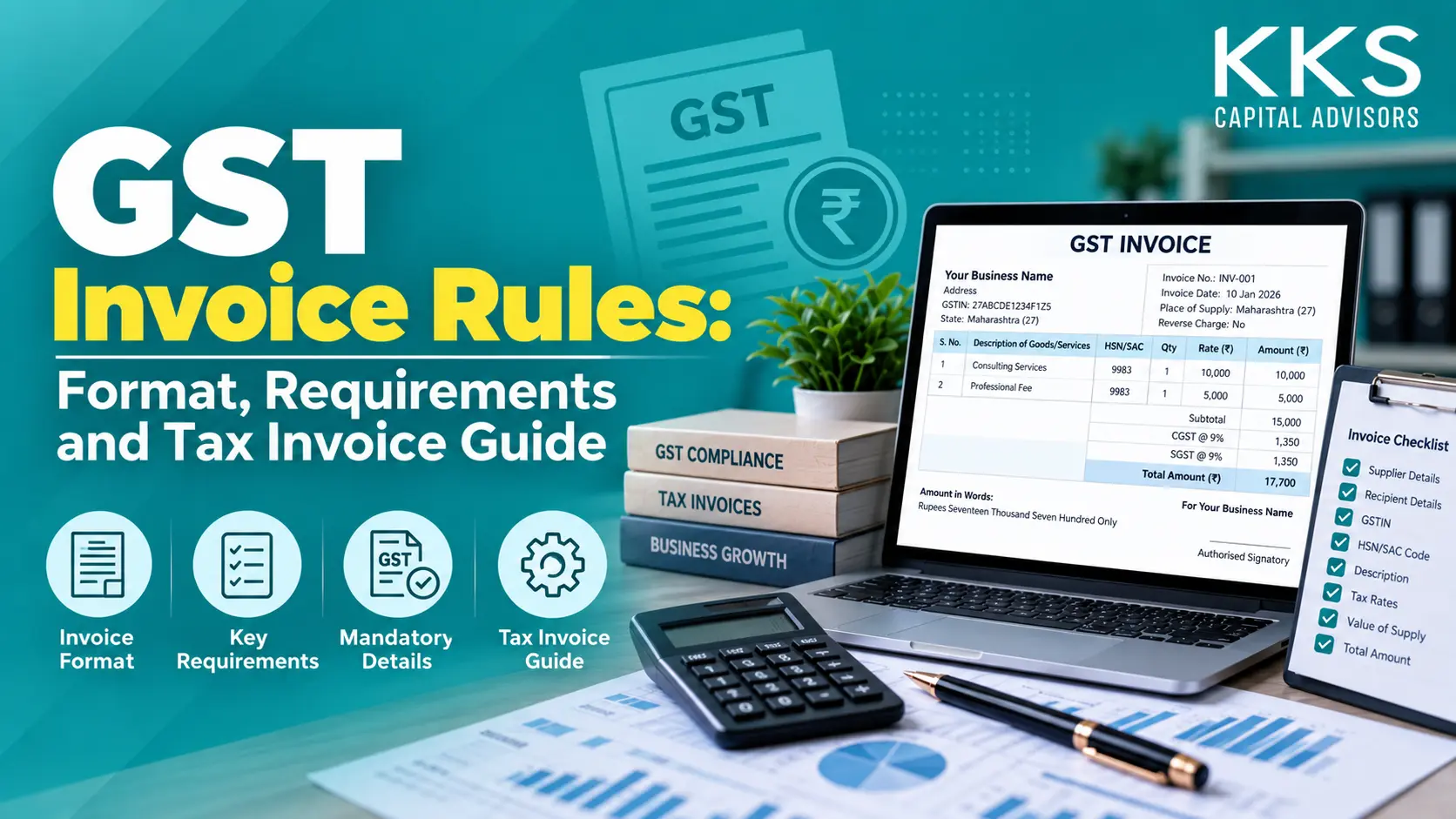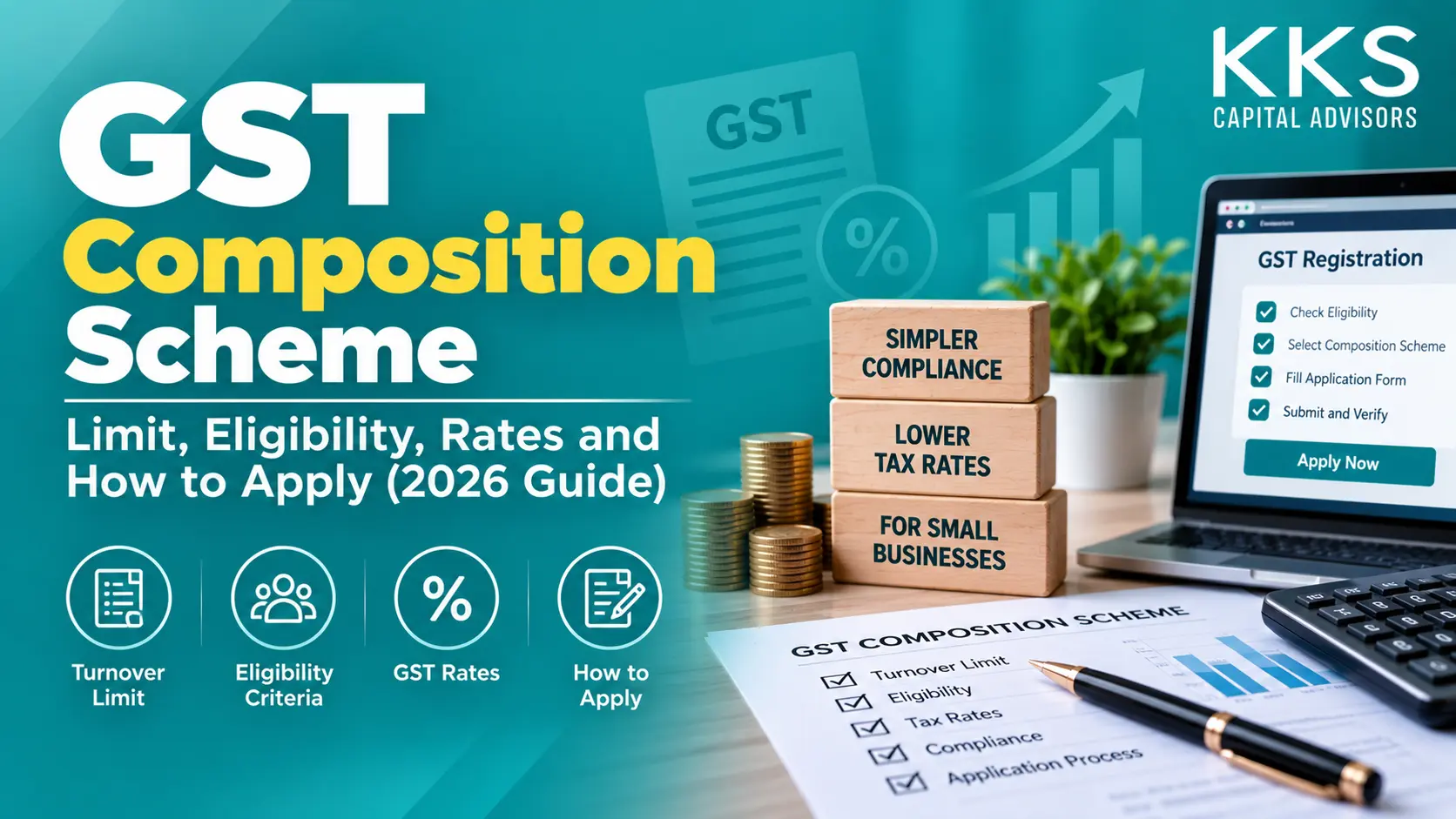
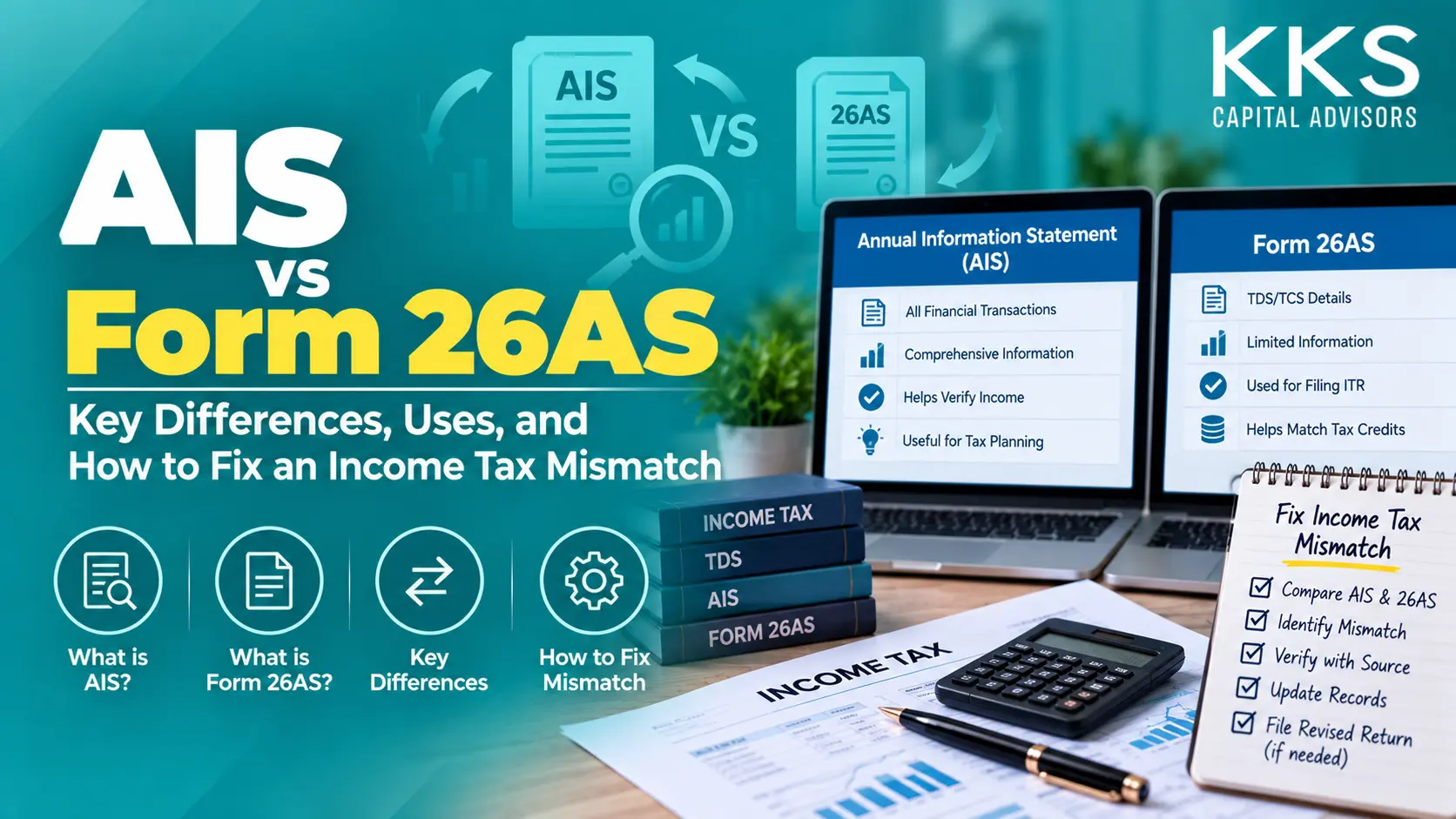
AIS vs Form 26AS: Key Differences, Uses, and How to Fix an Income Tax Mismatch

AIS vs Form 26AS serve different purposes when you prepare an Income Tax Return (ITR). AIS provides a wider view of financial information reported to the Income Tax Department. From AY 2023-24 onward, Form 26AS focuses on tax deducted at source (TDS) and tax collected at source (TCS). Review AIS for reported income and transactions, then use Form 26AS to verify tax credits. Check both against your records before filing.

Current-year note: AIS for AY 2026-27 covers FY 2025-26 under the earlier tax law. A separate annual information statement, Form No. 168, applies for Tax Year 2026-27 under the Income-tax Act, 2025. Select the correct assessment year or tax year. (See the Income Tax Department’s AIS and TDS Compliance FAQs.)

What Is an AIS Statement?

The Annual Information Statement (AIS) is a consolidated view of financial information available to the Income Tax Department about a taxpayer. It is designed to help taxpayers review information before filing an ITR and submit feedback when a reported item appears incorrect. AIS also supports return pre-filling where applicable.

What information does AIS include?

Depending on what reporting entities submit and what data the Department holds, an AIS statement can include:

  •       TDS and TCS information reported against your PAN.
  •       Specified Financial Transactions (SFT), such as certain reportable deposits, investments or property transactions.
  •       Reported interest income, including savings account or deposit interest, where available.
  •       Dividend, securities and mutual fund transaction information, where reported.
  •       Certain foreign remittances or foreign currency purchases.
  •       Tax payment, demand and refund data under relevant AIS categories.
  •       Other information received from reporting sources, depending on the taxpayer and year.

AIS also contains a Taxpayer Information Summary (TIS). TIS groups information by category and can display system-processed values and values accepted by the taxpayer or confirmed by the source. Do not assume AIS shows every transaction you made. The Income Tax Department states that taxpayers remain responsible for reporting complete and accurate income in their returns, including information that is not displayed in AIS.

What Is Form 26AS?

Form 26AS is the Annual Tax Statement available through the tax portal and TRACES. From AY 2023-24 onward, it displays TDS/TCS-related data, while other reported financial information is available through AIS. Use it to check whether tax deducted or collected against your PAN appears in the Department’s records.

Compare salary TDS with Form 16, bank TDS with the bank’s certificate, and other credits with records from the deductor. If a credit is missing or wrong, contact the deductor and request a correction where required. Formats for older years can differ, so check the statement for the relevant assessment year.

AIS vs Form 26AS: What Is the Difference?

Comparison point

AIS statement

Form 26AS

Main purpose

Review a broader range of reported income and financial transactions.

Verify TDS and TCS information against your PAN.

Coverage

Wider reporting, including certain interest, dividend, securities, SFT and other data.

Primarily TDS/TCS-related data for AY 2023-24 onward.

Feedback

Allows feedback on eligible reported information through the AIS portal.

No equivalent AIS-style transaction feedback function.

Best use

Find income or transactions to investigate before filing.

Confirm tax credits before claiming them in the ITR.

Mismatch action

Check source documents and submit feedback when information is wrong.

Check TDS/TCS records and ask the deductor to correct a reporting error.

Relationship

Provides a wider information picture.

Provides a focused tax-credit view.

Which Should You Check Before Filing an ITR?

Review both. AIS covers a broader range of reported information, while Form 26AS helps verify TDS/TCS credits. Neither document replaces your own records or decides every item of taxable income by itself.

Use this practical sequence:

  1. Download AIS and Form 26AS for the correct assessment year or tax year.
  2. Compare TDS/TCS with Form 16, Form 16A, salary slips and deductor records.
  3. Match interest, dividends and securities transactions with bank, broker and mutual fund statements.
  4. Separate gross transaction values from taxable income. A share sale value, for example, is not the same as the taxable capital gain.
  5. Resolve incorrect entries and report all taxable income required by law.

What Is an AIS Mismatch?

An AIS mismatch occurs when information in AIS does not appear to agree with your records or with the figures used in your ITR. A difference is not always an error. AIS can show a transaction value that needs tax computation, information from more than one source, or a report that requires clarification.

Common reasons for an income tax mismatch

  •       Duplicate reporting: the same transaction appears more than once or through more than one reporting route.
  •       Incorrect PAN or taxpayer details: a reporting entity has used the wrong identifier or supplied incorrect data.
  •       Timing differences: a transaction or tax deduction is reported or corrected later than expected.
  •       Gross value versus taxable income: the reported sale amount, deposit or transaction total is not itself the taxable amount.
  •       Missing source correction: a bank, employer, broker or other reporting entity has not filed or corrected its statement.
  •       Wrong year selected: the AIS or Form 26AS is for a different assessment year or tax year from the return under review.

How to Fix an AIS Mismatch

First identify the exact entry and the reporting source. Keep the relevant statement, transaction proof and communication records together. Then take the step that matches the issue:

  1. If the AIS information is correct, report it in the ITR using the applicable tax treatment.
  2. If the entry is incorrect, duplicated or does not belong to you, open the relevant AIS item and submit the most suitable feedback option in the portal.
  3. If a TDS/TCS credit is missing or inaccurate, contact the employer, bank or other deductor. Ask them to verify the PAN and file a correction where required.
  4. Save the feedback acknowledgement and keep a record of the source documents. The AIS portal provides activity history and an acknowledgement for submitted feedback.
  5. Recheck the updated statement and your ITR figures before submission. Do not ignore valid income simply because you submitted feedback on an AIS entry.

AIS feedback does not automatically change every source record or settle the tax treatment. Seek qualified tax advice if the issue affects taxable income, capital gains, foreign transactions or a tax notice.

Why Might AIS and Form 26AS Show Different Information?

Different information is expected because the statements have different scopes. AIS includes categories beyond TDS and TCS, so interest, dividends or reportable securities transactions may appear in AIS without appearing as equivalent entries in Form 26AS. That difference alone does not mean the records are wrong.

For an item that appears in both statements, compare the deductor or collector, PAN, amount, financial period and available transaction details. If the mismatch concerns TDS or TCS, the deductor may need to correct its return. If it concerns other reported income, compare AIS with the underlying bank, broker, employer or transaction documents and use AIS feedback when appropriate.

Important Update for Tax Year 2026-27

The Income-tax Act, 2025 took effect on 1 April 2026. The Income Tax Department says AIS for AY 2026-27 relates to FY 2025-26 under the earlier Act. Form No. 168 applies as the annual information statement for Tax Year 2026-27 under the new Act. Both statements are available through the e-filing portal.

Before comparing statements, confirm whether your records relate to an assessment year under the earlier framework or a tax year under the new one. For a TDS mismatch during the transition, the Department advises early reconciliation and contacting the deductor to correct the relevant statement if needed.

How KKS Capital Advisor Can Help

Reconciling AIS, Form 26AS and your ITR takes careful review of tax credits, financial transactions and supporting documents. A tax professional can help identify the source of a mismatch, distinguish a reporting issue from a tax-computation issue, and organise the evidence needed to resolve it.

KKS Capital Advisor provides tax advisory, income tax return filing and income tax notice support. If you are dealing with an AIS mismatch, missing TDS credit or a tax query, visit the KKS Capital Advisor website to enquire about assistance for your situation.

Conclusion

For an accurate ITR, understand each statement’s purpose. AIS helps you review reported income and transactions, while Form 26AS helps verify TDS/TCS credits for applicable assessment years. Reconcile both with your records, investigate meaningful differences and request corrections where needed. For tax reconciliation or ITR support, contact KKS Capital Advisor through its website.

FAQ'S

What is the main difference between AIS and Form 26AS?

AIS gives a broader view of financial information reported to the Income Tax Department. Form 26AS focuses on TDS/TCS-related details from AY 2023-24 onward. Check both before filing your ITR.

They serve different purposes. AIS helps you review reported income and transactions. Form 26AS helps you verify tax credits. Use both with your source documents.

Yes. AIS covers more information categories, so some entries appear only in AIS. If TDS/TCS values differ, reconcile the details and contact the deductor when a correction is needed.

Check the source, date, amount and supporting documents. If the item is incorrect or does not belong to you, submit appropriate feedback in AIS and retain the acknowledgement. Contact the reporting entity if its records need correction.

Yes, where the income is taxable under applicable law. AIS is based on information currently available to the Department and may not show every transaction. You remain responsible for reporting complete and accurate income in your ITR.

The Income Tax Department says the annual information statement for Tax Year 2026-27 is Form No. 168 under the Income-tax Act, 2025. AIS for AY 2026-27 remains associated with FY 2025-26 under the earlier Act. Select the relevant period before comparing statements.
Read More

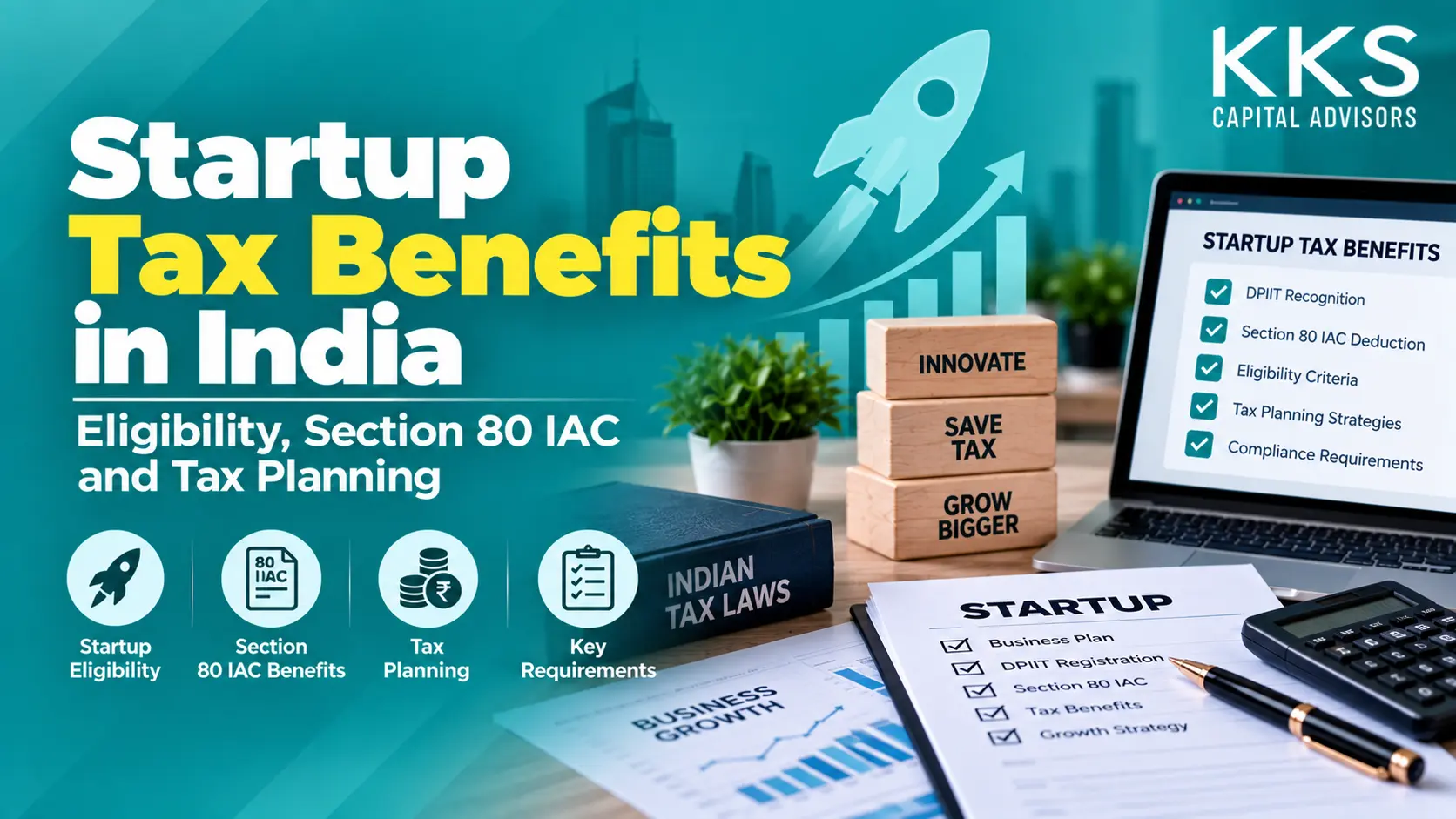
Startup Tax Benefits in India Eligibility Section 80 IAC and Tax Planning

Quick Answer: Startup tax benefits in India may include a deduction for qualifying business profits, conditional protection for carried-forward losses, and ESOP tax-payment deferral. Eligibility depends on the benefit, entity, incorporation date, approvals and applicable law. DPIIT recognition alone does not automatically provide every tax concession.

Building a startup means balancing product development, hiring, funding and cash flow. Tax questions often arrive alongside these decisions: Does recognition make the business tax-free? Should the company claim a profit deduction immediately? Could an investment round affect earlier losses?

Understanding startup tax benefits in India starts with separating recognition from individual tax conditions. A business may qualify for one concession without qualifying for another.

KKS Capital provides tax, regulatory and financial advisory services. This guide explains the main eligibility checks, the relief commonly searched as Section 80-IAC, and practical planning considerations. It also distinguishes current tax-year rules from older provisions, helping founders prepare better questions before making a claim or choosing a tax regime.

What are startup tax benefits in India

Startup benefits under the Income Tax Act generally work in three ways:

  •       Deduction: An eligible amount reduces the income on which tax is calculated.
  •       Exemption: Specified income is excluded from taxation, subject to conditions.
  •       Deferral: Tax payment moves to a later date; the liability remains.

These terms should not be used interchangeably.

Incorporation establishes your legal entity. MSME registration serves a separate enterprise-classification framework. DPIIT recognition identifies qualifying startups under its notified criteria. None independently establishes entitlement to every startup tax exemption.

The applicable period also matters. The Income-tax Act, 2025 applies from Tax Year 2026–27. Income for FY 2025–26, assessed in AY 2026–27, remains governed by the earlier framework and transition rules.

Who qualifies for startup tax benefits

Start by checking recognition eligibility and tax-deduction eligibility separately.

DPIIT recognition

Under the February 2026 DPIIT notification, ordinary recognition covers specified Indian companies, registered partnerships, LLPs and cooperative entities within ten years of incorporation or registration.

Turnover must not have exceeded ₹200 crore in any financial year since formation. The business must involve innovation, improvement or a scalable model with employment or wealth-creation potential, and must not result from splitting or reconstructing an existing business.

Recognised Deep Tech Startups have a separate framework allowing twenty years and a ₹300 crore turnover ceiling. These recognition limits do not automatically determine tax-deduction eligibility.

Profit deduction eligibility checklist

For the relief traditionally called Section 80-IAC, review:

  •       Entity: A qualifying company or LLP.
  •       Incorporation: On or after 1 April 2016 and before 1 April 2030.
  •       Activity: An eligible innovative or scalable business.
  •       Approval: The required Inter-Ministerial Board certificate.
  •       Turnover: The limit applicable to the particular claim period.
  •       Formation: Restrictions concerning reconstruction and previously used machinery.

For Tax Year 2026–27, Section 140’s turnover ceiling is ₹300 crore for the relevant claim year, following the Finance Act, 2026 amendment. The older ₹100 crore figure still appears in some official application guidance. Recognition and tax eligibility must therefore be tested independently.

What tax benefits can eligible startups claim

Benefit

Who may qualify

Main condition

Practical limitation

Eligible-business profit deduction

Qualifying companies and LLPs

Approval, eligible business and statutory conditions

Covers qualifying profits, not turnover

Relaxed loss-continuity treatment

Eligible closely held startup companies

Required original shareholders retain their shares

Does not remove other loss rules

ESOP tax-payment deferral

Employees of qualifying startup employers

Employer and employee conditions are satisfied

Delays payment rather than eliminating tax

 These benefits address different situations. A profitable company, a business raising investment and an employee receiving shares will need different eligibility reviews.

What changed with angel tax

The provision formerly known as angel tax under Section 56(2)(viib) ceased to apply from AY 2025–26. An old angel-tax exemption application should therefore not be presented as a routine requirement for current fundraising.

Earlier transactions and proceedings may still require review. Fundraising also continues to involve source-of-funds evidence, valuation, company-law requirements and FEMA compliance where applicable.

How does Section 80 IAC work under current law

Section 80-IAC belongs to the Income-tax Act, 1961. Its corresponding provision under the Income-tax Act, 2025 is Section 140.

The deduction covers 100% of eligible-business profits for three consecutive years, selected within the first ten years beginning with incorporation. These are assessment years under the legacy framework and tax years under the current framework.

The deduction does not automatically cover every receipt, unrelated income or the company’s entire tax bill.

Formation restrictions also apply. Previously used machinery requires careful checking: statutory exceptions include qualifying imported equipment and a permitted transfer limit of 20% of total machinery value.

Illustrative example

Assume an approved startup has ₹40 lakh of qualifying taxable business profit, meets every condition and selects the year within its permitted claim period.

Its deduction could be ₹40 lakh. That is the deduction amount, not ₹40 lakh of tax saved. Other income, applicable minimum-tax rules and the selected regime must still be considered.

What annual filing is required

Approval and annual deduction compliance are separate.

For current-law claims, the Income Tax Department identifies Form 32 under Rule 66 as the prescribed audit report, replacing the relevant legacy Form 10CCB reporting. The official Form 32 guidance requires filing before the applicable audit-report deadline. The income-tax return must also satisfy the relevant claim and timely-filing requirements.

How can a startup assess eligibility and prepare a claim

Use a structured review before submitting an application or return.

  1.   Identify the period. Establish which Act, claim year and transitional rules apply.
  2.   Check recognition and tax conditions separately. Record the entity, incorporation date, turnover and business activity.
  3.   Review approval status. Confirm the required certificate and whether clarification is needed.
  4.   Build the evidence file. Support innovation, scalability, formation history and financial figures.
  5.   Complete applicable filings. Coordinate the application, audit report and return.
  6.   Maintain annual records. Revisit turnover, profits, ownership and regime choices each year.

Which documents should founders prepare

Keep three distinct document sets:

Purpose

Documents or evidence

Statutory eligibility

Incorporation records, recognition details, eligible-business certificate, turnover calculations and formation evidence

Portal application

Shareholding details, relevant board resolutions, financial statements and returns, pitch deck, business video, website and applicable supporting declarations

Annual deduction claim

Audited eligible-business accounts, prescribed audit report, profit computation, return and supporting reconciliations


The Startup India application page also requests supporting information about employment, funding, intellectual property and other evaluation parameters, where applicable. Application evidence should not be confused with annual tax-return compliance.

What should founders consider for startup tax planning

Effective startup tax planning connects tax decisions with commercial forecasts.

Choose claim years carefully

A profit deduction has limited immediate value without qualifying profits. Compare realistic earnings forecasts before starting the consecutive claim period.

Document your assumptions and revisit them as the business changes. A funding announcement or rising sales does not necessarily mean taxable profit has arrived.

Compare the full tax regime outcome

The domestic-company option under Section 200, corresponding to legacy Section 115BAA, restricts deductions and does not permit Section 140 relief. Its election generally cannot be withdrawn.

Compare multiple years, including available deductions, losses, depreciation, surcharge and cess. A lower headline rate alone does not establish the better option.

Minimum Alternate Tax for companies, or Alternate Minimum Tax for non-company entities where applicable, also requires review. A profit deduction does not necessarily mean zero tax payable.

Review losses before changing ownership

Section 119 provides a startup alternative to the ordinary 51% voting-power continuity test. It requires the relevant original voting shareholders to continue holding their shares, with qualifying losses incurred within the first ten years.

This concerns shareholding continuity; it does not create a fresh ten-year carry-forward entitlement. Ordinary business losses and unabsorbed depreciation require separate treatment and filing checks.

Budget for ESOP obligations

For qualifying current-law ESOP arrangements, payment is due within fourteen days of the earliest prescribed trigger: sixty months after the relevant tax year ends, sale of the shares, or leaving the employer.

Legacy awards require their own period-specific review. Employees should understand that deferral does not remove the eventual liability.

Maintain accurate books, fundraising records, payroll information and a filing calendar. KKS Capital’s guide to business tax planning provides a broader planning context.

What common mistakes should founders avoid

  •       Assuming every recently incorporated business qualifies.
  •       Treating recognition as automatic tax approval.
  •       Confusing turnover, qualifying profit, deduction and tax saved.
  •       Reusing old deadlines or promoting expired relief.
  •       Ignoring regime restrictions and minimum-tax exposure.
  •       Preparing evidence only when the filing deadline approaches.

Lawful planning relies on accurate records and supported claims. Misstating business activity or financial information can undermine an application.

How can KKS Capital help

KKS Capital Advisors Private Limited describes its services as tax, regulatory and financial advisory. Its website also lists accounting, auditing, valuation and business advisory services.

Founders can seek tax advisory support to discuss eligibility, financial forecasts, regime comparisons and compliance requirements. Agree on the engagement scope before assuming that a particular approval application or specialist filing is included.

Discuss your startup eligibility with KKS Capital

Understanding startup tax benefits in India means matching each benefit to your business, financial position and applicable tax period.

Discuss your startup’s tax position with KKS Capital to review eligibility and planning needs before your next filing or major financial decision.

FAQ'S

What are the main startup tax benefits in India

The main targeted benefits include eligible-business profit deductions, conditional relief from shareholding restrictions on carried-forward losses, and qualifying ESOP payment deferral. Each has separate conditions. Incorporation or recognition alone does not establish entitlement to the complete package.

No. Recognition establishes status under the DPIIT framework. The profit deduction requires separate tax eligibility and the prescribed certificate. Founders must also meet annual claim conditions, so a recognition certificate should never be treated as proof that every receipt is tax-free.

Section 80-IAC is the legacy profit-deduction provision. Section 140 is its current-law counterpart. Qualifying startups can deduct eligible-business profits for three consecutive years within the ten-year incorporation window, subject to the required approval, statutory conditions and applicable filing rules.

Yes. A qualifying LLP can claim the deduction if it satisfies the incorporation window, eligible-business requirements, applicable turnover test, certification and annual compliance conditions. An ordinary partnership firm does not qualify for this deduction simply because it has startup recognition.

There is no positive eligible profit to shelter when the qualifying business makes a loss. Founders should review future claim years and separately protect available losses through correct records and timely filings. The deduction itself does not create a cash grant.

The former Section 56(2)(viib) provision does not apply from AY 2025–26. Earlier periods may still need examination. Its removal does not eliminate other fundraising requirements, including evidence about investors and funds, applicable valuation rules, company-law compliance or foreign-investment reporting.

No. The employer must meet the eligible-startup conditions referenced by the relevant tax provision. Employee circumstances and payment triggers also matter. Being employed by a young company or receiving options from a recognised startup is insufficient without checking the complete statutory requirements.

A regime election can restrict profit-linked deductions and affect future years. Founders should compare projected profits, available losses and minimum-tax exposure before deciding. Choosing solely by the advertised rate can overlook a valuable deduction or other consequences of the election.

Read More

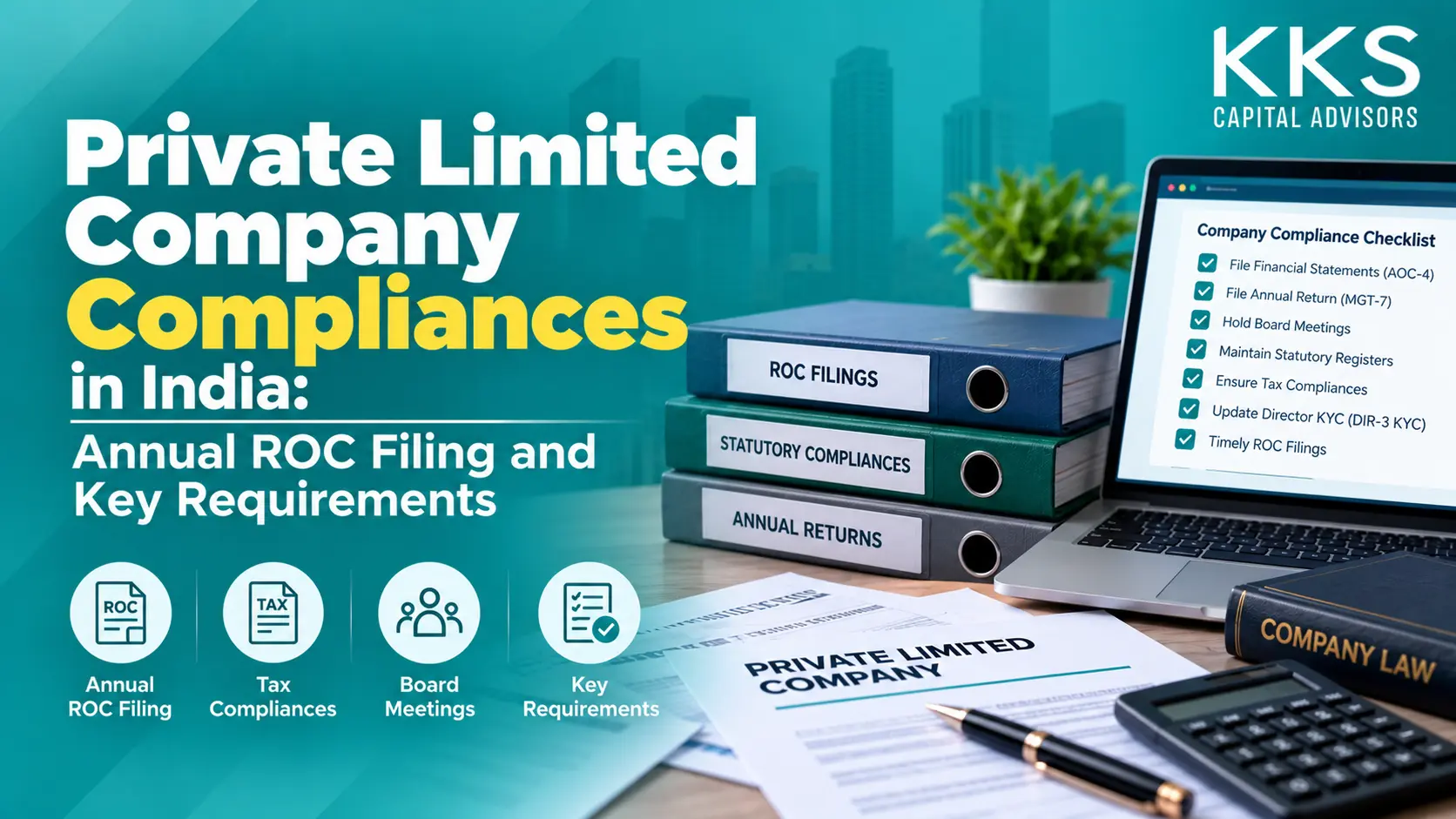
Private Limited Company Compliances in India: Annual ROC Filing and Key Requirements

Running a private limited company in India involves several legal, financial, and regulatory responsibilities. Under the Companies Act, 2013, companies must maintain statutory records, conduct board meetings, complete annual filings, and comply with applicable tax regulations. These requirements apply even when a company has limited business activity or reports no profit, subject to specific exemptions.

Private limited company compliances include holding the Annual General Meeting (AGM), completing a statutory audit, filing financial statements through Form AOC-4, submitting the annual return through Form MGT-7 or MGT-7A, and completing applicable director KYC and tax filings. The Registrar of Companies (ROC), under the Ministry of Corporate Affairs (MCA), oversees corporate filings and statutory records. 

Understanding these obligations helps business owners plan deadlines, maintain accurate records, and reduce the risk of additional filing fees and regulatory penalties.

What Are Private Limited Company Compliances?

Private limited company compliances are the legal and administrative requirements a company must meet after incorporation. They cover corporate governance, financial reporting, statutory audits, tax returns, director disclosures, and regulatory filings.

These obligations fall into three main categories.

  •       Annual compliances include the AGM, statutory audit, annual financial statements, and annual return.
  •       Periodic compliances include board meetings, director disclosures, applicable GST returns, and tax-related filings.
  •       Event-based compliances arise from specific transactions or changes, such as issuing shares, changing directors, creating charges, or receiving foreign investment.

The applicable requirements depend on the company’s size, business activities, transactions, and regulatory status. Companies should prepare a compliance calendar that reflects their specific obligations rather than relying on a generic deadline list.

What Are the Key Annual ROC Compliance Requirements?

ROC annual compliance requires companies to prepare and submit prescribed information to the Registrar of Companies. The main requirements include the following.

Annual General Meeting (AGM)

Most private limited companies must hold an AGM every year. The first AGM must generally take place within nine months from the close of the company’s first financial year. Subsequent AGMs must generally take place within six months from the close of the financial year, with no more than 15 months between two AGMs. Specific statutory exceptions apply to certain company categories. 

During the AGM, shareholders consider matters such as the adoption of financial statements, the auditor’s report, and other applicable resolutions.

Companies should prepare the meeting notice, financial statements, relevant reports, and minutes according to the applicable legal requirements.

Statutory Audit of Financial Statements

A statutory audit examines whether a company’s financial statements comply with applicable accounting and legal requirements. Private limited companies are generally required to obtain an annual statutory audit, regardless of turnover or profitability.

A qualified auditor examines the company’s books, supporting documents, financial transactions, and reported balances. The audit report forms part of the financial reporting process.

Companies should maintain accurate accounting records throughout the year. This includes invoices, bank statements, expense records, payroll information, loan documents, and details of related-party transactions.

The first auditor of a non-government company must generally be appointed by its board within 30 days of registration. Subsequent auditor appointments follow the applicable requirements of the Companies Act, 2013. 

Filing Financial Statements Through Form AOC-4

Form AOC-4 is used to file a company’s financial statements with the ROC. The filing generally includes the adopted financial statements and the prescribed supporting documents.

For an ordinary private limited company, the filing deadline is within 30 days of the AGM. A company must follow the applicable statutory procedure if its financial statements are not adopted at the meeting. One Person Companies follow a separate filing timeline. 

Before submitting AOC-4, the company should verify:

  •       Whether the financial statements have been properly approved and adopted.
  •       Whether the auditor’s report and other required attachments are complete.
  •       Whether the prescribed form contains accurate financial and corporate information.
  •       Whether the required digital signatures and certifications are in place.

Errors or missing attachments can delay filing and create additional work for the company.

Filing the Annual Return Through Form MGT-7 or MGT-7A

The annual return records important information about a company as of the end of its financial year. It generally includes details of its registered office, shareholding, directors, members, and meetings.

Companies generally file Form MGT-7 within 60 days of the AGM. Eligible One Person Companies and small companies use Form MGT-7A, subject to the applicable rules. 

The annual return should agree with the company’s statutory registers, shareholding records, director information, and other corporate documents.

Business owners should also check whether the annual return requires certification by a practising company secretary based on the company’s category and the applicable statutory provisions.

What Other Compliances Must Private Limited Companies Complete?

Annual ROC filing is only one part of corporate compliance. Companies must also meet other requirements throughout the financial year.

Board Meetings and Director Disclosures

Under Section 173 of the Companies Act, 2013, a company generally must hold its first board meeting within 30 days of incorporation. It must then hold at least four board meetings each year, with no more than 120 days between consecutive meetings. Certain company categories qualify for modified requirements. 

The board discusses financial performance, operational matters, statutory obligations, and other significant company decisions.

Companies should maintain board meeting notices, agendas, attendance records, minutes, and resolutions. Directors must also provide applicable disclosures of interests and declarations concerning disqualification.

Director KYC Through DIR-3 KYC

Directors holding a Director Identification Number (DIN) must comply with applicable KYC requirements under MCA rules.

The annual KYC deadline is generally 30 September of the relevant year for directors required to complete the filing. The applicable form or web service depends on whether the director is filing KYC for the first time or updating information.

Companies should verify their directors’ KYC status and submit details before the applicable deadline. 

Maintenance of Statutory Registers and Records

Companies must maintain prescribed statutory registers and records at the registered office or another permitted location. These records help document ownership, management decisions, and compliance with the Companies Act.

Depending on the company, records include:

  •       Register of members and shareholding information.
  •       Register of directors and key managerial personnel.
  •       Registers of contracts and arrangements, where applicable.
  •       Board and general meeting minutes.
  •       Share certificates, resolutions, and prescribed disclosures.

Keeping these records updated throughout the year makes annual filing and statutory reviews easier.

Income Tax Returns and Tax Audit

Corporate income tax compliance is separate from ROC filing. Companies must calculate their taxable income, meet applicable tax payment obligations, and file the prescribed income tax return.

A tax audit is required when the relevant statutory conditions apply. Its applicability and filing deadline depend on the company’s circumstances and the tax rules for the relevant period.

India’s Income-tax Act, 2025 took effect on 1 April 2026. Tax years beginning before that date remain subject to the relevant transitional provisions and the earlier law. Companies should therefore confirm which rules apply to each filing period instead of assuming that one set of tax deadlines applies to every financial year. (Source: Income Tax Department)

GST, TDS, and Other Applicable Filings

Companies registered under the Goods and Services Tax (GST) framework must complete the returns and tax payments applicable to their registration and filing scheme.

Businesses deducting tax at source (TDS) must comply with relevant deposit, return, and certificate requirements. Companies with employees may also have obligations under provident fund, employee insurance, and other applicable labour laws.

Additional corporate filings may arise from deposits, outstanding payments to micro and small enterprises, changes in directors, share allotments, charges, or foreign investment. These requirements depend on specific facts and statutory conditions.

Private Limited Company Compliance Calendar

The following table summarises common compliance timelines for planning purposes.

Compliance

General deadline

First board meeting

Within 30 days of incorporation

Subsequent board meetings

Generally at least four meetings per year

First AGM

Within nine months of the first financial year’s close

Subsequent AGMs

Within six months of the financial year’s close

AOC-4 financial statements

Within 30 days of the AGM

MGT-7 annual return

Within 60 days of the AGM

DIR-3 KYC

Generally by 30 September, where applicable

Income tax return

Depends on the applicable tax year, audit status, and tax rules

GST and TDS filings

According to the relevant filing category and period


These are general timelines, not a complete compliance calendar for every company. Special rules, company categories, filing requirements, and government extensions can change the applicable deadline. Check the latest MCA and Income Tax Department notifications before filing. 

What Happens If a Company Misses Its Compliance Deadlines?

Missing a statutory deadline can result in additional filing fees, penalties, and other regulatory consequences. The impact depends on the type of filing, duration of the default, and applicable legal provisions.

For example, failure to file financial statements or the annual return within the prescribed period can expose the company and responsible officers to statutory penalties. Repeated or prolonged defaults also create complications during due diligence, fundraising, ownership changes, and other corporate transactions. 

Companies should avoid treating annual filing as a last-minute task. Maintain a central calendar, assign responsibility for each filing, reconcile accounting records regularly, and review pending requirements before the due date.

How Can You Manage Private Limited Company Compliances Efficiently?

A structured compliance process helps businesses meet deadlines and maintain consistent records.

  1.     Identify the company’s applicable requirements. Review its incorporation documents, company category, director details, tax registrations, financial activities, and any special regulatory obligations.
  2.     Prepare a financial-year compliance calendar. Record AGM dates, board meetings, audit milestones, ROC filing deadlines, KYC requirements, and tax-related dates. Include the person responsible for each task.
  3.     Keep accounting records updated during the year. Share the required documents with the auditor and compliance professional early enough to resolve discrepancies before filing.
  4.     Review submissions after filing. Keep acknowledgement receipts, challans, signed statements, filed forms, and supporting documents in an organised repository.

Where the company has multiple directors, investors, business locations, or regulatory obligations, professional support helps coordinate these activities and identify missing requirements.

How Can KKS Capital Help With Company Compliance?

Managing private limited company compliances requires coordination across corporate law, accounting, auditing, and taxation. Businesses that lack an internal compliance team often need help understanding the obligations that apply to their circumstances.

KKS Capital provides legal and secretarial support, accounting and auditing services, tax advisory, and related business compliance services. Its team supports businesses with regulatory matters and company documentation. 

Working with a compliance professional helps you organise records, prepare required documents, track statutory deadlines, and address filing issues. The appropriate scope of support depends on your company’s structure and requirements.

Visit KKS Capital Advisor to enquire about private limited company compliance, ROC annual filing, documentation, and ongoing statutory obligations.

Conclusion

Private limited company compliances in India involve annual ROC filing, statutory audits, AGMs, director disclosures, tax returns, and other applicable regulatory obligations. Businesses should monitor these requirements throughout the financial year rather than waiting until the annual filing period.

Maintain accurate records, follow the applicable deadlines, and verify current filing rules before submitting statutory forms. For help with company compliance and ROC annual filing, contact KKS Capital to discuss your requirements.

FAQ'S

Are private limited company compliances mandatory if the company has no business activity?

Generally, yes. A company with no revenue or business activity must still meet applicable statutory requirements unless a specific exemption or recognised status changes its obligations. Dormant or inactive status should not be assumed to remove every filing requirement.

AOC-4 is used to submit prescribed financial statements to the ROC. MGT-7 is the annual return containing details such as shareholding, directors, and company meetings. These forms serve different purposes and have separate filing deadlines.

For an ordinary private limited company, AOC-4 is generally due within 30 days of the AGM, while MGT-7 is generally due within 60 days. Special provisions apply to certain company categories, and current MCA rules should be checked before filing.

The company must meet its applicable legal obligations whether or not it hires an external professional. A chartered accountant or company secretary helps with audit coordination, document preparation, filing requirements, deadline tracking, and regulatory interpretation.

Read More

GST Invoice Rules: Format, Requirements and Tax Invoice Guide 

Quick Answer

GST invoice rules decide when you must issue a bill, what it must show and how to share it. In short:

  1. Every registered business must issue a tax invoice for taxable sales. Exempt sales and composition dealers use a bill of supply instead.
  2. A valid invoice must carry the mandatory fields under Rule 46 of the CGST Rules, such as GSTIN, invoice number, date, HSN/SAC code, taxable value, tax rate and place of supply.
  3. Goods: issue the invoice before or at the time of removal or delivery. Services: within 30 days of supply (45 days for banks, insurers and NBFCs).
  4. Businesses with turnover above ₹5 crore in any year from 2017-18 must issue e-invoices for B2B sales and get an IRN.
  5. Wrong or missing invoices can attract a penalty of ₹10,000 or the tax involved, whichever is higher.

Read on for the full checklist, a sample GST invoice format and the mistakes that cost businesses their input tax credit.

Why GST Invoice Rules Matter for Your Business

A GST invoice is not just a bill. It is the proof your buyer needs to claim input tax credit (ITC). It is also the record the tax department checks first during a notice or audit.

One missing GSTIN, a wrong HSN code or a late e-invoice can block your customer’s ITC. That means delayed payments, angry clients and, sometimes, penalties.

The good news? Once you know the rules, getting invoices right is simple. This guide breaks down every GST invoice requirement in plain words, with tables and a ready sample.

Updated for 2026: this guide reflects the new GST rate structure (5%, 18% and 40%) that came into force on 22 September 2025, and the 30-day e-invoice reporting limit for businesses with turnover of ₹10 crore or more.

What Is a Tax Invoice Under GST?

A tax invoice under GST is a bill issued by a registered supplier when they sell taxable goods or services. It is governed by Section 31 of the CGST Act, 2017 and Rule 46 of the CGST Rules, 2017.

It does three key jobs:

  • Shows how much GST was charged on a sale.
  • Lets the buyer claim input tax credit.
  • Creates a clear record for GST returns like GSTR-1.

Who Must Issue a GST Invoice?

Business type

Document to issue

Regular registered taxpayer making taxable sales

Tax invoice

Registered person selling exempt or nil-rated items

Bill of supply

Composition scheme dealer

Bill of supply

Registered person buying from an unregistered supplier under reverse charge

Self-invoice + payment voucher

Exporter

Tax invoice with an export declaration

Mandatory Fields in a GST Invoice (Rule 46 Checklist)

These are the core GST invoice requirements. Miss one and your buyer may lose ITC.

#

Field

Simple tip

1

Supplier’s name, address and GSTIN

Print it exactly as on your GST certificate.

2

Invoice number

Unique per financial year, up to 16 characters. Letters, numbers, “-” and “/” are allowed.

3

Invoice date

Use one clear format, such as DD/MM/YYYY.

4

Recipient’s name, address and GSTIN

GSTIN is needed when the buyer is registered.

5

Delivery address

Only if it differs from the billing address.

6

Place of supply (with state name)

Needed for interstate sales. It decides IGST vs CGST + SGST.

7

HSN code (goods) or SAC (services)

4 digits if turnover is up to ₹5 crore; 6 digits above ₹5 crore.

8

Description of goods or services

Keep it clear and specific.

9

Quantity and unit

For goods only.

10

Total value

Before discounts.

11

Taxable value

After discounts.

12

GST rate

CGST, SGST/UTGST or IGST, shown separately.

13

GST amount

Shown separately for each tax.

14

Reverse charge

State “Yes” or “No”.

15

Signature or digital signature

E-invoices and software bills can use a DSC or electronic signature.

16

QR code with IRN

Only for e-invoices.

Selling to an unregistered buyer? If the sale value is ₹50,000 or more, the invoice must also show the buyer’s name, address and delivery address with the state name and state code.

Small sales below ₹200: you can skip a separate invoice when the buyer is unregistered and does not ask for one. Instead, issue one consolidated invoice for all such sales at the end of the day.

Sample GST Invoice Format (With Example)

Here is a simple GST invoice format for a B2B sale within Haryana at the 18% rate.

Item

HSN

Qty

Rate (₹)

Taxable value (₹)

CGST 9% (₹)

SGST 9% (₹)

Total (₹)

Office chairs

9401

20

5,000

1,00,000

9,000

9,000

1,18,000

Header details: Supplier ABC Furnishings, Gurugram (GSTIN 06XXXXX1234X1ZX) · Buyer XYZ Pvt Ltd, Gurugram (GSTIN 06XXXXX5678X1ZX) · Invoice No. ABC/26-27/0045 · Date 15/10/2026 · Place of supply: Haryana (06) · Reverse charge: No.

If the buyer were in Delhi, the same sale would carry IGST at 18% (₹18,000) instead of CGST + SGST. The total stays ₹1,18,000.

Note: the GSTINs above are dummy placeholders for illustration. Always check the correct rate for your HSN code, since many rates changed on 22 September 2025.

Time Limit to Issue a GST Invoice

Type of supply

When to issue the invoice

Goods (with movement)

Before or at the time of removal for delivery

Goods (no movement)

Before or at the time of delivery or making goods available

Continuous supply of goods

Before or at the time each statement is issued or payment is received

Services

Within 30 days of the date of supply (Rule 47)

Banks, insurers, NBFCs

Within 45 days of the date of supply

E-invoice (turnover ₹10 crore or more)

Report on the IRP within 30 days of the invoice date

How Many Copies of a GST Invoice Are Needed?

Rule 48 sets the number of copies:

  • Goods: 3 copies, marked Original for Recipient, Duplicate for Transporter and Triplicate for Supplier.
  • Services: 2 copies, marked Original for Recipient and Duplicate for Supplier.
  • E-invoices: these copy rules do not apply, because the invoice is registered online.

Types of GST Invoices Compared

Document

When to use it

Is GST charged?

Can the buyer claim ITC?

Tax invoice

Taxable sale by a registered business

Yes

Yes

Bill of supply

Exempt sale, or sale by a composition dealer

No

No

Revised tax invoice

Issued after new GST registration, for sales made between the effective date and the date of the certificate

Yes

Yes

Debit note

Price goes up, or extra tax is due after the invoice

Yes (extra)

Yes

Credit note

Price goes down, goods returned, or tax was charged too high

Reduces tax

Buyer must reverse ITC

Self-invoice

Buying from an unregistered supplier under reverse charge

Yes (paid by buyer)

Yes

Proforma invoice

Quote or estimate before the sale

No

No, it is not a tax invoice

Export invoice

Export with IGST, or under bond/LUT without IGST

Yes or No

Refund route instead

E-Invoicing Under GST: What You Must Know

E-invoicing means you upload B2B invoice details to the government’s Invoice Registration Portal (IRP). The IRP returns an Invoice Reference Number (IRN) and a QR code, which must be printed on the invoice.

Who must issue e-invoices? Businesses whose aggregate turnover crossed ₹5 crore in any financial year from 2017-18 onwards. This limit applies from 1 August 2023 (Notification 10/2023 – Central Tax).

The 30-day rule: since 1 April 2025, businesses with turnover of ₹10 crore or more cannot report an invoice, credit note or debit note on the IRP if it is older than 30 days (GSTN advisory). Miss it, and the invoice becomes invalid for ITC.

Why it matters: if you are covered by e-invoicing and issue a normal invoice, the law treats it as no invoice at all (Rule 48(5)). Your buyer cannot claim ITC on it.

Normal Invoice vs E-Invoice

Factor

Normal GST invoice

E-invoice

Who issues

All registered businesses

Turnover above ₹5 crore (B2B, exports)

IRN and QR code

Not needed

Mandatory

Upload to IRP

No

Yes

GSTR-1 auto-fill

No, enter manually

Yes, auto-filled

E-way bill

Created separately

Can be created with the IRN

Copies

2 or 3

Not required

7 Common GST Invoice Mistakes (and How to Fix Them)

  1. Wrong or missing buyer GSTIN. Always verify it on the GST portal before billing.
  2. Charging IGST instead of CGST + SGST (or the reverse). Check the place of supply first.
  3. Using old GST rates. Many rates changed on 22 September 2025, when 12% and 28% slabs were folded into 5%, 18% and 40%.
  4. Wrong HSN digits. Use 6 digits if your turnover is above ₹5 crore.
  5. Duplicate invoice numbers. Restart your series each financial year and never reuse a number.
  6. Late e-invoice reporting. If your turnover is ₹10 crore or more, upload within 30 days.
  7. Using a proforma invoice as a tax invoice. It does not count for ITC.

Penalty for Not Following GST Invoice Rules

Offence

Penalty

Not issuing an invoice, or issuing a wrong or incomplete one (Section 122)

₹10,000 or the tax involved, whichever is higher

Issuing a fake invoice without actual supply (Section 122)

₹10,000 or the tax involved, whichever is higher, plus possible prosecution

General breach with no specific penalty (Section 125)

Up to ₹25,000

Goods moved without a proper invoice or e-way bill (Section 129)

Goods and vehicle can be detained

Beyond penalties, the bigger cost is often lost trust. Buyers stop working with suppliers whose invoices block their ITC.

How KKS Capital Helps You Stay GST-Compliant

Getting GST invoice rules right every single time is hard when you are busy running a business. That is where KKS Capital Advisors can help.

Our team of Chartered Accountants in Gurugram helps businesses with:

  • Invoice and billing review: we check your invoice format against Rule 46 and fix gaps before they cause notices.
  • E-invoicing setup: IRN generation, IRP reporting and 30-day compliance.
  • GST registration: quick, error-free GST registration in Gurgaon.
  • GST return filing and ITC matching: so your customers never lose credit because of your invoices.
  • Notice replies and audits: expert support if the department questions your invoices.

Explore our full GST services or book a consultation with a GST expert today.

FAQ'S

What are the GST invoice rules in India?

GST invoice rules come from Section 31 of the CGST Act and Rules 46 to 55 of the CGST Rules. They say every registered business must issue a tax invoice for taxable sales, with mandatory details like GSTIN, invoice number, date, HSN/SAC, taxable value, tax rate and place of supply, within the set time limit.

A correct GST invoice format has three parts: a header (supplier and buyer details with GSTIN, invoice number, date and place of supply), an item table (description, HSN/SAC, quantity, taxable value, GST rate and amount), and a footer (total, reverse charge status and signature). E-invoices also carry an IRN and QR code.

Yes, for taxable sales by a registered person. The only relief is for sales below ₹200 to unregistered buyers who do not ask for a bill. These can be covered by one consolidated invoice at the end of the day.

For goods, issue it before or at the time of removal or delivery. For services, issue it within 30 days of supply. Banks, insurers and NBFCs get 45 days.

A tax invoice charges GST and lets the buyer claim input tax credit. A bill of supply is used for exempt goods or by composition dealers. It does not charge GST, so no ITC can be claimed.

It is mandatory if your aggregate turnover crossed ₹5 crore in any financial year from 2017-18 onwards. It applies to B2B sales, exports, and credit and debit notes. B2C invoices do not need an IRN.

No. You should not change an issued invoice. Use a credit note to reduce the value or tax, or a debit note to increase it. For e-invoices, an IRN can be cancelled only within 24 hours on the IRP.

Yes. It needs a physical signature or digital signature of the supplier or an authorised person. E-invoices and many software-generated invoices can use a digital signature instead.

Small errors can block your buyer’s input tax credit. Wrong or incomplete invoices can attract a penalty of ₹10,000 or the tax involved, whichever is higher. Fix errors quickly with a credit or debit note, and correct the details in your next GSTR-1.

Conclusion: Get Every Invoice Right, Every Time

Following GST invoice rules protects your cash flow, your customers’ ITC and your business reputation. Use the Rule 46 checklist, follow the time limits, apply the latest GST rates and stay on top of e-invoicing.

Not sure if your invoices are fully compliant? Let the GST experts at KKS Capital Advisors review them for you. Contact us, call +91 96540 73033 or email info@kkscapital.com.

Written by the team at KKS Capital Advisors, a firm of Chartered Accountants, Company Secretaries and legal experts in Gurugram. This article is for general information only. For advice on your specific case, consult a qualified professional.

Sources

Read More

GST Composition Scheme: Limit, Eligibility, Rates and How to Apply (2026 Guide)

Quick Answer

The GST composition scheme is a simple, optional tax plan for small businesses in India. Instead of filing many returns and charging GST on every bill, you pay a small flat tax on your turnover.

  • Turnover limit: up to ₹1.5 crore in the last financial year (₹75 lakh in special category states).
  • Service providers: up to ₹50 lakh under a separate option.
  • Tax rates: 1% for manufacturers and traders, 5% for restaurants (no alcohol), 6% for service providers.
  • Returns: pay tax every quarter (CMP-08) and file one annual return (GSTR-4).
  • Main catch: no input tax credit and no inter-state sales of goods.

What Is the GST Composition Scheme?

The composition scheme GST option comes from Section 10 of the CGST Act, 2017. It was made for small shopkeepers, manufacturers and restaurant owners who find regular GST compliance costly and confusing.

Under the regular GST system, a business files monthly returns, charges GST on every invoice and tracks input tax credit. Under the composition scheme, you simply pay a fixed percentage of your turnover. Less paperwork, lower tax rates and fewer filings.

Think of it like this: regular GST is like keeping a detailed diary of every rupee. The composition scheme is like paying a simple monthly fee and getting on with business.

GST Composition Scheme Limit (2026)

The GST composition scheme limit depends on your type of business and your state. The limit is checked on your aggregate turnover of the previous financial year, counted for all businesses under the same PAN across India.

Type of business

Turnover limit (previous FY)

Special category states

Manufacturers of goods

₹1.5 crore

₹75 lakh

Traders of goods

₹1.5 crore

₹75 lakh

Restaurants (not serving alcohol)

₹1.5 crore

₹75 lakh

Service providers and mixed suppliers (Section 10(2A))

₹50 lakh

₹50 lakh


Good to know:

  • The limit was raised from ₹1 crore to ₹1.5 crore based on the GST Council’s 32nd meeting decisions (ICSI summary).
  • A goods composition dealer can also supply services worth up to 10% of turnover or ₹5 lakh, whichever is higher.
  • If your turnover crosses the limit during the year, you must leave the scheme from that day.
  • Some websites claim the limit has gone up to ₹2.5 crore. As of October 2026, we have not seen an official CBIC notification confirming this. Always check the GST portal or ask your CA before deciding.

GST Composition Scheme Eligibility

Here is a simple checklist for GST composition scheme eligibility. You can opt in if:

  • Your previous year’s turnover is within the limit above.
  • You are a manufacturer, trader, restaurant owner or small service provider.
  • You sell goods only within your own state (intra-state supply).
  • All your businesses registered under the same PAN also opt for the scheme.
  • You do not sell goods through e-commerce platforms that collect TCS.

Who Cannot Opt for the Composition Scheme?

You are not eligible if you:

  • Make inter-state sales of goods.
  • Sell goods through e-commerce operators like Amazon or Flipkart that must collect TCS.
  • Manufacture notified goods like ice cream, pan masala or tobacco products.
  • Supply goods that are not taxable under GST (like alcohol for human use).
  • Are a casual taxable person or a non-resident taxable person.
  • Provide services above the allowed limit, unless you qualify under Section 10(2A).

GST Composition Scheme Tax Rates

The rates are flat and easy to calculate. They are split equally between CGST and SGST.

Category

CGST

SGST/UTGST

Total rate

Tax is charged on

Manufacturers

0.5%

0.5%

1%

Total turnover in the state

Traders

0.5%

0.5%

1%

Turnover of taxable goods only

Restaurants (no alcohol)

2.5%

2.5%

5%

Total turnover in the state

Service providers (Section 10(2A))

3%

3%

6%

Total turnover in the state


What about GST 2.0? The big GST rate reform that took effect on 22 September 2025 moved most goods to 5% and 18% slabs. However, composition dealers pay a flat percentage of turnover, so their composition rates stayed the same.

Example: Ramesh runs a hardware shop in Gurgaon with a turnover of ₹80 lakh. Under the composition scheme, he pays 1% of ₹80 lakh, which is ₹80,000 a year, in four quarterly payments. He files one CMP-08 each quarter and one GSTR-4 a year, instead of monthly GSTR-1 and GSTR-3B returns.

Composition Scheme vs Regular GST: Quick Comparison

Point

Composition scheme

Regular GST

Tax rate

Flat 1%, 5% or 6% of turnover

5%, 18% or 40% on each item

Input tax credit

Not available

Available

Invoice type

Bill of Supply (no GST shown)

Tax invoice (GST shown)

Returns

CMP-08 quarterly + GSTR-4 yearly

GSTR-1 and GSTR-3B monthly or quarterly + annual return

Inter-state sales of goods

Not allowed

Allowed

E-commerce selling

Not allowed (TCS platforms)

Allowed

Who pays the tax

Business pays from its own pocket

Collected from the customer

Best for

Small local B2C businesses

B2B businesses and growing brands


Benefits of the GST Composition Scheme

  • Lower tax rates: pay as little as 1% of turnover.
  • Less paperwork: no need for detailed purchase and sales records for ITC.
  • Fewer returns: quarterly payment and one annual return.
  • Better cash flow: a small, predictable tax amount is easy to plan.
  • Lower compliance cost: less accounting work and lower CA fees.

Disadvantages You Should Know

  • No input tax credit: you cannot claim GST paid on your purchases.
  • Cannot charge GST to customers: the tax comes out of your own margin.
  • Not ideal for B2B: your business customers cannot claim ITC on your bills, so they may prefer regular dealers.
  • No inter-state sales of goods: this limits growth beyond your state.
  • No online marketplace selling: you cannot sell through TCS-collecting e-commerce platforms.
  • Must show your status: you must write “Composition taxable person” on every bill and on a board at your shop.

Is the Composition Scheme Right for You?

Use this simple rule of thumb:

  • Choose composition if you mostly sell to final consumers (B2C), sell only in your state, have low purchase GST and want simple compliance. Examples: local kirana shops, small hardware stores, sweet shops and small restaurants.
  • Choose regular GST if you sell to other businesses (B2B), plan to sell online or in other states, or pay a lot of GST on your purchases.

Not sure which one saves you more? A quick tax comparison by a CA can show you the real numbers for your business. Talk to a KKS Capital expert.

How to Apply for the GST Composition Scheme

For New Businesses

  1. Apply for GST registration on the GST portal using Form GST REG-01.
  2. Select the option to opt for the composition scheme in the form.
  3. Your composition status starts from your registration date once approved.

For Existing Regular Taxpayers

  1. Log in to the GST portal.
  2. File Form GST CMP-02 before the start of the financial year (by 31 March).
  3. File Form GST ITC-03 within 60 days to report and reverse ITC on stock in hand.
  4. Start the scheme from 1 April of the new financial year.

KKS Capital can handle your GST registration and composition filing from start to finish.

Returns and Due Dates for Composition Dealers

Form

Purpose

Frequency

Due date

CMP-08

Pay tax for the quarter

Quarterly

18th of the month after the quarter ends

GSTR-4

Annual return

Yearly

30 April of the next financial year

CMP-02

Opt into the scheme

Once

Before the start of the financial year

CMP-04

Opt out of the scheme

When needed

Within 7 days of becoming ineligible, or anytime voluntarily


Late filing attracts late fees and interest, so mark these dates in your calendar.

Rules Composition Dealers Must Follow

  • Issue a Bill of Supply, not a tax invoice. Do not charge GST on it.
  • Write “Composition taxable person, not eligible to collect tax on supplies” on every bill.
  • Display the words “Composition taxable person” on a board at your shop or office.
  • Pay GST under reverse charge where the law requires it.
  • Leave the scheme by filing CMP-04 if your turnover crosses the limit.

Common Mistakes to Avoid

  1. Ignoring the PAN rule: turnover of all businesses under one PAN is counted together.
  2. Selling on Amazon or Flipkart: this can cancel your composition status.
  3. Charging GST on bills: composition dealers cannot collect GST from customers.
  4. Missing CMP-08: late quarterly payments add interest and late fees.
  5. Crossing the limit and not opting out: this can lead to tax demands and penalties.

How KKS Capital Helps You With the GST Composition Scheme

At KKS Capital Advisors, our chartered accountants in Gurgaon help small businesses choose the right GST option and stay fully compliant.

Our GST composition services include:

  • Eligibility check and composition vs regular GST cost comparison.
  • New GST registration with composition option.
  • Filing CMP-02, ITC-03 and CMP-04.
  • Quarterly CMP-08 and annual GSTR-4 filing.
  • Bookkeeping and accounting support.
  • Help with GST notices and tax advisory.

Why businesses trust us: rated 4.9 by 68+ clients on Google, queries answered within 24 hours, and transparent pricing.

Get started today. Call +91 96540 73033, email info@kkscapital.com, or book a free consultation. Visit us at 2nd Floor, SCO 12, Sector 23A, Gurgaon.

FAQ'S

What is the GST composition scheme in India?

The GST composition scheme in India is an optional, simple tax plan for small businesses under Section 10 of the CGST Act. Eligible businesses pay a flat tax of 1%, 5% or 6% on turnover and file fewer returns.

The limit is ₹1.5 crore of turnover in the previous financial year for manufacturers, traders and restaurants. It is ₹75 lakh in special category states and ₹50 lakh for service providers.

Small manufacturers, traders, restaurants not serving alcohol and small service providers within the turnover limit are eligible. They must sell goods only within their state and not through TCS-collecting e-commerce platforms.

Yes. Service providers with turnover up to ₹50 lakh can opt in under Section 10(2A) and pay 6% GST (3% CGST + 3% SGST).

No. Composition dealers cannot claim input tax credit on purchases, and their customers cannot claim ITC on their bills either.

No. A goods composition dealer cannot sell through e-commerce operators that collect TCS. Doing so makes you ineligible for the scheme.

A composition dealer pays tax every quarter through Form CMP-08 and files one annual return in Form GSTR-4.

File Form GST CMP-04 on the GST portal. You must do this within 7 days if you become ineligible, or you can opt out voluntarily anytime.

No. A composition dealer issues a Bill of Supply and cannot show or collect GST on it.

No. The GST 2.0 reform from 22 September 2025 changed item-wise GST slabs, but composition rates of 1%, 5% and 6% stayed the same.

Conclusion

The GST composition scheme is a smart choice for small, local businesses that want lower taxes and simple compliance. But it is not right for everyone. If you sell to businesses, sell online or plan to grow across states, regular GST may save you more.

The best move? Compare both options with real numbers before you decide. KKS Capital’s GST experts can do this for you in one quick consultation. Contact us today.

Disclaimer: This article is for general information only. GST rules can change, so please check the latest notifications or consult a chartered accountant before making decisions.

Sources

Read More