Quick Answer
GST invoice rules decide when you must issue a bill, what it must show and how to share it. In short:
Table of Contents
Toggle- Every registered business must issue a tax invoice for taxable sales. Exempt sales and composition dealers use a bill of supply instead.
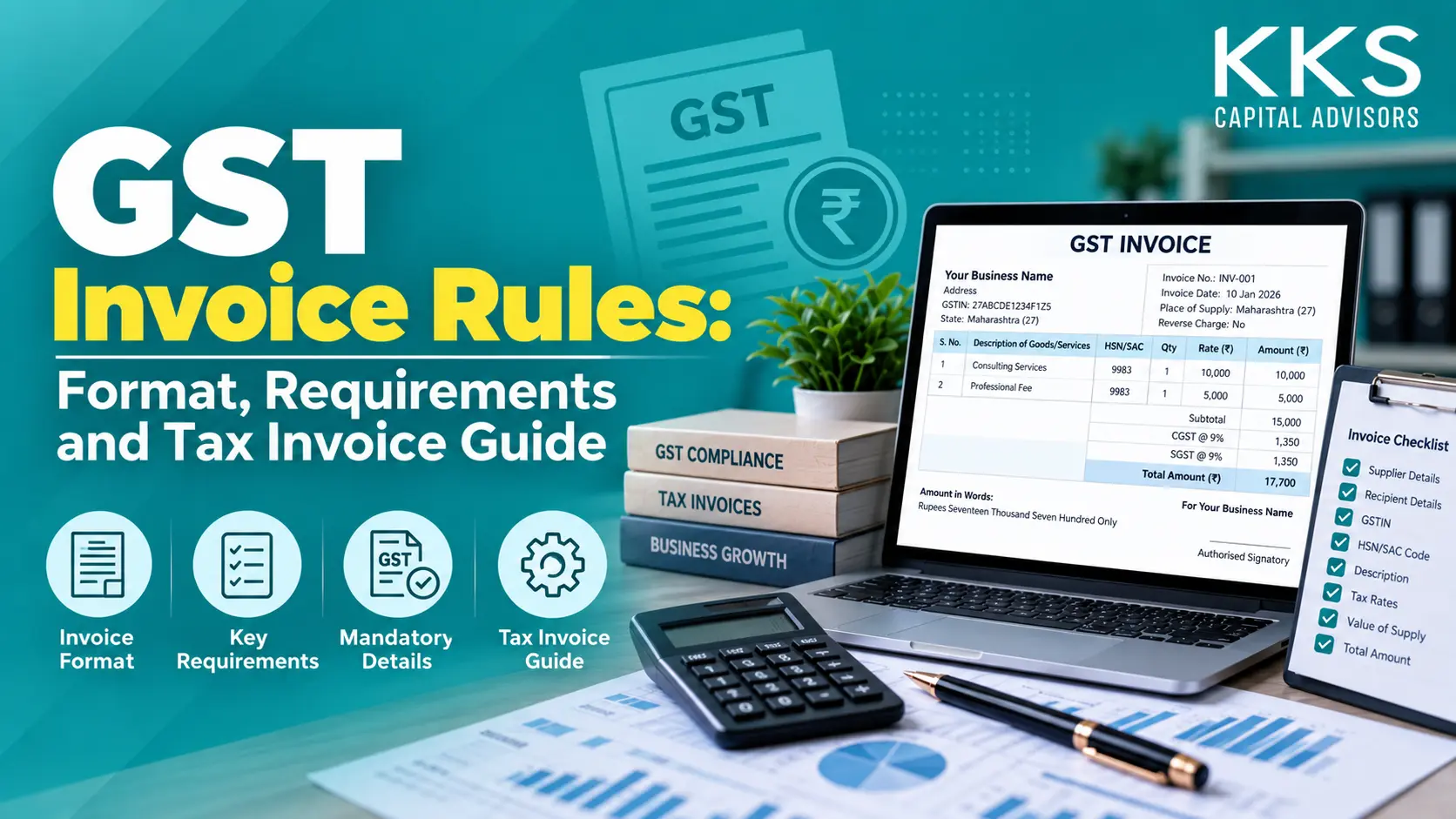
- A valid invoice must carry the mandatory fields under Rule 46 of the CGST Rules, such as GSTIN, invoice number, date, HSN/SAC code, taxable value, tax rate and place of supply.
- Goods: issue the invoice before or at the time of removal or delivery. Services: within 30 days of supply (45 days for banks, insurers and NBFCs).
- Businesses with turnover above ₹5 crore in any year from 2017-18 must issue e-invoices for B2B sales and get an IRN.
- Wrong or missing invoices can attract a penalty of ₹10,000 or the tax involved, whichever is higher.
Read on for the full checklist, a sample GST invoice format and the mistakes that cost businesses their input tax credit.
Why GST Invoice Rules Matter for Your Business
A GST invoice is not just a bill. It is the proof your buyer needs to claim input tax credit (ITC). It is also the record the tax department checks first during a notice or audit.
One missing GSTIN, a wrong HSN code or a late e-invoice can block your customer’s ITC. That means delayed payments, angry clients and, sometimes, penalties.
The good news? Once you know the rules, getting invoices right is simple. This guide breaks down every GST invoice requirement in plain words, with tables and a ready sample.
Updated for 2026: this guide reflects the new GST rate structure (5%, 18% and 40%) that came into force on 22 September 2025, and the 30-day e-invoice reporting limit for businesses with turnover of ₹10 crore or more.
What Is a Tax Invoice Under GST?
A tax invoice under GST is a bill issued by a registered supplier when they sell taxable goods or services. It is governed by Section 31 of the CGST Act, 2017 and Rule 46 of the CGST Rules, 2017.
It does three key jobs:
- Shows how much GST was charged on a sale.
- Lets the buyer claim input tax credit.
- Creates a clear record for GST returns like GSTR-1.
Who Must Issue a GST Invoice?
Business type | Document to issue |
|---|---|
Regular registered taxpayer making taxable sales | Tax invoice |
Registered person selling exempt or nil-rated items | Bill of supply |
Composition scheme dealer | Bill of supply |
Registered person buying from an unregistered supplier under reverse charge | Self-invoice + payment voucher |
Exporter | Tax invoice with an export declaration |
Mandatory Fields in a GST Invoice (Rule 46 Checklist)
These are the core GST invoice requirements. Miss one and your buyer may lose ITC.
# | Field | Simple tip |
|---|---|---|
1 | Supplier’s name, address and GSTIN | Print it exactly as on your GST certificate. |
2 | Invoice number | Unique per financial year, up to 16 characters. Letters, numbers, “-” and “/” are allowed. |
3 | Invoice date | Use one clear format, such as DD/MM/YYYY. |
4 | Recipient’s name, address and GSTIN | GSTIN is needed when the buyer is registered. |
5 | Delivery address | Only if it differs from the billing address. |
6 | Place of supply (with state name) | Needed for interstate sales. It decides IGST vs CGST + SGST. |
7 | HSN code (goods) or SAC (services) | 4 digits if turnover is up to ₹5 crore; 6 digits above ₹5 crore. |
8 | Description of goods or services | Keep it clear and specific. |
9 | Quantity and unit | For goods only. |
10 | Total value | Before discounts. |
11 | Taxable value | After discounts. |
12 | GST rate | CGST, SGST/UTGST or IGST, shown separately. |
13 | GST amount | Shown separately for each tax. |
14 | Reverse charge | State “Yes” or “No”. |
15 | Signature or digital signature | E-invoices and software bills can use a DSC or electronic signature. |
16 | QR code with IRN | Only for e-invoices. |
Selling to an unregistered buyer? If the sale value is ₹50,000 or more, the invoice must also show the buyer’s name, address and delivery address with the state name and state code.
Small sales below ₹200: you can skip a separate invoice when the buyer is unregistered and does not ask for one. Instead, issue one consolidated invoice for all such sales at the end of the day.
Sample GST Invoice Format (With Example)
Here is a simple GST invoice format for a B2B sale within Haryana at the 18% rate.
Item | HSN | Qty | Rate (₹) | Taxable value (₹) | CGST 9% (₹) | SGST 9% (₹) | Total (₹) |
|---|---|---|---|---|---|---|---|
Office chairs | 9401 | 20 | 5,000 | 1,00,000 | 9,000 | 9,000 | 1,18,000 |
Header details: Supplier ABC Furnishings, Gurugram (GSTIN 06XXXXX1234X1ZX) · Buyer XYZ Pvt Ltd, Gurugram (GSTIN 06XXXXX5678X1ZX) · Invoice No. ABC/26-27/0045 · Date 15/10/2026 · Place of supply: Haryana (06) · Reverse charge: No.
If the buyer were in Delhi, the same sale would carry IGST at 18% (₹18,000) instead of CGST + SGST. The total stays ₹1,18,000.
Note: the GSTINs above are dummy placeholders for illustration. Always check the correct rate for your HSN code, since many rates changed on 22 September 2025.
Time Limit to Issue a GST Invoice
Type of supply | When to issue the invoice |
|---|---|
Goods (with movement) | Before or at the time of removal for delivery |
Goods (no movement) | Before or at the time of delivery or making goods available |
Continuous supply of goods | Before or at the time each statement is issued or payment is received |
Services | Within 30 days of the date of supply (Rule 47) |
Banks, insurers, NBFCs | Within 45 days of the date of supply |
E-invoice (turnover ₹10 crore or more) | Report on the IRP within 30 days of the invoice date |
How Many Copies of a GST Invoice Are Needed?
Rule 48 sets the number of copies:
- Goods: 3 copies, marked Original for Recipient, Duplicate for Transporter and Triplicate for Supplier.
- Services: 2 copies, marked Original for Recipient and Duplicate for Supplier.
- E-invoices: these copy rules do not apply, because the invoice is registered online.
Types of GST Invoices Compared
Document | When to use it | Is GST charged? | Can the buyer claim ITC? |
|---|---|---|---|
Tax invoice | Taxable sale by a registered business | Yes | Yes |
Bill of supply | Exempt sale, or sale by a composition dealer | No | No |
Revised tax invoice | Issued after new GST registration, for sales made between the effective date and the date of the certificate | Yes | Yes |
Debit note | Price goes up, or extra tax is due after the invoice | Yes (extra) | Yes |
Credit note | Price goes down, goods returned, or tax was charged too high | Reduces tax | Buyer must reverse ITC |
Self-invoice | Buying from an unregistered supplier under reverse charge | Yes (paid by buyer) | Yes |
Proforma invoice | Quote or estimate before the sale | No | No, it is not a tax invoice |
Export invoice | Export with IGST, or under bond/LUT without IGST | Yes or No | Refund route instead |
E-Invoicing Under GST: What You Must Know
E-invoicing means you upload B2B invoice details to the government’s Invoice Registration Portal (IRP). The IRP returns an Invoice Reference Number (IRN) and a QR code, which must be printed on the invoice.
Who must issue e-invoices? Businesses whose aggregate turnover crossed ₹5 crore in any financial year from 2017-18 onwards. This limit applies from 1 August 2023 (Notification 10/2023 – Central Tax).
The 30-day rule: since 1 April 2025, businesses with turnover of ₹10 crore or more cannot report an invoice, credit note or debit note on the IRP if it is older than 30 days (GSTN advisory). Miss it, and the invoice becomes invalid for ITC.
Why it matters: if you are covered by e-invoicing and issue a normal invoice, the law treats it as no invoice at all (Rule 48(5)). Your buyer cannot claim ITC on it.
Normal Invoice vs E-Invoice
Factor | Normal GST invoice | E-invoice |
|---|---|---|
Who issues | All registered businesses | Turnover above ₹5 crore (B2B, exports) |
IRN and QR code | Not needed | Mandatory |
Upload to IRP | No | Yes |
GSTR-1 auto-fill | No, enter manually | Yes, auto-filled |
E-way bill | Created separately | Can be created with the IRN |
Copies | 2 or 3 | Not required |
7 Common GST Invoice Mistakes (and How to Fix Them)
- Wrong or missing buyer GSTIN. Always verify it on the GST portal before billing.
- Charging IGST instead of CGST + SGST (or the reverse). Check the place of supply first.
- Using old GST rates. Many rates changed on 22 September 2025, when 12% and 28% slabs were folded into 5%, 18% and 40%.
- Wrong HSN digits. Use 6 digits if your turnover is above ₹5 crore.
- Duplicate invoice numbers. Restart your series each financial year and never reuse a number.
- Late e-invoice reporting. If your turnover is ₹10 crore or more, upload within 30 days.
- Using a proforma invoice as a tax invoice. It does not count for ITC.
Penalty for Not Following GST Invoice Rules
Offence | Penalty |
|---|---|
Not issuing an invoice, or issuing a wrong or incomplete one (Section 122) | ₹10,000 or the tax involved, whichever is higher |
Issuing a fake invoice without actual supply (Section 122) | ₹10,000 or the tax involved, whichever is higher, plus possible prosecution |
General breach with no specific penalty (Section 125) | Up to ₹25,000 |
Goods moved without a proper invoice or e-way bill (Section 129) | Goods and vehicle can be detained |
Beyond penalties, the bigger cost is often lost trust. Buyers stop working with suppliers whose invoices block their ITC.
How KKS Capital Helps You Stay GST-Compliant
Getting GST invoice rules right every single time is hard when you are busy running a business. That is where KKS Capital Advisors can help.
Our team of Chartered Accountants in Gurugram helps businesses with:
- Invoice and billing review: we check your invoice format against Rule 46 and fix gaps before they cause notices.
- E-invoicing setup: IRN generation, IRP reporting and 30-day compliance.
- GST registration: quick, error-free GST registration in Gurgaon.
- GST return filing and ITC matching: so your customers never lose credit because of your invoices.
- Notice replies and audits: expert support if the department questions your invoices.
Explore our full GST services or book a consultation with a GST expert today.
FAQ'S
What are the GST invoice rules in India?
GST invoice rules come from Section 31 of the CGST Act and Rules 46 to 55 of the CGST Rules. They say every registered business must issue a tax invoice for taxable sales, with mandatory details like GSTIN, invoice number, date, HSN/SAC, taxable value, tax rate and place of supply, within the set time limit.
What is the correct GST invoice format?
A correct GST invoice format has three parts: a header (supplier and buyer details with GSTIN, invoice number, date and place of supply), an item table (description, HSN/SAC, quantity, taxable value, GST rate and amount), and a footer (total, reverse charge status and signature). E-invoices also carry an IRN and QR code.
Is a GST invoice mandatory for every sale?
Yes, for taxable sales by a registered person. The only relief is for sales below ₹200 to unregistered buyers who do not ask for a bill. These can be covered by one consolidated invoice at the end of the day.
What is the time limit to issue a tax invoice under GST?
For goods, issue it before or at the time of removal or delivery. For services, issue it within 30 days of supply. Banks, insurers and NBFCs get 45 days.
What is the difference between a tax invoice and a bill of supply?
A tax invoice charges GST and lets the buyer claim input tax credit. A bill of supply is used for exempt goods or by composition dealers. It does not charge GST, so no ITC can be claimed.
Is e-invoicing mandatory for my business?
It is mandatory if your aggregate turnover crossed ₹5 crore in any financial year from 2017-18 onwards. It applies to B2B sales, exports, and credit and debit notes. B2C invoices do not need an IRN.
Can I edit a GST invoice after issuing it?
No. You should not change an issued invoice. Use a credit note to reduce the value or tax, or a debit note to increase it. For e-invoices, an IRN can be cancelled only within 24 hours on the IRP.
Is a signature required on a GST invoice?
Yes. It needs a physical signature or digital signature of the supplier or an authorised person. E-invoices and many software-generated invoices can use a digital signature instead.
What happens if my GST invoice has a mistake?
Small errors can block your buyer’s input tax credit. Wrong or incomplete invoices can attract a penalty of ₹10,000 or the tax involved, whichever is higher. Fix errors quickly with a credit or debit note, and correct the details in your next GSTR-1.
Conclusion: Get Every Invoice Right, Every Time
Following GST invoice rules protects your cash flow, your customers’ ITC and your business reputation. Use the Rule 46 checklist, follow the time limits, apply the latest GST rates and stay on top of e-invoicing.
Not sure if your invoices are fully compliant? Let the GST experts at KKS Capital Advisors review them for you. Contact us, call +91 96540 73033 or email info@kkscapital.com.
Written by the team at KKS Capital Advisors, a firm of Chartered Accountants, Company Secretaries and legal experts in Gurugram. This article is for general information only. For advice on your specific case, consult a qualified professional.
Sources
- Tally Solutions: GST Invoice Format, Mandatory Fields and Rules
- GSTZen: Rule 47 – Time Limit for Issuing Tax Invoice
- GST Gyaan: Rule 48 – Manner of Issuing Invoice
- EY: E-invoicing threshold lowered to ₹5 crore
- Taxmann: 30-day e-invoice reporting limit for AATO ₹10 crore and above
- Tally Solutions: New GST Rates from 22 September 2025