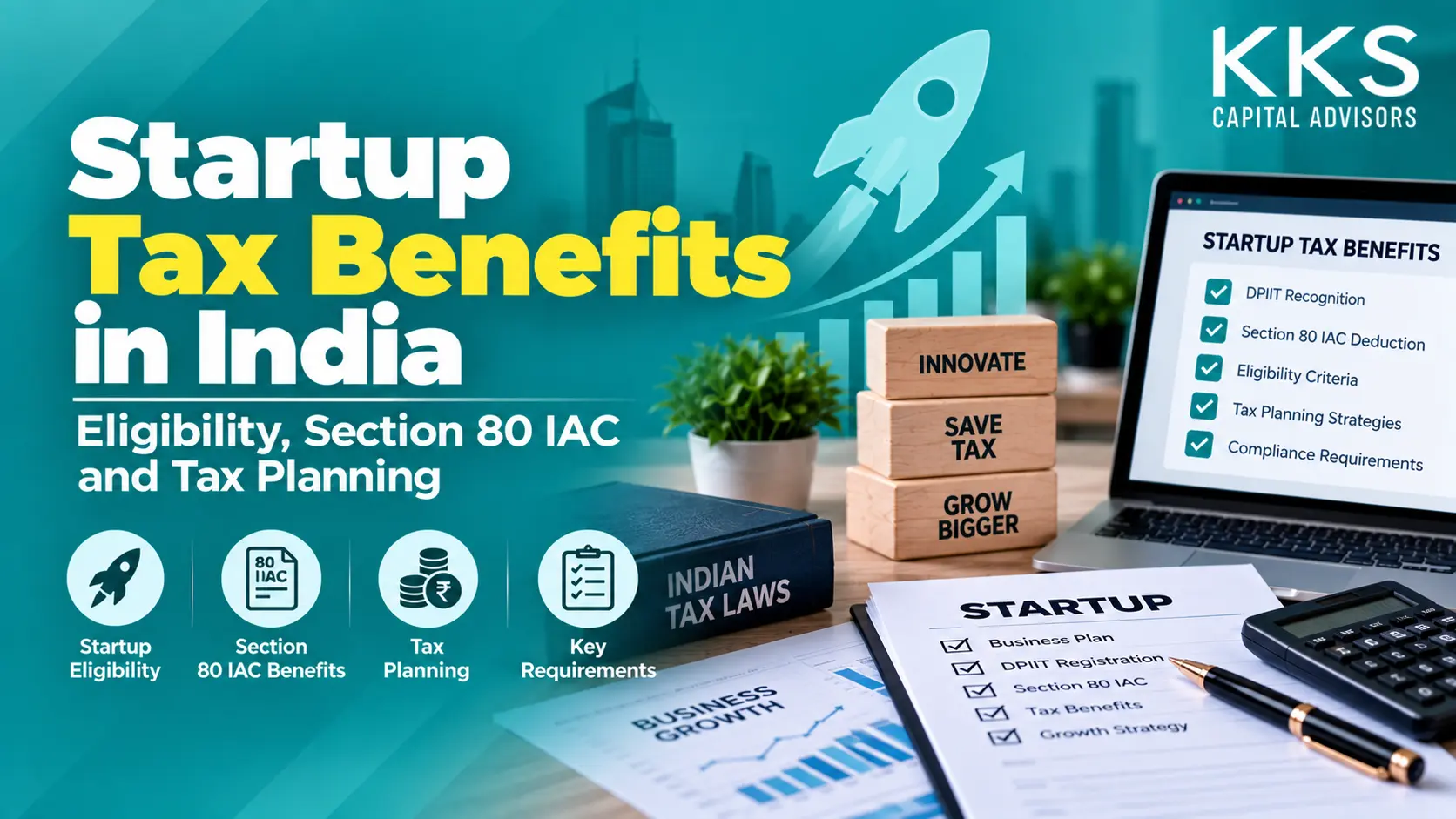
Quick Answer: Startup tax benefits in India may include a deduction for qualifying business profits, conditional protection for carried-forward losses, and ESOP tax-payment deferral. Eligibility depends on the benefit, entity, incorporation date, approvals and applicable law. DPIIT recognition alone does not automatically provide every tax concession.
Table of Contents
ToggleBuilding a startup means balancing product development, hiring, funding and cash flow. Tax questions often arrive alongside these decisions: Does recognition make the business tax-free? Should the company claim a profit deduction immediately? Could an investment round affect earlier losses?
Understanding startup tax benefits in India starts with separating recognition from individual tax conditions. A business may qualify for one concession without qualifying for another.
KKS Capital provides tax, regulatory and financial advisory services. This guide explains the main eligibility checks, the relief commonly searched as Section 80-IAC, and practical planning considerations. It also distinguishes current tax-year rules from older provisions, helping founders prepare better questions before making a claim or choosing a tax regime.
What are startup tax benefits in India
Startup benefits under the Income Tax Act generally work in three ways:
- Deduction: An eligible amount reduces the income on which tax is calculated.
- Exemption: Specified income is excluded from taxation, subject to conditions.
- Deferral: Tax payment moves to a later date; the liability remains.
These terms should not be used interchangeably.
Incorporation establishes your legal entity. MSME registration serves a separate enterprise-classification framework. DPIIT recognition identifies qualifying startups under its notified criteria. None independently establishes entitlement to every startup tax exemption.
The applicable period also matters. The Income-tax Act, 2025 applies from Tax Year 2026–27. Income for FY 2025–26, assessed in AY 2026–27, remains governed by the earlier framework and transition rules.
Who qualifies for startup tax benefits
Start by checking recognition eligibility and tax-deduction eligibility separately.
DPIIT recognition
Under the February 2026 DPIIT notification, ordinary recognition covers specified Indian companies, registered partnerships, LLPs and cooperative entities within ten years of incorporation or registration.
Turnover must not have exceeded ₹200 crore in any financial year since formation. The business must involve innovation, improvement or a scalable model with employment or wealth-creation potential, and must not result from splitting or reconstructing an existing business.
Recognised Deep Tech Startups have a separate framework allowing twenty years and a ₹300 crore turnover ceiling. These recognition limits do not automatically determine tax-deduction eligibility.
Profit deduction eligibility checklist
For the relief traditionally called Section 80-IAC, review:
- Entity: A qualifying company or LLP.
- Incorporation: On or after 1 April 2016 and before 1 April 2030.
- Activity: An eligible innovative or scalable business.
- Approval: The required Inter-Ministerial Board certificate.
- Turnover: The limit applicable to the particular claim period.
- Formation: Restrictions concerning reconstruction and previously used machinery.
For Tax Year 2026–27, Section 140’s turnover ceiling is ₹300 crore for the relevant claim year, following the Finance Act, 2026 amendment. The older ₹100 crore figure still appears in some official application guidance. Recognition and tax eligibility must therefore be tested independently.
What tax benefits can eligible startups claim
Benefit | Who may qualify | Main condition | Practical limitation |
Eligible-business profit deduction | Qualifying companies and LLPs | Approval, eligible business and statutory conditions | Covers qualifying profits, not turnover |
Relaxed loss-continuity treatment | Eligible closely held startup companies | Required original shareholders retain their shares | Does not remove other loss rules |
ESOP tax-payment deferral | Employees of qualifying startup employers | Employer and employee conditions are satisfied | Delays payment rather than eliminating tax |
These benefits address different situations. A profitable company, a business raising investment and an employee receiving shares will need different eligibility reviews.
What changed with angel tax
The provision formerly known as angel tax under Section 56(2)(viib) ceased to apply from AY 2025–26. An old angel-tax exemption application should therefore not be presented as a routine requirement for current fundraising.
Earlier transactions and proceedings may still require review. Fundraising also continues to involve source-of-funds evidence, valuation, company-law requirements and FEMA compliance where applicable.
How does Section 80 IAC work under current law
Section 80-IAC belongs to the Income-tax Act, 1961. Its corresponding provision under the Income-tax Act, 2025 is Section 140.
The deduction covers 100% of eligible-business profits for three consecutive years, selected within the first ten years beginning with incorporation. These are assessment years under the legacy framework and tax years under the current framework.
The deduction does not automatically cover every receipt, unrelated income or the company’s entire tax bill.
Formation restrictions also apply. Previously used machinery requires careful checking: statutory exceptions include qualifying imported equipment and a permitted transfer limit of 20% of total machinery value.
Illustrative example
Assume an approved startup has ₹40 lakh of qualifying taxable business profit, meets every condition and selects the year within its permitted claim period.
Its deduction could be ₹40 lakh. That is the deduction amount, not ₹40 lakh of tax saved. Other income, applicable minimum-tax rules and the selected regime must still be considered.
What annual filing is required
Approval and annual deduction compliance are separate.
For current-law claims, the Income Tax Department identifies Form 32 under Rule 66 as the prescribed audit report, replacing the relevant legacy Form 10CCB reporting. The official Form 32 guidance requires filing before the applicable audit-report deadline. The income-tax return must also satisfy the relevant claim and timely-filing requirements.
How can a startup assess eligibility and prepare a claim
Use a structured review before submitting an application or return.
- Identify the period. Establish which Act, claim year and transitional rules apply.
- Check recognition and tax conditions separately. Record the entity, incorporation date, turnover and business activity.
- Review approval status. Confirm the required certificate and whether clarification is needed.
- Build the evidence file. Support innovation, scalability, formation history and financial figures.
- Complete applicable filings. Coordinate the application, audit report and return.
- Maintain annual records. Revisit turnover, profits, ownership and regime choices each year.
Which documents should founders prepare
Keep three distinct document sets:
Purpose | Documents or evidence |
Statutory eligibility | Incorporation records, recognition details, eligible-business certificate, turnover calculations and formation evidence |
Portal application | Shareholding details, relevant board resolutions, financial statements and returns, pitch deck, business video, website and applicable supporting declarations |
Annual deduction claim | Audited eligible-business accounts, prescribed audit report, profit computation, return and supporting reconciliations |
The Startup India application page also requests supporting information about employment, funding, intellectual property and other evaluation parameters, where applicable. Application evidence should not be confused with annual tax-return compliance.
What should founders consider for startup tax planning
Effective startup tax planning connects tax decisions with commercial forecasts.
Choose claim years carefully
A profit deduction has limited immediate value without qualifying profits. Compare realistic earnings forecasts before starting the consecutive claim period.
Document your assumptions and revisit them as the business changes. A funding announcement or rising sales does not necessarily mean taxable profit has arrived.
Compare the full tax regime outcome
The domestic-company option under Section 200, corresponding to legacy Section 115BAA, restricts deductions and does not permit Section 140 relief. Its election generally cannot be withdrawn.
Compare multiple years, including available deductions, losses, depreciation, surcharge and cess. A lower headline rate alone does not establish the better option.
Minimum Alternate Tax for companies, or Alternate Minimum Tax for non-company entities where applicable, also requires review. A profit deduction does not necessarily mean zero tax payable.
Review losses before changing ownership
Section 119 provides a startup alternative to the ordinary 51% voting-power continuity test. It requires the relevant original voting shareholders to continue holding their shares, with qualifying losses incurred within the first ten years.
This concerns shareholding continuity; it does not create a fresh ten-year carry-forward entitlement. Ordinary business losses and unabsorbed depreciation require separate treatment and filing checks.
Budget for ESOP obligations
For qualifying current-law ESOP arrangements, payment is due within fourteen days of the earliest prescribed trigger: sixty months after the relevant tax year ends, sale of the shares, or leaving the employer.
Legacy awards require their own period-specific review. Employees should understand that deferral does not remove the eventual liability.
Maintain accurate books, fundraising records, payroll information and a filing calendar. KKS Capital’s guide to business tax planning provides a broader planning context.
What common mistakes should founders avoid
- Assuming every recently incorporated business qualifies.
- Treating recognition as automatic tax approval.
- Confusing turnover, qualifying profit, deduction and tax saved.
- Reusing old deadlines or promoting expired relief.
- Ignoring regime restrictions and minimum-tax exposure.
- Preparing evidence only when the filing deadline approaches.
Lawful planning relies on accurate records and supported claims. Misstating business activity or financial information can undermine an application.
How can KKS Capital help
KKS Capital Advisors Private Limited describes its services as tax, regulatory and financial advisory. Its website also lists accounting, auditing, valuation and business advisory services.
Founders can seek tax advisory support to discuss eligibility, financial forecasts, regime comparisons and compliance requirements. Agree on the engagement scope before assuming that a particular approval application or specialist filing is included.
Discuss your startup eligibility with KKS Capital
Understanding startup tax benefits in India means matching each benefit to your business, financial position and applicable tax period.
Discuss your startup’s tax position with KKS Capital to review eligibility and planning needs before your next filing or major financial decision.
FAQ'S
What are the main startup tax benefits in India
The main targeted benefits include eligible-business profit deductions, conditional relief from shareholding restrictions on carried-forward losses, and qualifying ESOP payment deferral. Each has separate conditions. Incorporation or recognition alone does not establish entitlement to the complete package.
Does DPIIT recognition automatically provide a startup tax exemption
No. Recognition establishes status under the DPIIT framework. The profit deduction requires separate tax eligibility and the prescribed certificate. Founders must also meet annual claim conditions, so a recognition certificate should never be treated as proof that every receipt is tax-free.
What is Section 80 IAC and how does it apply now
Section 80-IAC is the legacy profit-deduction provision. Section 140 is its current-law counterpart. Qualifying startups can deduct eligible-business profits for three consecutive years within the ten-year incorporation window, subject to the required approval, statutory conditions and applicable filing rules.
Can an LLP claim the startup profit deduction
Yes. A qualifying LLP can claim the deduction if it satisfies the incorporation window, eligible-business requirements, applicable turnover test, certification and annual compliance conditions. An ordinary partnership firm does not qualify for this deduction simply because it has startup recognition.
Can a loss making startup benefit from the profit deduction immediately
There is no positive eligible profit to shelter when the qualifying business makes a loss. Founders should review future claim years and separately protect available losses through correct records and timely filings. The deduction itself does not create a cash grant.
Is angel tax still applicable to startups
The former Section 56(2)(viib) provision does not apply from AY 2025–26. Earlier periods may still need examination. Its removal does not eliminate other fundraising requirements, including evidence about investors and funds, applicable valuation rules, company-law compliance or foreign-investment reporting.
Does every startup qualify for ESOP tax deferral
No. The employer must meet the eligible-startup conditions referenced by the relevant tax provision. Employee circumstances and payment triggers also matter. Being employed by a young company or receiving options from a recognised startup is insufficient without checking the complete statutory requirements.
Why plan before choosing a tax regime
A regime election can restrict profit-linked deductions and affect future years. Founders should compare projected profits, available losses and minimum-tax exposure before deciding. Choosing solely by the advertised rate can overlook a valuable deduction or other consequences of the election.