
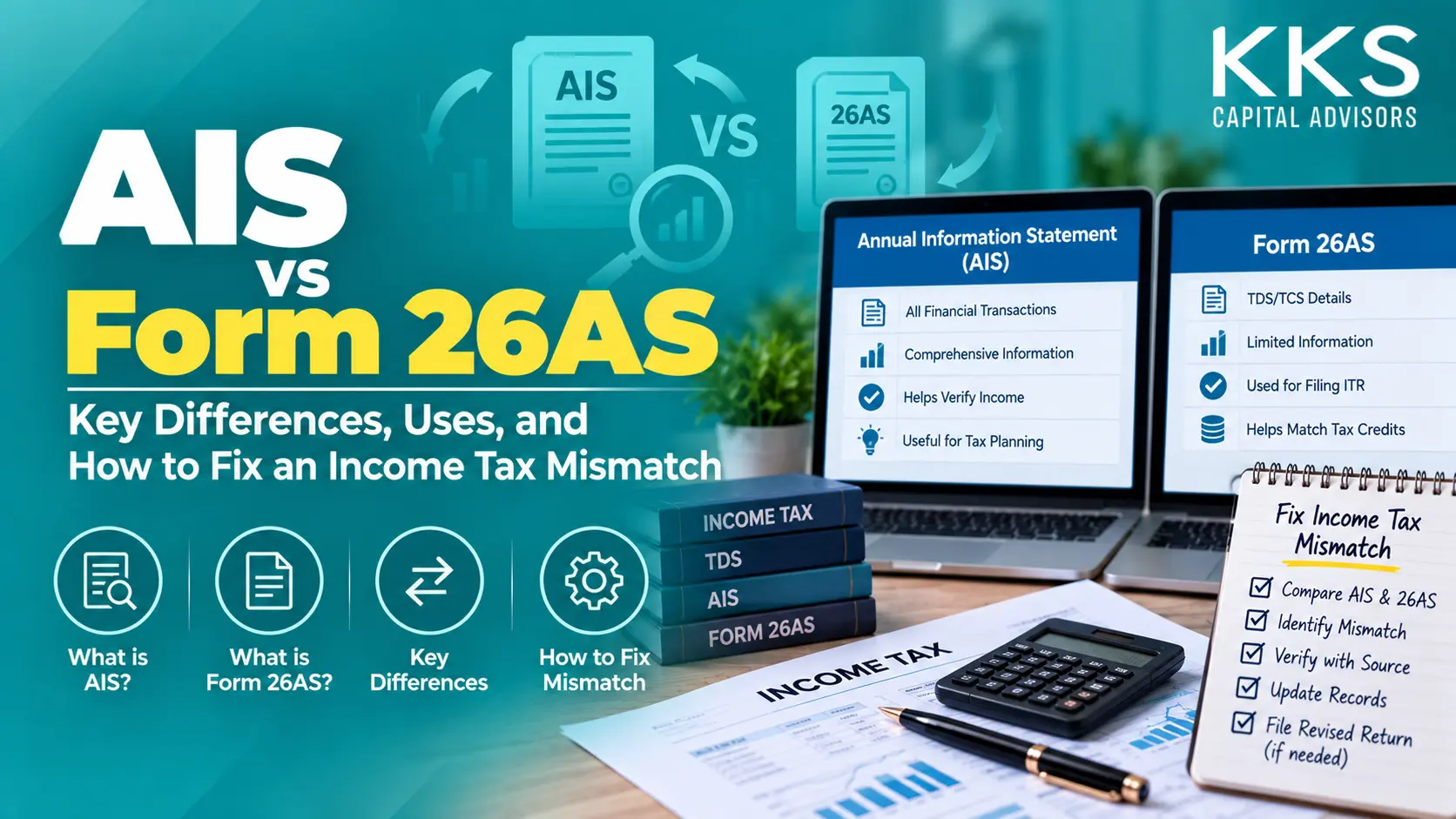
AIS vs Form 26AS serve different purposes when you prepare an Income Tax Return (ITR). AIS provides a wider view of financial information reported to the Income Tax Department. From AY 2023-24 onward, Form 26AS focuses on tax deducted at source (TDS) and tax collected at source (TCS). Review AIS for reported income and transactions, then use Form 26AS to verify tax credits. Check both against your records before filing.
Table of Contents
ToggleCurrent-year note: AIS for AY 2026-27 covers FY 2025-26 under the earlier tax law. A separate annual information statement, Form No. 168, applies for Tax Year 2026-27 under the Income-tax Act, 2025. Select the correct assessment year or tax year. (See the Income Tax Department’s AIS and TDS Compliance FAQs.)
What Is an AIS Statement?
The Annual Information Statement (AIS) is a consolidated view of financial information available to the Income Tax Department about a taxpayer. It is designed to help taxpayers review information before filing an ITR and submit feedback when a reported item appears incorrect. AIS also supports return pre-filling where applicable.
What information does AIS include?
Depending on what reporting entities submit and what data the Department holds, an AIS statement can include:
- TDS and TCS information reported against your PAN.
- Specified Financial Transactions (SFT), such as certain reportable deposits, investments or property transactions.
- Reported interest income, including savings account or deposit interest, where available.
- Dividend, securities and mutual fund transaction information, where reported.
- Certain foreign remittances or foreign currency purchases.
- Tax payment, demand and refund data under relevant AIS categories.
- Other information received from reporting sources, depending on the taxpayer and year.
AIS also contains a Taxpayer Information Summary (TIS). TIS groups information by category and can display system-processed values and values accepted by the taxpayer or confirmed by the source. Do not assume AIS shows every transaction you made. The Income Tax Department states that taxpayers remain responsible for reporting complete and accurate income in their returns, including information that is not displayed in AIS.
What Is Form 26AS?
Form 26AS is the Annual Tax Statement available through the tax portal and TRACES. From AY 2023-24 onward, it displays TDS/TCS-related data, while other reported financial information is available through AIS. Use it to check whether tax deducted or collected against your PAN appears in the Department’s records.
Compare salary TDS with Form 16, bank TDS with the bank’s certificate, and other credits with records from the deductor. If a credit is missing or wrong, contact the deductor and request a correction where required. Formats for older years can differ, so check the statement for the relevant assessment year.
AIS vs Form 26AS: What Is the Difference?
Comparison point | AIS statement | Form 26AS |
Main purpose | Review a broader range of reported income and financial transactions. | Verify TDS and TCS information against your PAN. |
Coverage | Wider reporting, including certain interest, dividend, securities, SFT and other data. | Primarily TDS/TCS-related data for AY 2023-24 onward. |
Feedback | Allows feedback on eligible reported information through the AIS portal. | No equivalent AIS-style transaction feedback function. |
Best use | Find income or transactions to investigate before filing. | Confirm tax credits before claiming them in the ITR. |
Mismatch action | Check source documents and submit feedback when information is wrong. | Check TDS/TCS records and ask the deductor to correct a reporting error. |
Relationship | Provides a wider information picture. | Provides a focused tax-credit view. |
Which Should You Check Before Filing an ITR?
Review both. AIS covers a broader range of reported information, while Form 26AS helps verify TDS/TCS credits. Neither document replaces your own records or decides every item of taxable income by itself.
Use this practical sequence:
- Download AIS and Form 26AS for the correct assessment year or tax year.
- Compare TDS/TCS with Form 16, Form 16A, salary slips and deductor records.
- Match interest, dividends and securities transactions with bank, broker and mutual fund statements.
- Separate gross transaction values from taxable income. A share sale value, for example, is not the same as the taxable capital gain.
- Resolve incorrect entries and report all taxable income required by law.
What Is an AIS Mismatch?
An AIS mismatch occurs when information in AIS does not appear to agree with your records or with the figures used in your ITR. A difference is not always an error. AIS can show a transaction value that needs tax computation, information from more than one source, or a report that requires clarification.
Common reasons for an income tax mismatch
- Duplicate reporting: the same transaction appears more than once or through more than one reporting route.
- Incorrect PAN or taxpayer details: a reporting entity has used the wrong identifier or supplied incorrect data.
- Timing differences: a transaction or tax deduction is reported or corrected later than expected.
- Gross value versus taxable income: the reported sale amount, deposit or transaction total is not itself the taxable amount.
- Missing source correction: a bank, employer, broker or other reporting entity has not filed or corrected its statement.
- Wrong year selected: the AIS or Form 26AS is for a different assessment year or tax year from the return under review.
How to Fix an AIS Mismatch
First identify the exact entry and the reporting source. Keep the relevant statement, transaction proof and communication records together. Then take the step that matches the issue:
- If the AIS information is correct, report it in the ITR using the applicable tax treatment.
- If the entry is incorrect, duplicated or does not belong to you, open the relevant AIS item and submit the most suitable feedback option in the portal.
- If a TDS/TCS credit is missing or inaccurate, contact the employer, bank or other deductor. Ask them to verify the PAN and file a correction where required.
- Save the feedback acknowledgement and keep a record of the source documents. The AIS portal provides activity history and an acknowledgement for submitted feedback.
- Recheck the updated statement and your ITR figures before submission. Do not ignore valid income simply because you submitted feedback on an AIS entry.
AIS feedback does not automatically change every source record or settle the tax treatment. Seek qualified tax advice if the issue affects taxable income, capital gains, foreign transactions or a tax notice.
Why Might AIS and Form 26AS Show Different Information?
Different information is expected because the statements have different scopes. AIS includes categories beyond TDS and TCS, so interest, dividends or reportable securities transactions may appear in AIS without appearing as equivalent entries in Form 26AS. That difference alone does not mean the records are wrong.
For an item that appears in both statements, compare the deductor or collector, PAN, amount, financial period and available transaction details. If the mismatch concerns TDS or TCS, the deductor may need to correct its return. If it concerns other reported income, compare AIS with the underlying bank, broker, employer or transaction documents and use AIS feedback when appropriate.
Important Update for Tax Year 2026-27
The Income-tax Act, 2025 took effect on 1 April 2026. The Income Tax Department says AIS for AY 2026-27 relates to FY 2025-26 under the earlier Act. Form No. 168 applies as the annual information statement for Tax Year 2026-27 under the new Act. Both statements are available through the e-filing portal.
Before comparing statements, confirm whether your records relate to an assessment year under the earlier framework or a tax year under the new one. For a TDS mismatch during the transition, the Department advises early reconciliation and contacting the deductor to correct the relevant statement if needed.
How KKS Capital Advisor Can Help
Reconciling AIS, Form 26AS and your ITR takes careful review of tax credits, financial transactions and supporting documents. A tax professional can help identify the source of a mismatch, distinguish a reporting issue from a tax-computation issue, and organise the evidence needed to resolve it.
KKS Capital Advisor provides tax advisory, income tax return filing and income tax notice support. If you are dealing with an AIS mismatch, missing TDS credit or a tax query, visit the KKS Capital Advisor website to enquire about assistance for your situation.
Conclusion
For an accurate ITR, understand each statement’s purpose. AIS helps you review reported income and transactions, while Form 26AS helps verify TDS/TCS credits for applicable assessment years. Reconcile both with your records, investigate meaningful differences and request corrections where needed. For tax reconciliation or ITR support, contact KKS Capital Advisor through its website.
FAQ'S
What is the main difference between AIS and Form 26AS?
AIS gives a broader view of financial information reported to the Income Tax Department. Form 26AS focuses on TDS/TCS-related details from AY 2023-24 onward. Check both before filing your ITR.
Is AIS more important than Form 26AS?
They serve different purposes. AIS helps you review reported income and transactions. Form 26AS helps you verify tax credits. Use both with your source documents.
Can AIS and Form 26AS show different amounts?
Yes. AIS covers more information categories, so some entries appear only in AIS. If TDS/TCS values differ, reconcile the details and contact the deductor when a correction is needed.
What should I do if AIS shows income I did not receive?
Check the source, date, amount and supporting documents. If the item is incorrect or does not belong to you, submit appropriate feedback in AIS and retain the acknowledgement. Contact the reporting entity if its records need correction.
Do I have to report income that is missing from AIS?
Yes, where the income is taxable under applicable law. AIS is based on information currently available to the Department and may not show every transaction. You remain responsible for reporting complete and accurate income in your ITR.
What changes for Tax Year 2026-27?
The Income Tax Department says the annual information statement for Tax Year 2026-27 is Form No. 168 under the Income-tax Act, 2025. AIS for AY 2026-27 remains associated with FY 2025-26 under the earlier Act. Select the relevant period before comparing statements.