
GST Registration Under Rule 14A: A Complete Guide for Small Taxpayers

GST Registration Under Rule 14A: A Complete Guide for Small Taxpayers

Introduction

GST registration under Rule 14A is a fast‑track option for small taxpayers who want a simpler, digital‑only way to get GST registration. Introduced through the CGST (Fourth Amendment) Rules, 2025, this scheme lets eligible businesses get GST registration approval within about three working days, without long‑drawn manual checks or physical verification.

If your monthly output tax liability on supplies to registered persons is not high and you use Aadhaar-based authentication, you can choose this fast-track option instead of the normal registration route. This article explains the conditions, step-by-step process, benefits, and common mistakes so you can decide whether this route suits your business.

What is GST Registration Under Rule 14A?

Rule 14A of the CGST Rules, 2017, creates a special electronic registration channel for small, low‑risk taxpayers. It doesn’t create a new tax system; it just alters the application process and speeds up GSTIN issuance.

Key points about Rule 14A GST registration:

  • Optional: You can still use the normal GST registration process if you do not meet Rule 14A conditions.
  • Time‑bound: Registration under Rule 14A must be granted within three working days from the date of submitting Form GST REG‑01, if all conditions are met.
  • Fully digital: There is no physical verification; Aadhaar authentication and system‑based risk checks replace manual scrutiny.

In simple terms, this is a “fast lane” for small businesses that sell mainly to other registered persons and have low monthly tax liability.

GST Registration Under Rule 14A Conditions

To qualify for GST registration under rule 14a, you must meet specific conditions laid down in the CGST Rules. These conditions are meant to keep the scheme for genuine, low‑risk taxpayers.

Main eligibility criteria

  • Monthly output tax limit: Your total output tax liability on supplies to registered persons (B2B) must not exceed ₹2.5 lakh per month. This includes CGST, SGST/UTGST, IGST, and Compensation Cess.
  • No large B2B exposure: The limit is based on tax payable, not on overall turnover. If your B2B tax grows above ₹2.5 lakh in any one month, you should exit Rule 14A and move to normal registration.
  • One GSTIN per State/UT under same PAN: You cannot hold more than one registration under the same PAN in a State or Union Territory under Rule 14A.
  • Aadhaar authentication:
    • The primary authorised signatory must complete Aadhaar authentication (OTP or biometric).
    • At least one promoter or partner must also complete Aadhaar authentication, unless they fall under an exempt category under Section‑25(6D).
  • No pending risk or fraud history:
    • No cancellation or amendment proceedings should be pending against your existing registration.
    • The system should not flag your application as high‑risk based on past compliance or other data checks.

If you meet all these conditions for GST registration under Rule 14a, you can opt for this simplified route when you fill in Form GST REG‑01.

ALSO READ: Income Tax Demand Notice Reply Format

GST Registration Process Under Rule 14A
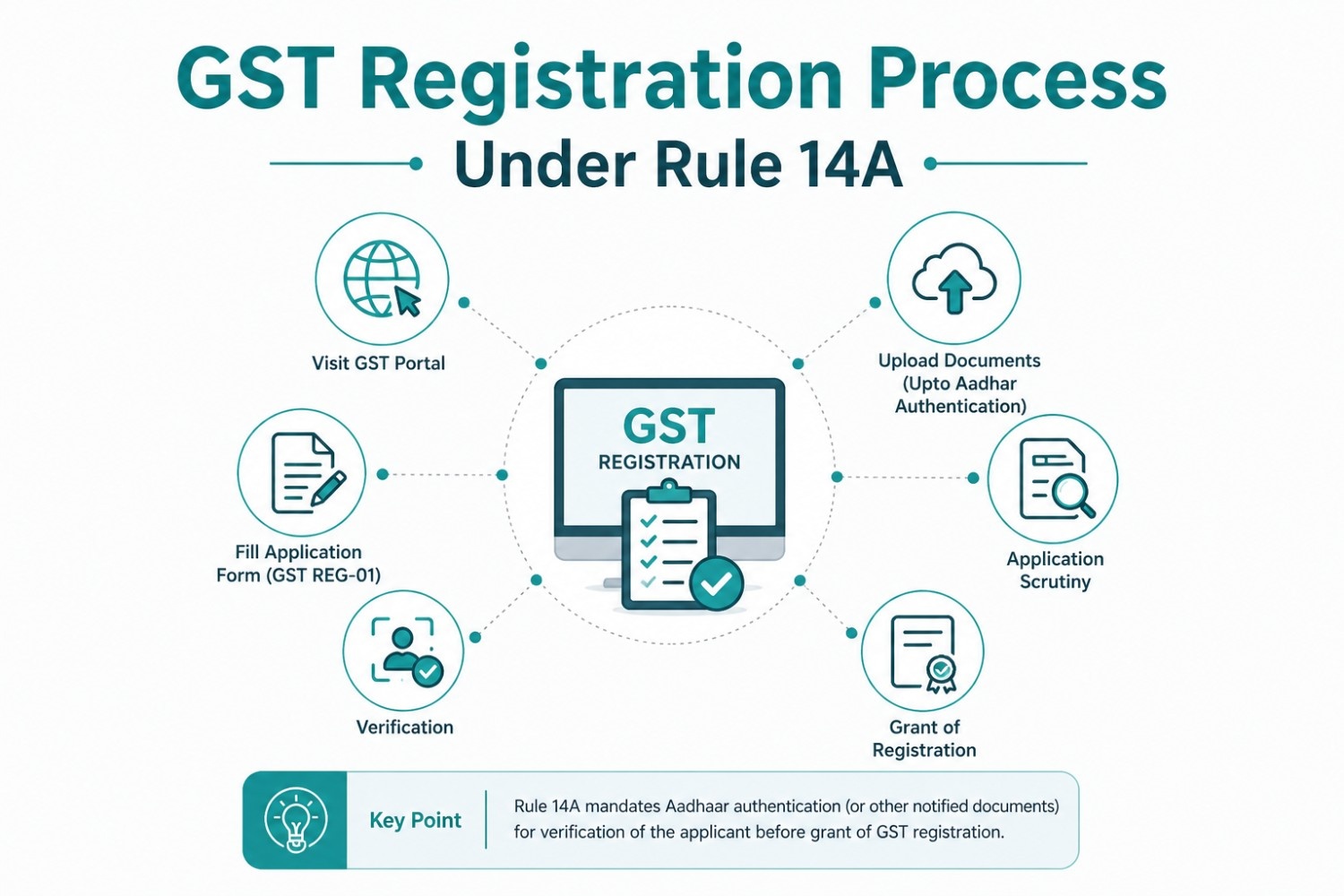
GST registration under Rule 14A

The gst registration process under rule 14a is almost the same as normal GST registration, except for one important check in the form and the reliance on Aadhaar authentication. Here is a simple step‑by‑step guide:

Step 1: Check eligibility and prepare documents

Before starting, ask:

  • Will your monthly output tax on B2B supplies stay under ₹2.5 lakh?
  • Do you have valid PAN and Aadhaar details of the authorised signatory and at least one partner?

Common documents you usually need:

  • PAN of the business and authorised signatory
  • Proof of business constitution (PAN‑based for proprietorship, partnership deed, incorporation certificate, etc.)
  • Address proof of the principal place of business
  • Mobile number and email for the GST portal

Step 2: Start Form GST REG‑01 on the GST portal

  • Go to the GST common portal (https://www.gst.gov.in/).
  • Click Services → Registration → New Registration.
  • Fill Part A of Form GST REG‑01 (basic details like PAN, mobile, email, State, etc.).
  • After submitting Part A, you will get a TRN (Temporary Reference Number).

Step 3: Fill Part B and choose Rule 14A

  • Log in using the TRN and open Form GST REG‑01 Part B.
  • In the relevant section, select “Yes” for “Option for registration under Rule 14A”.
  • Declare that your monthly output tax liability on supplies to registered persons is within the ₹2.5 lakh limit.

At this stage, you are clearly opting for GST registration under Rule 14A instead of the regular route.

Step 4: Complete Aadhaar authentication

  • The GST portal will prompt you to complete Aadhaar authentication for the authorised signatory and one partner.
  • You can choose OTP or biometric mode.
  • If Aadhaar authentication fails or is not completed, you cannot proceed under Rule 14A and must apply through normal registration rules.

Step 5: Submit and wait for electronic approval

  • After submitting the form, the system will run automated risk checks based on Aadhaar, PAN, and other data.
  • If the system finds your application low‑risk and all conditions are met, your GST registration certificate (Form GST REG‑06) will be issued electronically within three working days.

If risk parameters are triggered, the application may be shifted to the normal verification route (Rule 9/9A), which can take longer and may involve officer queries or document checks.

Benefits and Importance of GST Registration Under Rule 14A

Choosing GST registration under Rule 14A has several advantages for small businesses and professionals.

Key benefits

  • Faster approval: You can get GST registration within three working days, compared to the longer normal process that may involve physical verification.
  • Less paperwork: No physical verification of business premises is required for eligible applicants.
  • Digital‑only workflow: From Aadhaar authentication to certificate generation, the entire gst registration process under rule 14a is online, which suits tech‑savvy startups and freelancers.
  • Good for low-B2B businesses: Small traders, service providers, and professionals primarily supplying to registered persons with low monthly tax can use this route.

When it is useful

  • New businesses are testing the market.
  • Professionals like consultants, freelancers, and small service providers.
  • Small traders maintain controlled and predictable B2B tax exposure.

If you are unsure whether you meet the eligibility conditions, firms like KKS Capital Advisor can review your numbers and help you choose the right registration route.

Common Mistakes and How to Avoid Them

Even though the process looks simple, applicants often make mistakes that delay or block registration under Rule 14A.

Typical errors

  • Incorrect tax liability estimate:
    • Some taxpayers assume the limit is based on turnover, but Rule 14A uses output tax liability.
    • If your B2B tax exceeds ₹2.5 lakh in any month, you must exit Rule 14A and apply for normal registration.
  • Not completing Aadhaar authentication:
    • Skipping or failing Aadhaar checks makes you ineligible for Rule 14A. You then have to restart via normal registration.
  • Using multiple PAN‑State combinations under Rule 14A:
    • Rule 14A restricts one registration per State/UT under the same PAN. Trying to create another such registration can cause rejection or compliance issues.
  • Fake or mismatched details:
    • Wrong PAN, address, or business‑activity details can trigger system alerts and shift your application to manual scrutiny.

Best practices

  • Double‑check your B2B tax liability for each month and keep a simple record.
  • Use Aadhaar only through the GST portal; never share OTPs or biometric details with third parties.
  • Get help from a GST consultant (for example, KKS Capital Advisor) if you are new to GST or have complex business structures.

Table: Rule 14A vs Normal GST Registration

AspectGST Registration Under Rule 14ANormal GST Registration
TimelineUp to 3 working days once Aadhaar is done and there are no risk flags. No fixed timeline; may take longer due to manual checks. 
Manual verificationNot required for low‑risk cases. Possible physical verification or officer queries. 
Aadhaar authenticationMandatory for the authorised signatory and one partner. Optional or not required in some cases. 
EligibilityOnly for low‑B2B tax liability (<₹2.5 lakh/month). Open to all taxpayers, including high‑turnover businesses. 
Use caseSmall, low‑risk, digital‑first businesses. Large businesses, complex operations, or those exceeding Rule 14A conditions. 

Conclusion 

GST registration under Rule 14A is a smart choice for small taxpayers who want a quick, digital, and low‑hassle GST registration process. As long as your monthly output tax liability on B2B supplies stays under ₹2.5 lakh and you complete Aadhaar authentication correctly, you can enjoy faster approval and fewer manual checks.

However, the scheme is not automatic or risk‑free. You must monitor your tax liability, keep records clean, and exit Rule 14A in time if your business grows.

If you want to avoid common mistakes and ensure your GST registration under Rule 14a conditions are met, you can consult a professional firm like KKS Capital Advisor to guide you through the application and beyond.

Need help with GST Registration in Gurgaon under Rule 14A or regular GST compliance? Contact KKS Capital Advisor today for expert support tailored to your business size and sector.


FAQ'S

1. What does GST registration under Rule 14A mean?

GST registration under Rule 14A is a fast‑track, electronic registration option for small taxpayers whose monthly output tax liability on B2B supplies does not exceed ₹2.5 lakh.

Small businesses or professionals whose total monthly output tax on supplies to registered persons is within ₹2.5 lakh and who complete Aadhaar authentication of the authorised signatory and one partner can apply under Rule 14A.

If all conditions are met and Aadhaar authentication is successful, the law provides that registration must be granted within three working days from the date of submitting Form GST REG‑01.

Yes. Aadhaar authentication of the authorised signatory (and one promoter/partner) is mandatory to use the gst registration under rule 14a route.

Yes. If your monthly output tax liability on B2B supplies exceeds ₹2.5 lakh, you must withdraw from Rule 14A by filing Form GST REG‑32 and then fall under normal GST registration rules.

Read More

TDS section194s income tax act

TDS Section 194S of Income Tax Act: Complete ITR Guide 2026

If you are investing in crypto or dealing with digital assets, understanding tds section 194s of income tax act is very important. This rule affects how tax is deducted when you buy or sell virtual digital assets (VDAs) like cryptocurrency and NFTs.

In this guide by KKS Capital Advisor, we explain everything in simple terms so you can stay compliant and avoid penalties.

What is TDS Section 194S of Income Tax Act?

tds section 194s of income tax act was introduced in India to track and tax transactions related to virtual digital assets. It came into effect on 1 July 2022.

Under this section, 1% TDS (Tax Deducted at Source) is deducted on the transfer of VDAs.

Key Points:

  • Applies to crypto, NFTs, and other digital assets
  • TDS rate: 1%
  • Deducted at the time of transfer
  • Applicable to both buyers and sellers depending on the situation

This rule ensures that the government can monitor crypto transactions more effectively.

What is TDS on Virtual Digital Assets?

TDS on virtual digital assets means tax is deducted when a crypto transaction happens.

Example:

If you sell Bitcoin worth ₹1,00,000:

  • TDS deducted = ₹1,000 (1%)
  • You receive = ₹99,000

This deduction is reported to the Income Tax Department and reflected in your Form 26AS.

Who Needs to Deduct TDS Under Section 194S?

Under tds section 194s of income tax act, responsibility depends on the type of transaction.

1. Exchange Transactions

  • Crypto exchanges usually deduct TDS automatically

2. Peer-to-Peer Transactions

  • The buyer must deduct TDS before paying the seller

3. Specified Persons (Small Taxpayers)

  • Individuals/HUFs with:
  • Business turnover < ₹1 crore
  • Professional income < ₹50 lakh

They have relaxed compliance rules.

Threshold Limit for TDS Deduction

TDS is not required if transactions are below a certain limit.

Limits:

  • ₹50,000 per year → for individuals/HUF (specified persons)
  • ₹10,000 per year → for others

If your transactions cross these limits, tds under section 194s becomes applicable.

How to Show 194S Income in ITR?

TDS Section 194S of Income Tax Act

Many taxpayers are confused about how to show 194s income in itr. Here’s a simple explanation:

Step-by-Step:

  1. Report income under Capital Gains or Business Income
  2. Add total sale value of crypto
  3. Deduct purchase cost (if applicable)
  4. Apply 30% tax on gains
  5. Claim TDS credit in Form 26AS

Important:

  • No deduction allowed except cost of acquisition
  • Loss cannot be set off against other income

194S TDS Income Under Which Head in ITR?

A common question is: 194s tds income under which head in itr?

Answer:

It depends on your activity:

1. Investment Purpose

  • Show under Capital Gains

2. Trading or Business Activity

  • Show under Business Income

The TDS amount is claimed as tax credit, not income.

Calculation of TDS Under Section 194S

Let’s understand this with an example:

Example:

  • Purchase crypto: ₹50,000
  • Sell crypto: ₹80,000

Calculation:

  • Profit = ₹30,000
  • TDS = 1% of ₹80,000 = ₹800

Even though tax is on profit, TDS is deducted on total sale value.

When is TDS Deducted?

Under tds section 194s of income tax act, TDS is deducted:

  • At the time of payment OR
  • At the time of credit (whichever is earlier)

This means even if payment is delayed, TDS may still apply.

Special Cases in TDS on Virtual Digital Assets

1. Payment in Kind (Crypto-to-Crypto)

If you exchange one crypto for another:

  • TDS still applies
  • You must ensure tax is paid before completing the transaction 

2. Gift of Crypto

  • TDS may apply depending on transaction type
  • Taxability depends on income tax rules

Compliance Requirements

To comply with tds under section 194s, you must:

  • Deduct TDS correctly
  • Deposit it with the government
  • File TDS returns (Form 26Q)
  • Issue TDS certificate (Form 16A)

Failure to comply may lead to penalties and interest.

Penalties for Non-Compliance

If you don’t follow tds section 194s of income tax act, you may face:

  • Interest on late deduction
  • Late filing fees
  • Penalty up to the TDS amount
  • Disallowance of expenses

Why Choose KKS Capital Advisor?

Managing crypto taxes can be complex. KKS Capital Advisor helps you:

  • Calculate TDS accurately
  • File ITR with correct reporting
  • Avoid penalties
  • Stay compliant with latest tax laws

Whether you are an investor or trader, expert guidance can save time and money.

Also Read: Equalisation Levy Under Income Tax Act

FAQ'S

1. What is TDS Section 194S of Income Tax Act?

It is a provision requiring 1% TDS on transfer of virtual digital assets like cryptocurrencies and NFTs above specified thresholds.

Report it under capital gains or business income and claim TDS credit in the TDS schedule after matching with Form 26AS.

It depends on activity—capital gains for investors, business income for traders.

Yes, if your total tax liability is lower than TDS deducted, you can claim a refund.

It is a tax deducted at source when transferring crypto or NFTs, ensuring tax compliance.

ITR-2 for capital gains and ITR-3 for business income.

It may lead to notices, penalties, and scrutiny due to AIS mismatch.

Not mandatory, but recommended for complex transactions.

No, losses from VDA cannot be set off against other income.

Yes, as per current rules, without deductions (except cost of acquisition).

Read More

POEM Tax India Rules Explained: Foreign Company Residency Risks in 2026

POEM Tax India Rules Explained: Foreign Company Residency Risks in 2026

If your company is registered outside India but most of the key business decisions happen in India, you need to read this carefully. The POEM tax in India rules were introduced to stop companies from avoiding Indian taxes by simply incorporating abroad while actually running everything from here. And in 2026, tax authorities are looking at this more closely than ever before. Let’s understand what POEM is, how it works, and what risks your company might be facing right now.

What Does POEM Actually Mean?

POEM stands for Place of Effective Management. It is a concept used in Indian income tax law to decide whether a foreign company should be treated as an Indian tax resident, and therefore taxed in India on its global income. The basic idea is simple. Where is the company really being managed from? Not on paper. Not as per the registration certificate. But in actual practice, where do the key people sit, where do the important decisions get made, and where does the real control of the business lie?

If the answer is India, then under POEM tax rules India, that foreign company can be declared an Indian tax resident. And once that happens, it has to pay tax in India on its entire worldwide income. Not just the income earned in India. This is a big deal. And many companies did not take it seriously enough when the rules first came in.

When Did POEM Rules Come Into Effect in India?

The POEM India Income Tax provisions were introduced through the Finance Act, 2015. They became effective from the financial year 2016-17 onwards. The government also released detailed guidelines in January 2017 to help companies understand how POEM would be determined in practice. Before POEM, a foreign company was only taxed in India on income that was earned or received here. But after POEM, if the company’s effective management is found to be in India, it becomes a full Indian tax resident. The tax treatment changes completely.

Also, it is important to note that POEM applies only to companies. It does not apply to individuals, partnership firms, or LLPs. So if you run a foreign private limited company or a foreign subsidiary with Indian directors making key decisions, this is directly relevant to you.

How Does the Tax Department Decide POEM?

This is where most business owners get confused. The POEM tax residency rules are not based on one single factor. The tax department looks at the overall picture. First of all, they check where the board of directors meets and makes decisions. If board meetings happen regularly in India, that is a strong indicator of POEM being in India.

But they also look beyond board meetings. They check where the senior management team is located. They look at where strategic decisions, like entering new markets, approving budgets, or hiring top executives, are actually made. Also, if the company’s accounting records, legal documents, and key business data are maintained in India, that adds to the case for Indian POEM. One important thing the guidelines clarify, just because directors occasionally travel to India for meetings does not automatically make India the POEM. The department looks at the overall pattern of decision-making throughout the year, not just one or two meetings.

What Are the Real Risks for Foreign Companies in 2026?

The POEM provisions in income tax act create serious financial exposure for companies that are not careful. Here is what can happen if your foreign company is declared an Indian tax resident. Your company’s global income, income earned from all countries, not just India becomes taxable in India. This can dramatically increase your tax liability overnight. Also, the company would need to comply with Indian income tax return filing requirements, audit requirements, and transfer pricing rules. All of this adds to the compliance burden significantly.

There is also the risk of interest and penalties for past years if the tax department determines that POEM existed in India for earlier financial years but tax was not paid accordingly. In 2026, Indian tax authorities are becoming sharper at identifying companies that exist only on paper in foreign jurisdictions. Especially with the growth of international information sharing between tax departments, it is much harder to hide the real place of management. Because of all this, companies with cross-border structures need to review their POEM tax India position carefully this year.

How to Protect Your Company from POEM Risk

The good news is that POEM risk can be managed if you plan properly. Here are some practical steps. Make sure your foreign company’s board meetings are held outside India. Not just on paper but genuinely. Directors should physically be present in the country where the meeting is held. Keep proper minutes and records of these meetings.

Also, make sure that major strategic decisions are taken by people who are based outside India. If all your senior decision-makers sit in India and only coordinate with a token foreign director occasionally, that is a red flag. Keep proper documentation showing that the company’s management and control genuinely operates from outside India. Emails, meeting records, organizational charts, and decision logs all matter. And most importantly, get a qualified tax advisor to review your company’s structure. A proper POEM assessment done in advance is far better than dealing with a tax demand later.

Get Expert Help Before It Is Too Late

POEM is a complex area of international taxation. It is not something you want to figure out on your own, especially when the stakes involve your company’s entire global income being taxed in India.

Talk to KKS Capital Advisors  

At KKS Capital Advisors, we work with businesses that have cross-border structures and help them understand their POEM tax India position clearly. Our team of experienced chartered accountants and tax professionals has been advising companies since 2013 on complex tax and compliance matters. We review your company’s management structure, identify POEM risks, and help you take the right steps to protect your business before the tax department comes knocking.

Read More

GST Limitation Period 2026: Key Notices, Appeals & March 31 Deadlines

GST Limitation Period 2026: Key Notices, Appeals & March 31 Deadlines

If you run a business in India, GST compliance is something you simply cannot ignore. And one thing that trips up a lot of business owners is not understanding the GST limitation period, basically, the time limits within which the government can send you a notice and within which you can file an appeal or reply. Missing these deadlines can cost you heavily. So let’s understand this clearly before the March 31, 2026, deadline hits.

What Is the GST Limitation Period and Why Does It Matter?

Think of the GST limitation period like an expiry date. Just like a medicine has an expiry date after which it cannot be used, GST notices and appeals also have time limits. Once that time is gone, neither the tax department nor the taxpayer can act on that particular matter.

This works both ways. The government cannot send you a notice after a certain period. And you cannot file an appeal after your window closes, either. Because of this, knowing these time limits is not just useful; it is essential. Many businesses lose cases simply because they did not reply on time or filed an appeal one day too late. And many taxpayers also miss out on refunds because they did not claim them within the allowed period.

GST Time Limit for Notices 

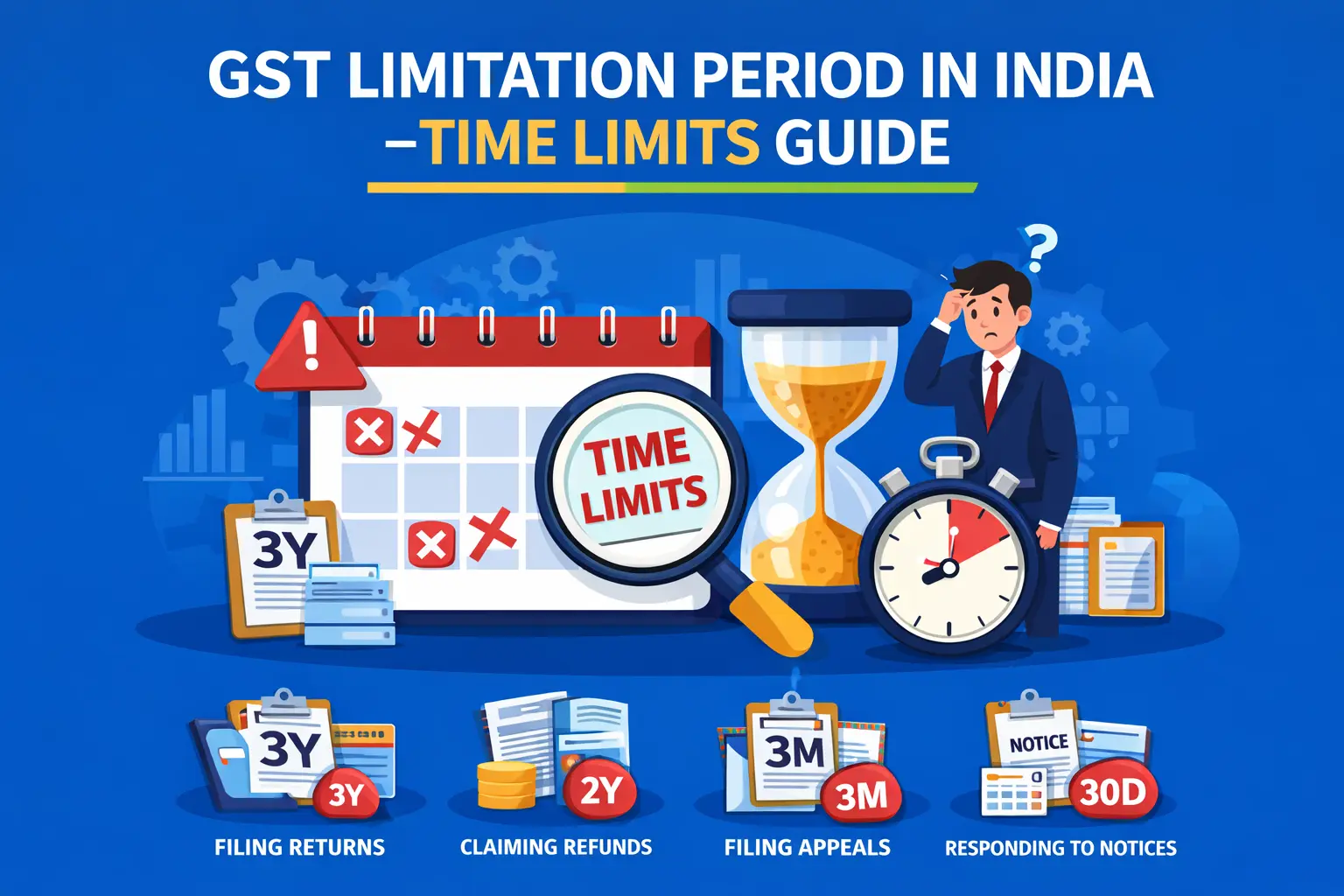
Under the GST law, the tax department has specific time limits within which they must issue notices to taxpayers. These are called the GST time limit for notices. For normal cases where there is no allegation of fraud or deliberate misrepresentation, the department must issue a show cause notice within three years from the due date of filing the annual return for that financial year.

But if the case involves fraud, willful misstatement, or suppression of facts, this time limit extends to five years. So the department gets more time to act when they believe something was done deliberately to avoid tax. Also, after issuing the notice, the department must pass the final order within three years from the notice date in normal cases and within five years in fraud cases. This is important because if the department sends a notice but does not pass an order within this time, the notice becomes invalid. Your lawyer or CA can challenge it.

GST Notice Limitation Period – Cases Affected by COVID Extensions

During COVID-19, the government gave extensions to many GST deadlines. Because of this, several notices and orders that should have been issued between 2020 and 2022 got extended timelines under special government notifications.

The GST notice limitation period for many of these COVID-affected cases was extended up to March 31, 2025 or in some cases March 31, 2026. This means the government is still actively issuing notices for those years even now in 2026. So if you have pending GST matters from financial years 2017-18, 2018-19, or 2019-20, do not assume they are dead issues. The department may still send you a notice before March 31, 2026. Stay alert and keep your records ready.

GST Appeal Limitation Period 

Now let’s talk about what happens if you receive a GST demand order and you want to fight it. You have the right to appeal. But you must do it within the GST appeal limitation period. Under GST law, you have three months from the date of the order to file an appeal before the Appellate Authority. If you have a good reason for the delay, you can get one additional month as a grace period. But beyond that, your appeal will not be accepted.

For appeals before the GST Appellate Tribunal, which is a higher level of appeal, the time limit is also three months from the date of the Appellate Authority’s order. Missing these windows means you lose your right to challenge the demand. Even if you have a strong case, the appeal will be rejected simply because it was filed late. Because of this, the moment you receive a GST demand or adverse order, contact your CA or tax advisor immediately. Do not sit on it. Every day counts.

The March 31, 2026 Deadline — What You Need to Know Right Now

March 31, 2026 is a critical date for GST compliance this year. Several extended limitation periods, including those granted during and after COVID, are set to expire on or around this date. This means the government is expected to issue a large number of GST notices and demand orders before March 31, 2026, to avoid losing its right to recover tax for older years.

If you receive a notice before this date, you typically get 30 days to reply. Do not ignore it, thinking it will go away. A notice that goes unanswered results in an ex parte order, meaning the department decides against you without hearing your side.

Also, if you are waiting on a GST refund from older years, check with your CA whether the limitation period under GST for claiming that refund has already passed or is about to pass. Refund claims also have a two-year limitation period from the relevant date. In the end, the GST limitation period rules are not complicated once you understand the basic structure. Three years for normal cases, five years for fraud cases, and three months for appeals.

Do Not Wait for a Notice to Land on Your Doorstep

Here is the truth. Most business owners only call their CA after a notice arrives. By then, half the options are already gone. Do not be that person. Before March 31, 2026, take one hour and review everything: old notices, pending replies, refund claims, and unresolved demands. One hour now can save you lakhs later.

Conclusion

GST notices and deadlines get confusing fast. Most business owners do not have the time to track every rule and every date on their own, and honestly, they should not have to. That is exactly what we are here for. At KKS Capital Advisors, our chartered accountants and tax team have been sitting across the table from businesses like yours since 2013. Startups, growing companies, and established enterprises—we have helped all kinds of clients stay on the right side of GST without the stress.

Read More

Understanding Transfer Pricing Adjustments Under Indian Tax Laws

Understanding Transfer Pricing Adjustments Under Indian Tax Laws

Your company just received a tax notice. The authorities say you underpaid taxes by crores. Why? Because of transfer pricing adjustments. You thought your inter-company pricing was fair. But the tax department disagrees. Now you’re facing massive tax demands, penalties up to 200%, and months of stressful negotiations. Transfer pricing adjustments happen when tax authorities determine that prices charged between related companies don’t match fair market rates. Think of it as the government saying, “You’re moving profits around to avoid taxes, and we’re fixing that.” These adjustments can dramatically increase your tax liability and create serious financial reporting headaches. Let’s explain this complex topic in simple terms so you can protect your business.

What Are Transfer Pricing Adjustments

Simply put, transfer pricing adjustments are changes that tax authorities make to the prices you charge between related companies. Here’s a real-world example. Your Indian company buys software from your US parent company for ₹10 crore. The tax department believes the fair market price should be ₹6 crore. They adjust ₹4 crore, adding that amount to your taxable income. Suddenly, you owe additional taxes on ₹4 crore you never actually earned. Plus interest. Plus penalties.

The Arm’s Length Principle Explained

Indian tax law requires all transactions between related companies to follow the “arm’s length principle.” What does that mean? Price things as if you’re dealing with strangers, not family. If you’d pay ₹100 to an unrelated vendor for the same service, you should pay roughly ₹100 to your related company too. Not ₹200. Not ₹50. Around ₹100. When prices deviate significantly from arm’s-length levels, transfer pricing adjustments apply.

Transfer Pricing Adjustment Impact on Your Business

Let’s talk about real consequences because they’re serious.

Immediate Tax Liability

The biggest transfer pricing adjustment impact is immediate tax exposure. Adjustments of ₹10-50 crore aren’t unusual for medium-sized companies with significant inter-company transactions. You owe tax on adjusted amounts at 25-30% corporate tax rates. A ₹20 crore adjustment means ₹5-6 crore additional tax.

Interest Charges

Tax authorities charge interest from the date tax was originally due. At 1% per month (12% annually), a two-year-old adjustment of ₹5 crore generates ₹1.2 crore in interest. That’s money gone forever, not deductible, just paid to the government.

Penalties

Non-compliance with transfer pricing rules triggers heavy penalties: For underreporting income, 50% of additional tax. For misreporting, 200% of additional tax On a ₹5 crore tax liability, penalties can reach ₹2.5 crore to ₹10 crore. Yes, you read that right.

Cash Flow Problems

Most companies don’t budget for unexpected ₹10 crore tax bills. These adjustments strain cash reserves, delay expansion plans, and sometimes force companies to seek emergency funding.

Transfer Pricing Financial Reporting Challenges

Transfer pricing financial reporting becomes complicated when adjustments occur.

Impact on Financial Statements

When tax authorities make adjustments, your previously filed financial statements become questionable. 

  • Profit and Loss Impact: Adjustments typically reduce reported profits. If you charged your subsidiary ₹10 crore for services but the authorities say the fair value is ₹6 crore, your revenue drops by ₹4 crore retroactively.
  • Balance Sheet Changes: Tax liabilities increase. Provisions need to be created. Retained earnings get restated.
  • Cash Flow Statement: Actual cash flows don’t change, but tax outflows increase dramatically.

Auditor Concerns

Your auditors will ask tough questions:

  • Why weren’t these transfer pricing risks disclosed earlier?
  • What’s your process for determining arm’s length prices?
  • Are current year transactions similarly mispriced?
  • What additional adjustments might arise?

Inadequate answers can trigger qualified audit opinions, which damage investor confidence.

Transfer Pricing Disclosure in Financial Statements

Indian accounting standards and tax laws mandate specific transfer pricing disclosure in financial statements.

What You Must Disclose

Related Party Transactions: Every transaction with related parties needs disclosure, including:

  • Nature of the relationship
  • Transaction amounts
  • Outstanding balances
  • Terms and conditions

Transfer Pricing Policies: You should disclose your methodology for pricing related-party transactions.

Pending Tax Disputes: If you’re contesting transfer pricing adjustments, disclose the amounts involved and potential outcomes.

Contingent Liabilities: Possible tax liabilities from ongoing investigations or likely adjustments.

Why Proper Disclosure Matters

Good disclosure protects you legally. It shows stakeholders you’re aware of risks and managing them transparently. Poor disclosure invites suspicion. Investors wonder what else you’re hiding. Auditors dig deeper. Regulators investigate.

Example: A company facing ₹50 crore in transfer pricing demands didn’t disclose them properly. When the matter became public, the stock price dropped 15% in one day. Investors felt misled.

Why Choose KKS Capital Advisors

At KKS Capital Advisors, we understand that transfer pricing isn’t just about tax compliance—it’s about protecting your business, maintaining investor confidence, and enabling smooth, disruption-free operations.

Our approach is practical:

  • We explain complex regulations in plain English
  • We find solutions that work for your business model
  • We stay updated on every regulatory change
  • We respond quickly when issues arise

Companies working with us report:

  • Zero surprise tax demands from transfer pricing
  • Faster resolution of disputes when they occur
  • Better financial statement disclosures
  • Confident responses to auditor questions
  • Strategic pricing that balances tax efficiency with compliance

Industry-Specific Considerations

Different industries face unique transfer pricing challenges.

IT and Software Services

India’s largest export sector. Common issues include:

  • Pricing of software development services
  • Royalties for using the parent company’s technology
  • Cost-sharing for R&D
  • Marketing intangibles

Safe harbors work well here if margins permit.

Manufacturing

Transfer pricing challenges include:

  • Pricing of raw materials from related suppliers
  • Tolling arrangements
  • Contract manufacturing agreements
  • Technical assistance fees

Manufacturing companies often face the largest transfer pricing adjustments because transaction values are huge.

Financial Services

Banks, insurance companies, and NBFCs have specific issues:

  • Interest rates on inter-company loans
  • Guarantee fees
  • Management fees
  • Commission on insurance or investment products

Financial services face stricter scrutiny because price manipulation is easier.

E-commerce and Digital

Emerging area with complex issues:

  • Allocation of digital advertising costs
  • Platform fees
  • Data-related transactions
  • Attribution of profits from digital permanent establishments

Regulations are still evolving. Extra caution needed.

Final Thoughts

Transfer pricing adjustments don’t have to be scary. With proper planning, documentation, and expert guidance, you can navigate these rules confidently. Think of transfer pricing compliance as insurance. Yes, it costs money upfront for studies, professional fees, and documentation. But it protects you from catastrophic tax demands that could cripple your business.

The choice is clear. Indian tax authorities are getting sophisticated. They use advanced analytics, access global databases, and scrutinize transactions more closely than ever. But they’re also becoming fairer. New provisions like block assessments and extended safe harbors show the government wants certainty too, not endless litigation. This creates opportunity. Companies that invest in proper transfer pricing compliance position themselves for success. They close foreign funding rounds faster. They attract better investors. They scale globally with confidence.

Read More

FEMA Compliance for Foreign Subsidiaries: A Guide for Indian Companies

FEMA Compliance for Foreign Subsidiaries: A Guide for Indian Companies

Your Indian company just set up a foreign subsidiary. Missing critical filings or deadlines can trigger hefty penalties. Frozen funding rounds. Damaged investor confidence. Even legal trouble with the Reserve Bank of India (RBI). FEMA compliance for foreign subsidiaries means following the Foreign Exchange Management Act rules when your Indian company invests abroad or when foreign entities invest in India. Think of it as the rulebook for cross-border money movements. Get it right, and your business thrives globally. Get it wrong, and you face serious consequences. Let’s walk you through everything you need to know:

What is FEMA and Why Should You Care

FEMA stands for Foreign Exchange Management Act. The Indian government introduced it in 1999 to manage foreign money flowing in and out of India. Before FEMA, there was FERA (Foreign Exchange Regulation Act). FERA was strict and restrictive. FEMA changed the game; it made rules clearer and business-friendlier. The Reserve Bank of India (RBI) manages FEMA. They create the guidelines. They monitor compliance. They impose penalties when companies break rules.

Understanding FEMA Compliance India Foreign Subsidiaries

Let’s clarify what FEMA compliance with India’s foreign subsidiaries actually covers.

Foreign Subsidiaries Investing in India

When a foreign subsidiary (owned and controlled by your Indian company) invests back into India, it is treated as an Indian-owned and controlled entity for downstream investment purposes under FEMA. Sounds confusing? Here’s a simple example. Your Indian company, ABC Ltd., owns 100% of XYZ Singapore Pte Ltd. Now XYZ Singapore wants to invest in an Indian startup. Even though XYZ is foreign-registered, FEMA treats the investment as Indian-owned because ABC Ltd. exercises control. This means:

  • Standard FEMA reporting applies
  • You must file Form FC-GPR within 30 days of share allotment
  • You need to follow sectoral investment caps
  • Transfer pricing rules apply to transactions between the parent and the subsidiary

Indian Companies Investing Abroad

When your Indian company sets up or invests in foreign subsidiaries, that’s called Overseas Direct Investment (ODI). ODI has specific rules:

  • You need to check if you qualify for the automatic route or need RBI approval
  • Your total commitment can’t exceed 400% of your company’s net worth
  • You must route funds through Authorized Dealer (AD) banks
  • Annual reporting is mandatory

FEMA Compliance Requirements You Must Meet

The actual FEMA compliance requirements step by step.

Filing Form FC-GPR

This is critical. FC-GPR stands for Foreign Currency – Gross Provisional Return.

  • When to file: Within 30 days of issuing shares to foreign investors
  • What it contains: Details about share allotment, amount received, investor information
  • Where to file: RBI’s FIRMS portal (Foreign Investment Reporting and Management System)

Missing this 30-day deadline invites penalties. Set reminders. Assign someone responsible. Don’t let this slip.

Form FC-TRS for Share Transfers

When shares transfer between residents and non-residents, you file Form FC-TRS.

Example scenarios:

  • Foreign investor sells shares to an Indian buyer
  • Indian shareholder sells to a foreign investor
  • Transfer between two foreign investors

File this within 60 days of the transaction.

Annual FLA Return

FLA stands for Foreign Liabilities and Assets.

  • Who files: Every Indian company that received FDI or made ODI in any previous year
  • Deadline: July 15 every year
  • What’s included: Complete details of foreign investments, loans, and assets

Even if you haven’t made new investments this year, file the return if you have outstanding foreign liabilities or assets from previous years.

Annual Performance Report (APR)

This applies specifically to companies with foreign subsidiaries.

  • Who files: Indian companies with Joint Ventures or Wholly Owned Subsidiaries abroad
  • Deadline: December 31 every year
  • Form used: ODI Part II
  • Where to submit: Your Authorized Dealer bank

This report tracks how your foreign subsidiary is performing. The RBI wants to know if your overseas investment is doing well.

FEMA Compliance Checklist for Foreign Subsidiaries

Here’s your practical FEMA compliance checklist. Follow this, and you’ll stay on the right side of regulations.

Before Taking Foreign Investment

  • Check sectoral caps: Not all sectors allow 100% foreign investment. Some have limits. Some need government approval.
  • Verify the route: Is your sector on the automatic route (faster, no approval needed) or the approval route (requires government permission)?
  • Complete KYC: Know Your Customer checks are mandatory. Your AD bank verifies foreign investor identity and conducts Anti-Money Laundering (AML) checks.
  • Follow pricing guidelines: You can’t issue shares at any price you want. RBI has specific pricing norms for foreign investments.

After Receiving Investment

  • File FC-GPR immediately: Don’t wait until day 29. File within a week if possible.
  • Issue shares in demat form: Physical share certificates aren’t allowed for FDI. Everything must be dematerialized.
  • Maintain proper records: Keep all documents, shareholder agreements, board resolutions, valuation reports, and bank statements.
  • Update the Single Master Form: This is your company’s profile on the FIRMS portal. Keep it current.

For Companies with Foreign Subsidiaries

  • Route investments through AD banks: Every rupee going abroad must flow through authorized banks.
  • File Form ODI within 30 days: When you invest in a foreign subsidiary, report it promptly.
  • Monitor the 400% limit: Your total overseas commitments (equity + loans + guarantees) shouldn’t exceed 400% of net worth.
  • Submit APR annually: Track your foreign subsidiary’s performance and report it by December 31.
  • Follow transfer pricing rules: Transactions between your Indian company and foreign subsidiary must follow arm’s length pricing. This means pricing as if you’re dealing with an unrelated party.

Common Mistakes Companies Make

Let me share mistakes I’ve seen companies make repeatedly.

Treating Foreign Subsidiaries as Separate

Just because your subsidiary is registered in Singapore or Dubai doesn’t mean you can ignore FEMA. Indian companies remain responsible for compliance even when money goes through foreign entities they control.

Missing Deadlines

The 30-day window for FC-GPR isn’t negotiable. “We were busy” doesn’t work with RBI. Set up systems. Automate reminders. Assign clear responsibilities.

Ignoring Downstream Investments

Your foreign subsidiary investing further into Indian or other foreign companies creates additional compliance layers. Each investment needs separate tracking and reporting.

Poor Documentation

“We received the investment two years ago but can’t find the documents.” This happens more than you’d think. Maintain organized records from day one.

Assuming Automatic Route Means No Compliance

The automatic route means you don’t need pre-approval. It doesn’t mean you skip reporting. All FEMA filings still apply.

Why Choose KKS Capital Advisors

We understand that you’re building a business, not just filling forms. Our approach is practical and business-focused. We explain complex regulations in simple terms. We don’t just tell you what you can’t do; we find ways to structure transactions that achieve your business goals while staying compliant. Companies working with us report:

  • Zero missed filings
  • Faster investment closures
  • Better investor confidence
  • Reduced compliance stress
  • Clear understanding of their obligations

Final Thoughts 

FEMA compliance for foreign subsidiaries doesn’t have to be a burden. Yes, the rules are detailed, and the deadlines are strict. But with proper systems and expert guidance, compliance becomes routine. Think of it like this: you wouldn’t drive without a license or ignore traffic rules. Similarly, don’t operate globally without proper FEMA compliance. The upfront effort saves you massive trouble later. Companies that treat compliance seriously attract better investors, close deals faster, and scale internationally with confidence. Working with experienced advisors like KKS Capital Advisors ensures you get compliance right the first time. Your business deserves to grow globally without regulatory roadblocks. Proper FEMA compliance makes that possible.

Read More

Equalisation Levy Under Income Tax Act: Meaning, Applicability & Rates

Equalisation Levy Under Income Tax Act: Meaning, Applicability & Rates

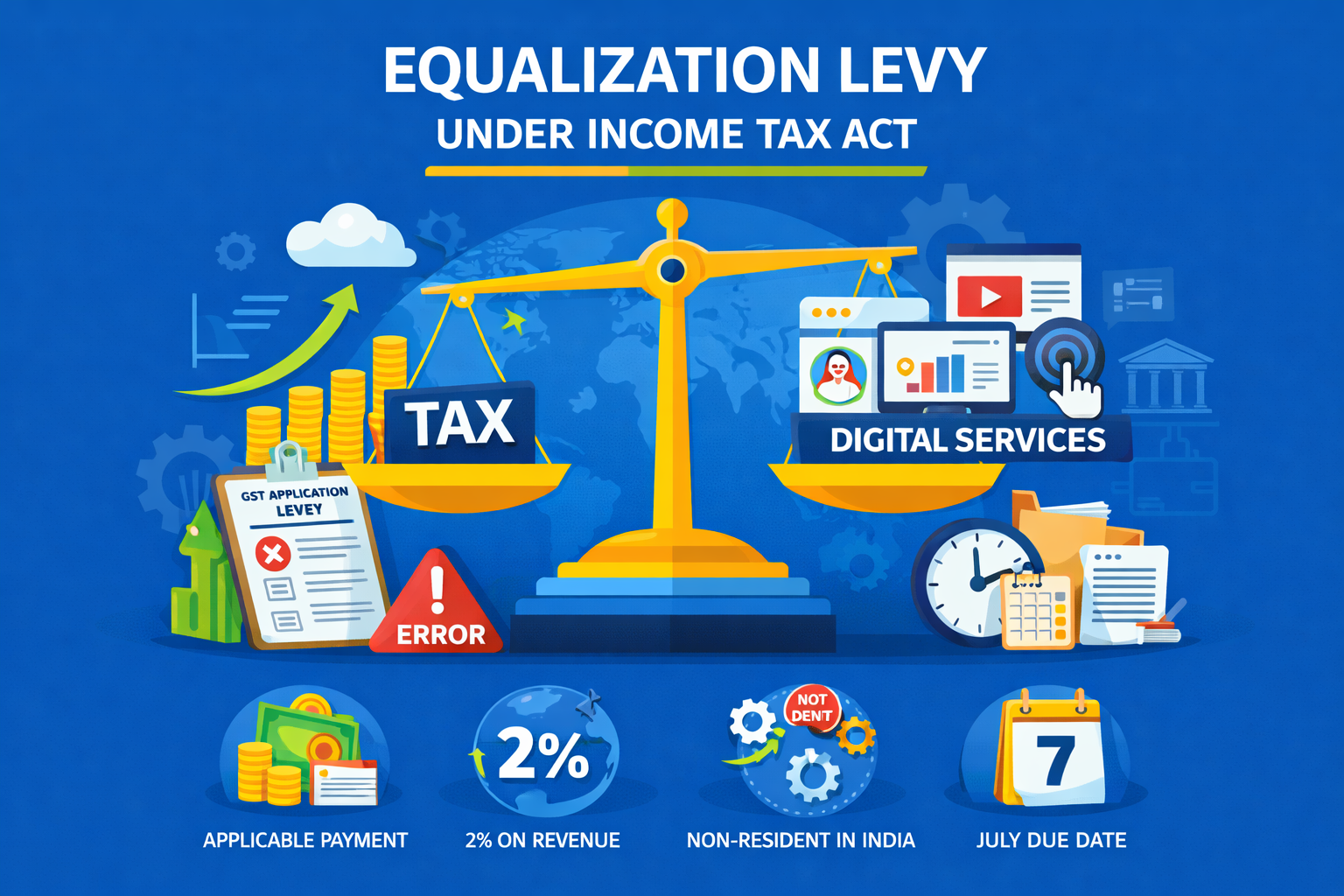
As digital markets grow rapidly, traditional tax rules struggle to keep up across countries. Today, overseas technology companies can earn revenue from users in India without setting up a physical office here. This makes tax collection difficult under conventional income tax laws, which is why the equalization levy under income tax act was introduced to ensure fair taxation of digital transactions.

To address this gap, India introduced a special digital tax called the Equalisation Levy.

This guide explains:

  • What the equalisation levy is
  • Where it applies
  • Applicable rates
  • Legal framework and key provisions
  • Filing, compliance, and penalties

What Is Equalisation Levy?

The equalisation levy is a charge imposed when payments are made to non-resident companies for specific online or digital services.

Its objective is to ensure fair taxation between:

  • Foreign digital companies earning income from India, and
  • Domestic Indian businesses already paying income tax

Unlike income tax, the equalisation levy operates as a separate levy, applying only to specified digital transactions. It applies when foreign companies earn revenue from India without having a physical presence in the country.

Fairness is the core principle—income earned from India should be taxed in India, regardless of where the business is located.

Legal Framework of Equalisation Levy

The equalisation levy was introduced through the Finance Act, 2016 as an independent levy, separate from the Income Tax Act, 1961.

Initially, it applied only to online advertising services, but its scope later expanded to cover:

  • Digital marketplaces
  • E-commerce operations
  • Certain cross-border online transactions

This expansion aligns with global efforts to tax the growing digital economy more effectively.

Key Provisions Under the Law

The relevant provisions under the Finance Act lay down:

  • Who is responsible for payment or deduction
  • What services are covered
  • How the levy amount is calculated
  • Consequences of non-compliance

Authorities monitor transactions closely to ensure proper compliance. Over time, the scope has widened beyond the initial digital advertising focus.

What Services Are Covered?

The equalisation levy applies to payments made for specified digital services, including:

  • Online advertising services
  • Provision of digital platforms
  • E-commerce transactions
  • Internet-based sale of goods or services

Digital platforms enable:

  • Online buying and selling
  • Order management
  • Inventory tracking
  • Delivery support through digital networks


When Does the Equalization Levy Apply?

The levy becomes applicable when all of the following conditions are met:

  • The service provider is a non-resident
  • The service recipient:
    • Is a resident of India, or
    • Has a permanent establishment or fixed place of business in India

In cases where a foreign service provider operates through a fixed base in India, and income is directly linked to that base, the levy may not apply.

Types of Equalisation Levy

The equalisation levy mainly falls into two categories, depending on the transaction type.

1. Levy on Specified Digital Services

  • Applies mainly to online advertising and similar services
  • Levy is deducted at the time of payment
  • The Indian payer deducts the levy before making payment

2. Levy on E-commerce Transactions

  • Applies to non-resident e-commerce operators
  • Covers online sale of goods or provision of services to Indian customers
  • In this case, the non-resident operator itself pays the levy

Rates of Equalisation Levy

The rate depends on the nature of the transaction. Different services attract different levy rates.

  • Digital advertising services attract a lower percentage
  • E-commerce transactions typically face a higher levy on gross revenue

These rates are fixed by law and remain unchanged regardless of profit margins. As a result, businesses must plan carefully, as the levy applies on gross receipts, not net income.

Filing & Compliance Requirements

Timely filing of equalization levy returns is crucial to avoid penalties.

Payment Timeline

  • Certain services require quarterly payments
  • E-commerce levy generally requires an annual payment

Return Filing

  • An annual equalisation levy statement must be filed
  • A single due date usually applies each year

Missing deadlines can lead to:

  • Interest charges
  • Monetary penalties
  • Additional compliance scrutiny

Information Required in the Return

The prescribed format requires details such as:

  • Nature of services provided
  • Amount received or receivable
  • Total levy payable
  • Payments already made during the year

Even if no levy is payable, compliance checks remain important to avoid future issues.

Penalties for Non-Compliance

Failure to follow equalisation levy provisions may result in:

  • Interest on delayed payments
  • Penalties for non-deduction or non-payment
  • Penalties for late filing of returns

In some cases, certain expenses may be disallowed, increasing the overall tax burden.

Why Equalisation Levy Matters

The equalisation levy plays a key role in modern digital taxation by:

  • Preventing tax base erosion
  • Creating a level playing field for Indian businesses
  • Aligning India’s tax system with global digital tax standards

As digital transactions grow, compliance is no longer optional. Businesses engaged in cross-border online activities must stay updated, track deadlines carefully, and ensure accurate reporting to avoid financial and operational risks.

Final Thoughts

Introduced in 2016, the equalization levy ensures that online income earned from India does not escape taxation. Applicability depends on transaction type, residency status, and service nature. Rates vary, deadlines are strict, and penalties can be costly.

With rules evolving constantly, professional guidance becomes essential.

With expert support from KKS Capital Advisors, businesses can navigate equalization levy requirements confidently—meeting deadlines, handling filings correctly, and gaining clarity on how the levy impacts their operations in an ever-changing digital tax landscape.

Read More

How to Check GST Registration Rejection Reason and Fix It Quickly

How to Check GST Registration Rejection Reason and Fix It Quickly

Getting registered for GST matters if a business wants to stay within legal boundaries while growing its presence. Yet, plenty stumble after submitting their request only to find it turned down without warning. At that point, many start searching for how to check the GST registration rejection reason, as work might stall, schedules shift, and clarity fades—especially when the message explaining why lacks detail or feels vague. The outcome is uncertainty at the very moment when momentum should be building.

Steps on How to Check GST Registration Rejection Reason 

If your GST application is rejected, the reason is shared on the GST portal itself. Follow these simple steps to find the exact cause of rejection.

Step 1: Open the GST Portal

Visit the official GST website and go to the homepage. Keep your TRN number ready before moving forward.

Step 2: Track Application Status

Click on Services, then select Registration, and choose Track Application Status from the menu.

Step 3: Enter Your TRN Number

Enter your TRN number in the given field and submit it. The portal will show the current status of your GST application.

Step 4: View Rejection Reason

If the status shows Rejected, click on it. The rejection reason will appear in the officer’s remarks or in the attached notice.

Step 5: Download the Rejection Notice

Download the rejection letter and read it carefully. This document explains what went wrong and helps you fix the issue before reapplying.

Understanding the rejection reason early helps you correct mistakes and avoid delays when submitting your GST application again.

GST Application Rejection: Why It Happens

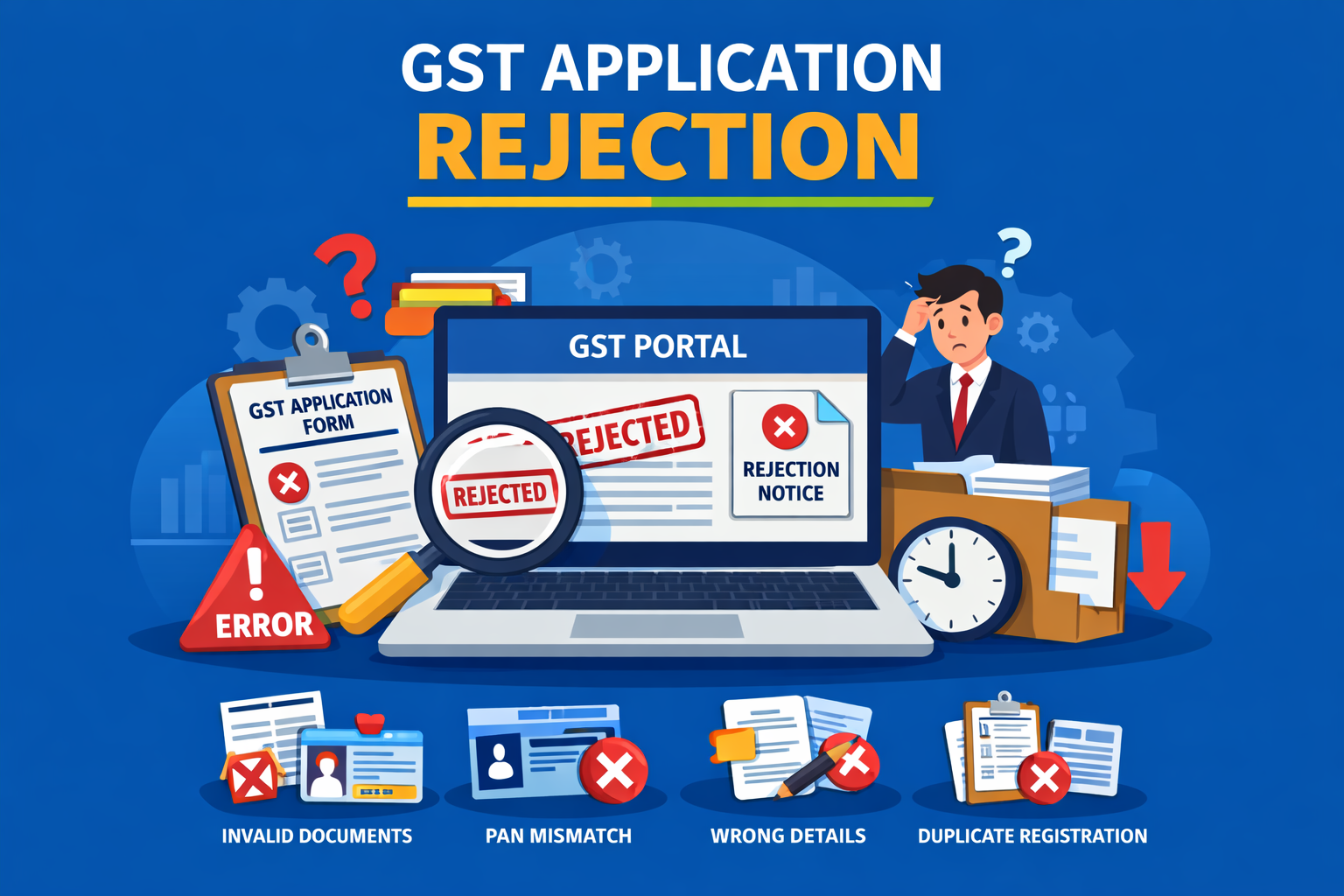
One big thing people face? Their gst application rejection reasons get turned down. What makes it worse? Not knowing why. Sometimes there is no clear message, just a flat no. That leaves applicants stuck, wondering where things went wrong.

Fixing this starts with finding out the exact cause. The tax portal usually has details, buried in messages or status updates. Look closely at every notice linked to your file. Errors often hide in basic info like address proof or bank statements. Maybe numbers did not match up. Or the documents were blurry.

Another issue pops up when forms are filled inconsistently. One section says one thing, another contradicts it. System flags that fast. Then there are cases where nothing shows up—no reason given at all. In those moments, calling support helps. So does visiting an official help center. They might share what online tools won’t.

Once the real problem comes out, fixing it becomes possible. Clean copies, double-checked fields, and correct codes—all matter now. Resubmit only after each gap closes. Getting it right means less delay next time.

Understanding GST Application Rejection

Even when most steps happen online, small or big mistakes might still cause a request to be turned down. Learning the reasons behind those denials gives companies a clearer path to fix errors before trying again. Approval often follows faster once lessons from past attempts are applied.

Common GST Application Rejection Reasons

Mistakes or missing details in paperwork often lead to GST applications being turned down. Examples include using outdated forms, incorrect information, or files that do not match official records.

Incorrect PAN Details

When what’s on paper does not line up with the info given, problems can start. Mismatched data often leads to a decision that stops things from moving forward.

A slip in matching your PAN information with what you put on the GST form might get it turned down. Problems arise when names, birth dates, or the business setup do not align with tax records. Errors like these often lead to applications being refused.

One frequent cause of GST denial hits small owner-run firms hardest. Yet it shows up just as much in shared-business setups.

Invalid Address Proof

When the address shown isn’t legitimate, problems start. A working business location needs real documentation. Officials might say no if what’s submitted doesn’t hold up. Paperwork that fails verification gets set aside without approval.

Proof of where you live is different from what was filled out on the form
Not listed under who applied
Names on papers differ from the requester’s

Few folks lack the paperwork showing they rent here. Some never got a signature on file. Others lost their lease entirely. Without these pages, proof slips away fast.

Non-Response to Clarification Request

When you file your GST return, questions might come up. If an official asks for more details, they expect answers by a set date. Missing that deadline means your filing gets turned down—no second chances. Silence is treated as non-compliance. The system does not wait.

Failing to respond to a clarification request sinks plenty of applications. Missing that step often kills the chance outright.

Duplicate GST Registration Under Same PAN

A second try at GST registration could face refusal when one already exists under the same PAN. That happens if there is no solid justification behind submitting another. Same tax ID, fresh request—without proper cause—it often gets turned down.

Automated GST Application Rejection

A surprise hits many who face this automated reason for GST rejection. It comes from the system, not a person, leaving users puzzled.

Some people pick a signup option they are not allowed to use. Choosing the wrong kind of business structure might get an application turned down. Fitting the rules for voluntary enrollment prevents issues. One mistake in classification can block approval entirely.

Understanding the Rejection Notice

A word comes from the officer—short, without detail. It hangs there, simple on purpose. Not much to hold onto, just enough to move things along. Nothing hidden, nothing stretched out either.

A closer look at the rejection notice? Missing. The applicant skips details. Careful reading falls short. Attention slips away early. Pages get glanced over fast. Understanding stays incomplete. Key points go unnoticed. Errors hide in plain sight. Facts are missed quietly. Clarity never arrives.

It sits inside a file you can pull down. That’s where the explanation hides.

Though it might seem random, every GST rejection has a note logged inside the portal. What looks like chaos actually follows a trail of written records tucked away where few think to check.

Track Application Status

Now go to Application Status. Choose Track Application Status, then type in your TRN. From there, details will appear on screen. Wait a moment for the system to load everything. The page refreshes once you submit the number. Information shows up if the record exists. Sometimes it takes a few seconds longer than expected.

Open the rejection letter once it arrives. Grab a copy of the document explaining why things didn’t move forward. The note comes straight from the reviewing official.

Look closely at what the officer wrote. Their notes hold the precise cause behind your GST application being turned down. Hidden inside those comments or the linked document lies the full story.

Before trying again, it helps to know what was said. Getting clear on the feedback matters most the second time around.

How to Fix a Rejected GST Application

Fixing a rejected GST application starts with knowing why it got turned down. From there, moving forward feels less confusing. What matters most is tackling each issue one at a time.

Fix the mistakes first, then try again for GST registration. Getting it right matters most—no cost details are correct. Another attempt should only be made once everything checks out.

Can You Appeal a GST Rejection?

Yes, it is possible to challenge a GST denial. Most companies decide to submit a new application instead. Going through an appeal often takes too long. It only makes sense if the refusal happened even though every rule was followed correctly.

Resolving the problem first, then sending in a new form, usually works better for many people applying. Most find that it gets things moving more quickly than waiting around.

Impact of GST Rejection on Business

  • GST rejection can:
  • Delay invoicing
  • Keep taxes under control. Stop people taking back tax they paid on supplies
  • Affect vendor and customer trust

Fixing rejections fast matters because it keeps operations running without hiccups. A smooth process avoids delays that pile up later.

Conclusion

Start by reviewing your PAN and Aadhaar information carefully. Ensure every piece of data matches official records exactly. Submit only clear, readable copies when uploading files. Blurry images won’t be accepted—quality matters behind the scenes. Mistakes now might cause delays later without warning.

Stay on top of the GST website. Quick replies when officials ask questions matter to the KKS Capital Advisor.

Read More

Master the 3 Golden Rules of Accounting: A Complete Guide

Master the 3 Golden Rules of Accounting: A Complete Guide

Accounting is the backbone of any business, providing clarity, transparency, and a structured approach to managing finances. Whether you run a small business, a startup, or a large corporation, understanding the golden rules of accounting is essential for accurate record-keeping, compliance, and decision-making.

This guide covers the three golden rules of accounting, explores the types of accounts, explains the benefits of accounting, and highlights how businesses can leverage professional advisory services like KKS Capital Advisor for better financial management.

What Are the Golden Rules of Accounting?

The golden rules of accounting—also known as golden principles of accounting—are the fundamental principles that guide the recording of financial transactions. These rules ensure consistency, accuracy, and clarity in bookkeeping, forming the foundation of the double-entry system of accounting.

Understanding these rules is critical for anyone involved in finance, accounting, or business management.

The Three Golden Rules of Accounting

three golden rules of accounting

Accounting is based on three types of accounts: Personal Account, Real Account, and Nominal Account. Each type follows a specific rule for recording transactions.

1. Personal Account

Definition: Personal accounts relate to individuals, companies, or organizations.

Golden Rule: “Debit the receiver, credit the giver.”

Example:

  • If a business purchases goods on credit from Mr. Sharma, Mr. Sharma is credited because he is the giver, and the business is debited because it is the receiver.

This rule ensures clarity in tracking transactions involving people or entities.

2. Real Account

Definition: Real accounts deal with tangible and intangible assets owned by the business. Examples include cash, machinery, buildings, patents, and vehicles.

Golden Rule: “Debit what comes in, credit what goes out.”

Example:

  • If a company buys furniture for the office, the furniture account is debited (what comes in), and the cash or bank account is credited (what goes out).

This rule helps in maintaining precise records of asset movements within the business.

3. Nominal Account

Definition: Nominal accounts track expenses, losses, incomes, and gains. Examples include salaries, rent, interest, and sales revenue.

Golden Rule: “Debit all expenses and losses, credit all incomes and gains.”

Example:

  • If the company pays electricity bills, the electricity expense account is debited, and cash or bank is credited.
  • Conversely, when the company earns interest income, the interest account is credited.

By following this rule, businesses can accurately record profits, losses, and operational costs.

Types of Accounts in Accounting

Accounting relies on categorizing transactions into various account types. Understanding types of accounts is crucial to applying the golden rules correctly.

1. Personal Accounts

  • Natural Person Accounts: Individuals such as Mr. A, Mrs. B
  • Artificial Person Accounts: Companies, firms, or organizations
  • Representative Personal Accounts: Accounts representing certain people or groups, like “Outstanding Salaries”

2. Real Accounts

  • Tangible Assets: Cash, machinery, buildings, stock
  • Intangible Assets: Patents, goodwill, copyrights

3. Nominal Accounts

  • Expenses and Losses: Rent, salaries, depreciation
  • Incomes and Gains: Interest, commission, sale of goods

By classifying accounts correctly, businesses can maintain organized and transparent financial records, simplifying auditing and reporting.

Benefits of Accounting

Benefits of Accounting

Adhering to accounting rules and applying the golden principles of accounting offers numerous advantages for businesses. Here are some key benefits of accounting:

1. Accurate Financial Records

Proper accounting ensures that all transactions are systematically recorded, reducing errors and discrepancies.

2. Supports Decision-Making

Accurate financial data helps business owners and management make informed decisions regarding investments, expenses, and growth strategies.

3. Legal Compliance

Maintaining books in accordance with accounting principles ensures compliance with statutory requirements like GST, Income Tax, and Company Law in India.

4. Assists in Auditing

Structured accounting simplifies audits, making it easier to assess financial health and compliance.

5. Helps in Budgeting and Forecasting

Well-maintained records allow businesses to forecast revenues, plan expenses, and set realistic budgets.

6. Enhances Credibility

Audited and accurate financial statements improve the trustworthiness of the business in the eyes of investors, banks, and stakeholders.

7. Detects Fraud and Errors

A systematic approach to accounting helps identify irregularities, minimizing financial risks.

8. Facilitates Financial Analysis

Accounting provides insights into profitability, liquidity, and operational efficiency, helping optimize business performance.

How the Golden Rules Simplify Accounting

The three golden rules of accounting create a framework that simplifies bookkeeping:

  • Consistency: Transactions are recorded uniformly, ensuring accurate historical data.
  • Clarity: Each entry clearly shows who received, who gave, and what came in or went out.
  • Error Detection: Following structured rules makes it easier to identify and correct mistakes.
  • Decision Support: Accurate accounting helps management assess the financial position and make strategic choices.

By mastering these rules, businesses can ensure that their accounting processes are accurate, transparent, and compliant with legal standards.

KKS Capital Advisor: Professional Accounting Support

Many businesses, especially startups and SMEs, face challenges in implementing proper accounting systems. This is where professional advisory services like KKS Capital Advisor play a crucial role.

KKS Capital Advisor assists businesses with:

  • Setting up robust accounting systems
  • Bookkeeping and financial reporting
  • Compliance with Indian accounting standards
  • Tax filing and audits
  • Advisory on financial planning and risk management

Engaging experienced advisors ensures businesses maintain accurate records, optimize finances, and comply with statutory regulations.

Conclusion

The golden rules of accounting form the foundation of accurate financial record-keeping. By understanding the types of accounts, applying the golden principles of accounting, and leveraging professional advisory services like KKS Capital Advisor, businesses can ensure transparency, accuracy, and compliance.

Implementing these rules helps in detecting errors, planning budgets, enhancing credibility, and making informed financial decisions. Whether you are a small entrepreneur or a large organization, mastering the three golden rules of accounting is essential for sustainable business growth and financial stability.

Read More

What Is an Audit? A Complete Guide for Businesses in India

What Is an Audit? A Complete Guide for Businesses in India

In a competitive and fast-evolving business landscape like India, transparency, financial accuracy, and regulatory compliance are essential for every organization—whether small, medium, or large. One of the most reliable ways to ensure this is through auditing. As companies expand and financial operations become more complex, audits help maintain trust, credibility, and accountability.

This comprehensive guide explains what an audit is, why it matters, the major types of audits in India, and the advantages of auditing. It also highlights the role of professional firms such as KKS Capital Advisor, which assist businesses in ensuring accurate audits and robust financial governance.

What Is an Audit?

An audit is a systematic examination of financial records, statements, operations, and processes of a business to ensure accuracy, compliance, and fairness. In simple terms, auditing checks whether the financial information presented by a company truly reflects its financial performance and position.

Audits may be conducted internally by company employees or externally by independent auditors. In India, audits must adhere to:

  • The Companies Act, 2013
  • Income Tax Act
  • GST Act
  • Standards on Auditing (SA) issued by ICAI

The primary objective of auditing is to build confidence among stakeholders—owners, investors, lenders, government authorities, and the public.

Auditing in Accounting: Why Is It Important?

Auditing in Accounting

Auditing in accounting refers to the verification and evaluation of a company’s financial statements and accounting records. It helps identify discrepancies, fraud, errors, or misstatements that may affect the reliability of financial information.

Accounting without auditing can lead to:

  • Inaccurate financial reporting
  • Manipulated or fraudulent transactions
  • Poor decision-making
  • Loss of investor confidence

This is why audit is a crucial pillar of corporate governance.

Importance of Auditing for Indian Businesses

Importance of Auditing

Whether you’re running a startup, SME, or corporate enterprise, understanding the importance of auditing is essential.

Here are key reasons why audits matter:

1. Ensures Accuracy and Reliability of Financial Information

Audits verify that all financial transactions are recorded correctly. This gives management confidence in the figures used for planning and strategy.

2. Prevents and Detects Fraud

Regular audits discourage fraudulent behavior and help catch irregularities early.

3. Strengthens Internal Controls

Audit reports evaluate the effectiveness of internal systems, reducing operational risks.

4. Enhances Credibility with Stakeholders

Investors, banks, and regulatory bodies trust companies with audited financial statements.

5. Ensures Statutory Compliance

Indian laws require many types of audits. Non-compliance can lead to penalties, legal issues, or reputational damage.

6. Improves Decision-Making

Accurate, audited financials support budgeting, forecasting, investments, and expansion decisions.

7. Builds Public Trust

Audited companies gain a stronger public image and market confidence.

Types of Audits in India

India has a structured auditing framework with different types of audits to address various legal and financial requirements. Here are the major types of audits in India:

1. Statutory Audit

Mandated under the Companies Act, all companies registered in India must undergo a statutory audit. The objective is to ensure financial statements represent a true and fair view.

2. Tax Audit

Under Section 44AB of the Income Tax Act, businesses crossing specified turnover thresholds must undergo a tax audit. It ensures correct computation of taxable income and adherence to tax laws.

3. Internal Audit

Internal audits are conducted by an organization’s internal team or outsourced experts. They focus on:

  • Internal processes
  • Operational efficiency
  • Risk management

Certain companies are mandated by law to conduct internal audits based on turnover and capital criteria.

4. GST Audit

Businesses with turnover exceeding the prescribed limit must undergo audits to ensure GST compliance, correct input tax credit claims, and accurate tax payments.

5. Cost Audit

Prescribed under the Companies Act, certain industries (like pharma, steel, cement, power) must conduct cost audits to verify cost records.

6. Management Audit

This evaluates managerial policies, decision-making processes, and organizational efficiency.

7. Compliance Audit

Ensures that the organization follows all legal, regulatory, and policy requirements.

8. Forensic Audit

Performed when fraud or financial misconduct is suspected. It involves in-depth investigation and evidence collection.

9. Operational Audit

Focuses on reviewing the effectiveness of operations, workflow, and resource utilization.

10. Due Diligence Audit

Conducted before mergers, acquisitions, or investments to assess financial health and risks.

Each type of audit plays a unique role in strengthening financial discipline and business integrity.

Advantages of Auditing

auditing in accounting

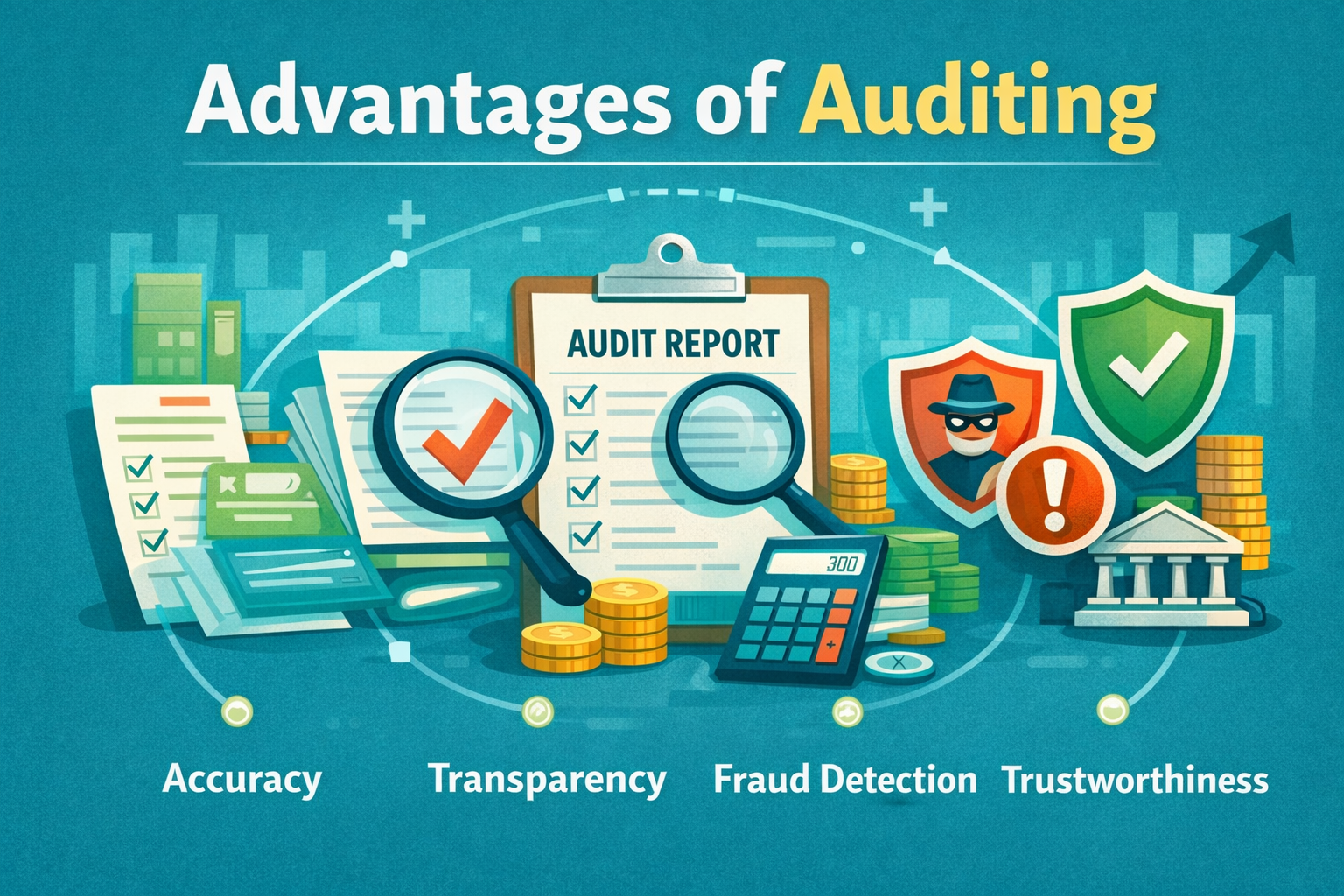
Audits offer numerous benefits beyond compliance. Here are major advantages of auditing for businesses in India:

1. Reduces Business Risk

Audits reveal weaknesses in internal systems, helping companies correct issues before they escalate.

2. Helps in Obtaining Loans and Investments

Banks and investors rely on audited financial statements. It increases trust and smoothens funding processes.

3. Enhances Operational Efficiency

Regular audits highlight inefficiencies and provide actionable recommendations.

4. Ensures Transparency

Audits promote ethical practices and transparency across departments.

5. Facilitates Better Financial Planning

With accurate financial data, budgeting and forecasting become more reliable.

6. Helps in Regulatory Compliance

Timely audits ensure adherence to Indian laws and prevent penalties.

7. Detects Errors and Fraud Early

This protects the organization from financial loss and reputational harm.

8. Strengthens Market Reputation

Audited businesses create confidence among customers, suppliers, and the general public.

The Role of Audit and Advisory Firms – KKS Capital Advisor

Professional firms play a crucial role in ensuring the audit process is smooth, compliant, and insightful. KKS Capital Advisor, for instance, assists businesses with:

  • Financial auditing
  • Tax and compliance audits
  • Internal audit services
  • Risk assessment
  • Business advisory and financial consulting

Their expertise helps companies maintain accuracy, adopt best practices, and meet all regulatory requirements efficiently.

Engaging experienced advisors ensures not just compliance, but also improved financial discipline and better governance across the organization.

Conclusion

Auditing is a vital component of financial management and corporate governance in India. Whether it’s ensuring accuracy in financial statements, boosting transparency, detecting fraud, or meeting statutory compliance, audits play an indispensable role in building strong and trustworthy organizations.

Understanding the importance of auditing, the various types of audits in India, and the advantages of auditing helps businesses strengthen their internal systems and gain stakeholder confidence. Professional firms such as KKS Capital Advisor further support companies in implementing effective audit practices that align with Indian regulations and global standards.

Read More