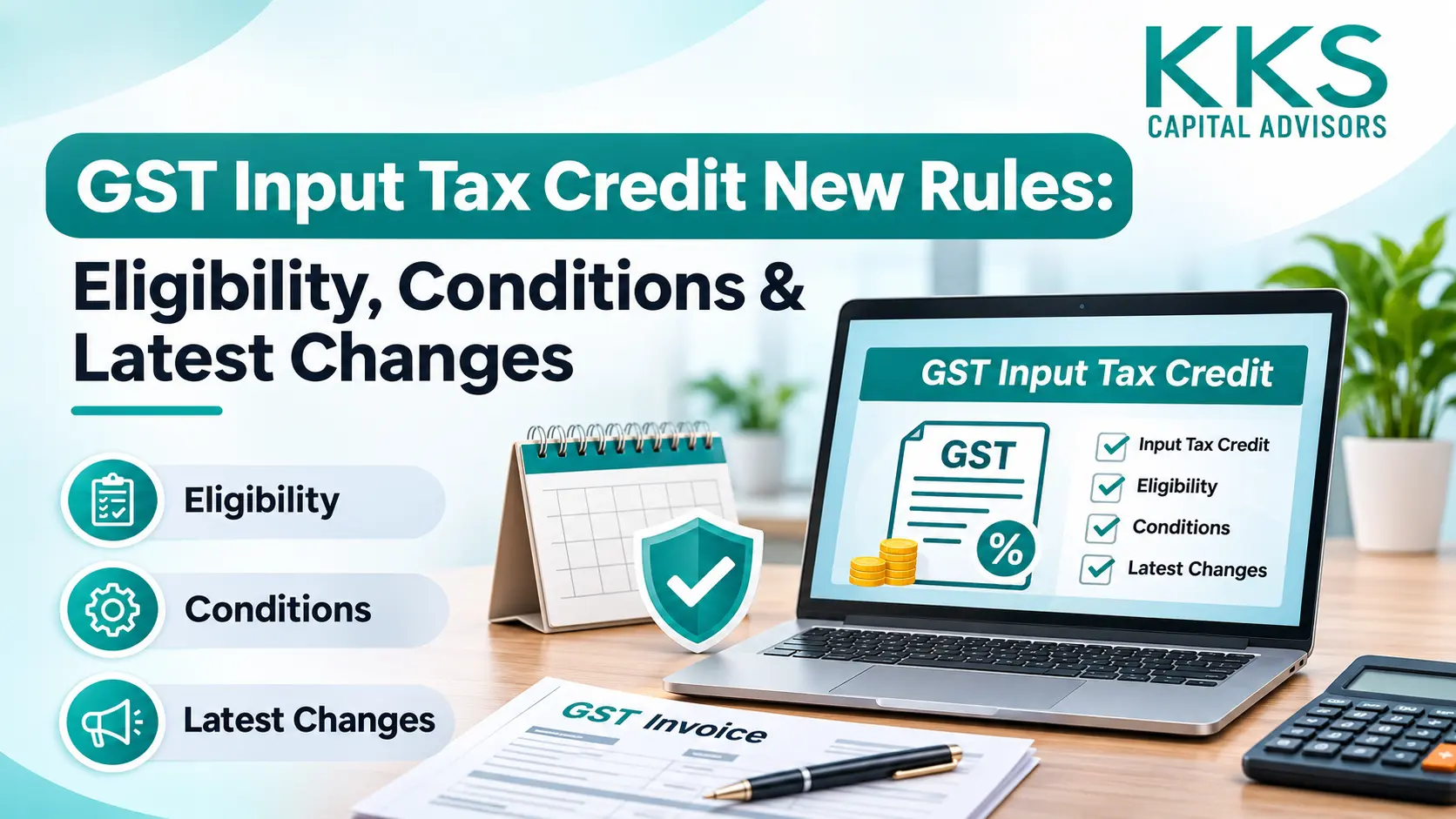
What Are the GST Input Tax Credit New Rules? (Quick Answer)
Input tax credit (ITC) under GST lets a registered business reduce the GST it owes on sales by the GST it has already paid on business purchases. For example, if you collect ₹1,00,000 GST on sales and paid ₹60,000 GST on eligible purchases, you pay only ₹40,000 in cash.
Table of Contents
ToggleThe biggest set of GST input tax credit new rules came from the 57th GST Council meeting on 8 October 2026. The Council recommended:
- Allowing ITC on items that are blocked today, such as health and life insurance, outdoor catering, free samples, telecom towers and pipelines outside the factory
- Refunds of accumulated ITC on input services (for ITC availed from 1 November 2026) and on capital goods (from 1 April 2027)
- Changes to GSTR-1, GSTR-3B and the Invoice Management System (IMS), proposed from the April 2027 return
Important: most of these are recommendations. They take effect only after the law, rules or notifications are amended. Until then, the existing GST ITC rules continue to apply, and you should not claim extra ITC based only on the Council’s announcement.
Input Tax Credit Eligibility: Conditions Under GST Law
Under Section 16 of the CGST Act, 2017, a registered person can claim ITC on goods or services used in the course or furtherance of business, but only if all of these conditions are met:
- You hold a valid tax invoice or debit note issued by a GST-registered supplier.
- You have received the goods or services. Delivery to a third party on your instruction also counts.
- The invoice appears in your GSTR-2B. Your supplier must have reported it in GSTR-1 or IFF.
- The supplier has actually paid the tax to the government.
- You have filed your GSTR-3B return.
- You pay the supplier within 180 days of the invoice date. If you don’t, the ITC must be reversed with interest, and you can claim it again once you pay.
Time limit: ITC for a financial year must be claimed by 30 November of the following year, or the date you file the annual return, whichever is earlier. For FY 2025-26, the last date is 30 November 2026.
ITC on capital goods: You can claim ITC on machinery and equipment used for business. However, you cannot claim both ITC on the GST component and depreciation on that same GST amount.
GST ITC New Rules: What the 57th GST Council Recommended
The table below lists the main ITC changes the GST Council recommended on 8 October 2026, along with their status.
Area | Rule Today | Recommended Change | Status / Effective From |
|---|---|---|---|
Health and life insurance | ITC blocked unless the insurance is required by law | ITC to be allowed | Needs amendment to Section 17(5); date to be notified |
Outdoor catering | ITC blocked unless used in the same line of business | Restriction to be removed | Needs amendment to Section 17(5); date to be notified |
Free samples | ITC blocked, and must be reversed | ITC to be allowed | Needs amendment to Section 17(5)(h); date to be notified |
Goods destroyed on shelf-life expiry | ITC must be reversed | ITC allowed where the law requires destruction on expiry | Needs amendment to Section 17(5)(h); date to be notified |
Telecom towers and pipelines outside the factory | Treated as immovable property, so ITC blocked | ITC to be allowed | Needs amendment to Section 17(5); date to be notified |
Refund of ITC on input services (inverted duty) | Not refundable | Refund allowed | For ITC availed on or after 1 November 2026 |
Refund of ITC on capital goods (inverted duty and zero-rated supplies) | Not refundable | Refund allowed, spread over 60 months | For ITC availed on or after 1 April 2027 |
IMS (Invoice Management System) | Works through the GST portal | Legal backing through a new Rule 60(6A) | Rule amendment to be notified |
Credit ledger blocking (Rule 86A) | Credit can be blocked without a hearing | A hearing must be given before blocking | Rule amendment to be notified |
GSTR-1 and GSTR-3B time limits | Different from the ITC deadline | Aligned with the 30 November deadline under Section 16(4) | Needs amendment to Sections 37 and 39 |
Return reporting | Current GSTR-1, GSTR-1A and GSTR-3B formats | New credit reversal and reclaim statement, plus a separate statement for reverse charge (RCM) tax and ITC | Proposed from the April 2027 return |
The Council also asked a committee to review ITC for genuine buyers who hold valid invoices but whose supplier did not pay the tax (Section 16(2)(c)). Any change from that review is expected from 1 April 2027 at the earliest.
What this means for your business: keep claiming ITC under the current rules for now. Credit you have already reversed cannot be claimed again unless the amendment specifically allows it.
Blocked Credits Under Section 17(5)
Even when all the Section 16 conditions are met, some purchases do not qualify for ITC. Under the current law, the main blocked credits are:
- Motor vehicles that seat up to 13 people, unless you use them to sell vehicles, carry passengers, train drivers, or transport goods
- Food, beverages, beauty treatment, health services and cosmetic surgery, unless used in the same line of business or required by law
- Club and health club memberships, and travel benefits for employees on leave or vacation
- Works contracts and construction of immovable property, except plant and machinery
- Goods or services used for personal consumption
- Goods lost, stolen, destroyed, written off or given away as gifts or free samples
- Tax paid under the composition scheme, or tax paid because of fraud, wilful misstatement or suppression of facts
Some of these, including insurance, outdoor catering, free samples and certain destroyed goods, may become eligible once the 57th GST Council recommendations are notified. Until then, they stay blocked.
ITC reversals to remember:
- Common credit (Rule 42 and Rule 43): if you make both taxable and exempt supplies, reverse the ITC on inputs and capital goods used for exempt supplies.
- Unpaid suppliers: reverse the ITC if you have not paid the supplier within 180 days.
- Credit notes: reduce your ITC when a supplier issues a credit note.
How to Claim ITC Under GST Correctly: Step by Step
- Check every purchase invoice. Confirm the supplier’s GSTIN, your GSTIN, the invoice number, the tax amount and the place of supply.
- Review invoices in IMS. In the Invoice Management System, mark each supplier invoice as accepted, rejected or pending. Your GSTR-2B is generated from these actions.
- Reconcile GSTR-2B with your purchase register. Claim only what appears in GSTR-2B and is supported by your books. Follow up with suppliers about any missing invoices.
- Remove blocked and ineligible credits. Exclude items blocked under Section 17(5), and calculate any reversal for exempt supplies.
- Track supplier payments. Reverse ITC on invoices that are still unpaid after 180 days, and claim it again once you pay.
- Report ITC in GSTR-3B. Enter eligible ITC, reversals and reclaims in the correct tables, and file the return by the due date.
- Close the year on time. Claim any missed ITC for the year before 30 November of the following year, or before you file the annual return, whichever is earlier.
Regular monthly reconciliation is the best protection against ITC mismatch notices and lost credit.
How KKS Capital Helps You Claim the Right ITC
ITC is often the largest working-capital item in a business’s GST. Missed invoices, late payments to suppliers and wrong claims of blocked credit can cost lakhs. KKS Capital, a chartered accountant firm in Gurgaon, helps businesses with:
- Monthly IMS review and GSTR-2B reconciliation against purchase records
- Identifying blocked credits and the reversals required under Rules 42 and 43
- Tracking the 180-day supplier payment rule and reclaiming reversed ITC
- Filing GSTR-3B and the annual return, so no eligible credit is lost before the 30 November deadline
- Refund claims for accumulated ITC under the inverted duty structure
- Planning for the 57th GST Council changes as they are notified
- Replying to ITC mismatch notices and Rule 86A credit-blocking cases
FAQ'S
1. What are the GST input tax credit new rules for 2026?
The 57th GST Council (8 October 2026) recommended allowing ITC on insurance, outdoor catering, free samples, telecom towers and pipelines, and refunds of ITC on input services and capital goods. It also proposed return and IMS changes from April 2027. Most of these apply only once they are notified.
2. Can I claim ITC on health insurance now?
Not yet, unless the insurance is required by law. The recommendation to allow it still needs an amendment to Section 17(5).
3. What is the last date to claim ITC for FY 2025-26?
30 November 2026, or the date you file the annual return for FY 2025-26, whichever is earlier.
4. Who is eligible for input tax credit under GST?
Any registered person who uses goods or services for business. They must hold a valid invoice, have received the supply, see the invoice in GSTR-2B, have a supplier who paid the tax, and file GSTR-3B.
5. Can I claim ITC if the invoice is not in GSTR-2B?
No. Under current law, ITC is allowed only on invoices that appear in your GSTR-2B. Ask the supplier to report the invoice in GSTR-1 or IFF.
6. What happens if I don’t pay my supplier within 180 days?
You must reverse the ITC with interest. You can claim it again once you pay the supplier.
7. Can I get a refund of ITC on input services?
The Council recommended allowing refunds of accumulated ITC on input services under the inverted duty structure, for ITC availed on or after 1 November 2026. The refund rules must be amended to put this into effect.
8. Is IMS mandatory for claiming ITC?
IMS actions decide which invoices flow into your GSTR-2B, so reviewing invoices in IMS is now an essential part of claiming ITC correctly. The Council has proposed a new Rule 60(6A) to give IMS legal backing.
Don’t Leave Eligible ITC on the Table
The GST input tax credit rules are changing, and the 30 November deadline is close. Talk to the KKS Capital team in Gurgaon for an ITC health check: we will reconcile your GSTR-2B, flag blocked credits and make sure every eligible rupee is claimed. Contact KKS Capital today.