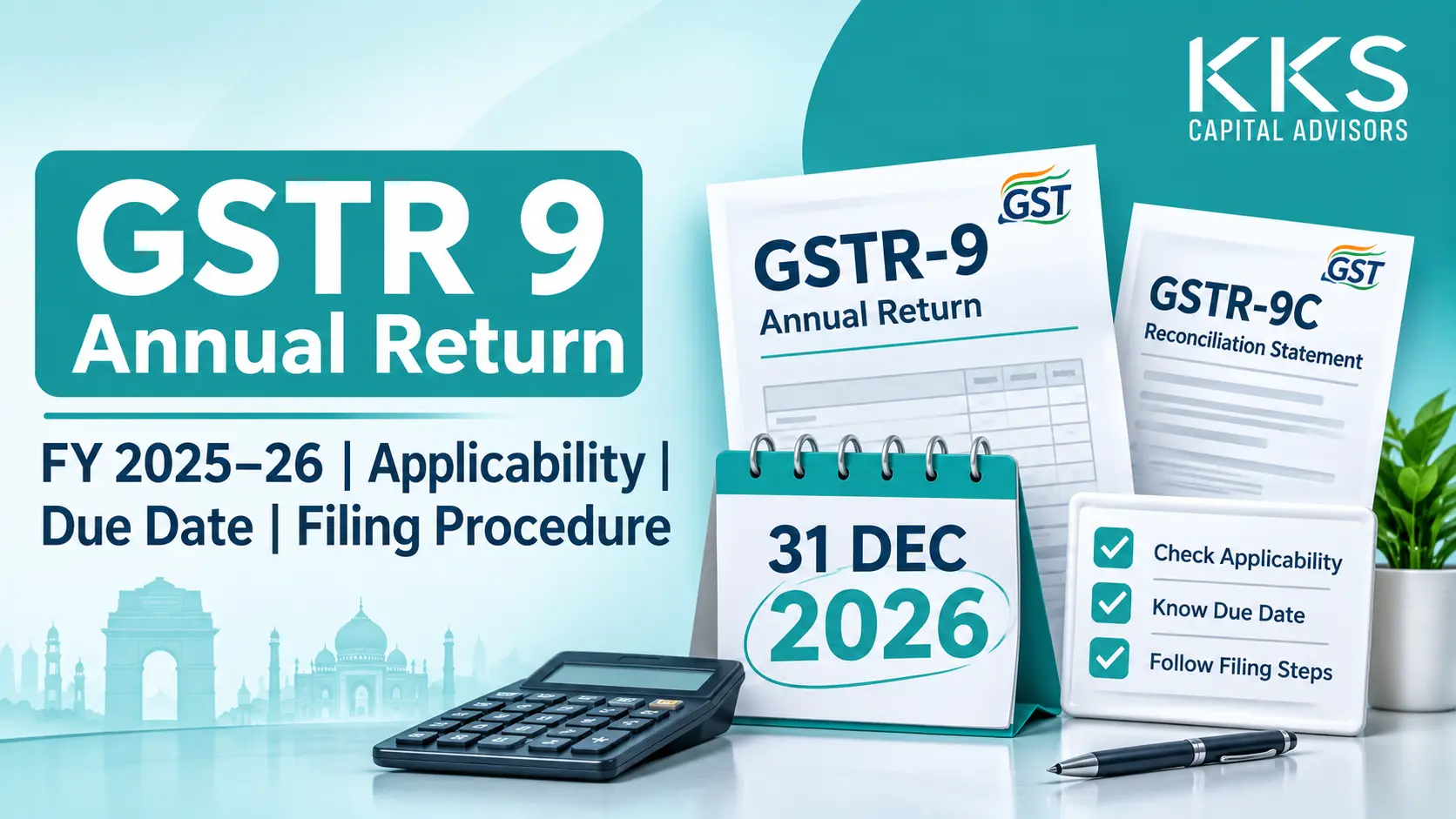
GSTR 9 Annual Return for FY 2025–26: Applicability, Due Date and Filing Procedure

GSTR 9 Annual Return for FY 2025–26: Applicability, Due Date and Filing Procedure

For FY 2025–26, regular GST-registered taxpayers generally need to file the GSTR 9 annual return if their aggregate turnover exceeds ₹2 crore. If it exceeds ₹5 crore, they must also file GSTR-9C. The standard deadline for both forms is 31 December 2026. As of 14 November 2026, no general extension was found in the notifications reviewed. Rule 80 · GST Council summary of Notification 15/2025

Quick answer for FY 2025–26

Aggregate turnover across India under the same PAN

Filing requirement for regular taxpayers

Up to and including ₹2 crore

Exempt from GSTR-9 filing

Above ₹2 crore and up to and including ₹5 crore

File GSTR-9

Above ₹5 crore

File GSTR-9 and self-certified GSTR-9C

Before filing, clear pending periodic returns and reconcile the books with filed returns and input tax credit (ITC) records. Check the ITC and amendment cut-offs before signing the annual return.

What is the GSTR-9 annual return?

Form GSTR-9 is the annual return under Section 44 of the Central Goods and Services Tax (CGST) Act. It summarises taxable and other supplies, GST paid, ITC claimed and reversed, and relevant transactions from the financial year reported in the following year. It also captures other particulars, such as refunds and demands, where the form requires them. GST Portal GSTR-9 manual

Your finance team will use two sets of periodic returns to build that summary. GSTR-1 contains outward supply details. GSTR-3B records the summary liability, eligible credit and tax payment. Since each form serves a different purpose, compare both with the books before accepting annual figures from the portal. For a refresher on what each form covers, read the guide to GST returns in India.

Who must file GSTR-9 for FY 2025–26?

Test the threshold using aggregate turnover across all Goods and Services Tax Identification Numbers (GSTINs) under the same Permanent Account Number (PAN). Include taxable supplies, exempt supplies, exports and inter-State supplies as applicable. Exclude GST and cess and inward supplies on which the recipient pays GST under reverse charge. Once you determine applicability, prepare the return separately for each applicable GSTIN. Notification No. 15/2025–Central Tax grants the exemption for turnover up to ₹2 crore from FY 2024–25 onward. CBIC notification text · CBIC guidance on aggregate turnover

Example. A company has two regular registrations under the same PAN, with ₹1.7 crore of turnover in Haryana and ₹1.4 crore in Delhi. Its aggregate turnover is ₹3.1 crore. Both registrations must file GSTR-9, even though neither individually crosses ₹2 crore. At ₹3.1 crore, GSTR-9C is outside the filing requirement.

Rule 80 excludes input service distributors, casual and non-resident taxable persons, and persons paying or collecting tax under Sections 51 or 52 in those capacities. Businesses under the composition scheme throughout the year use annual GSTR-4. If your business switched between regular and composition status, evaluate the regular registration period separately before deciding which forms to file. Rule 80

When is GSTR-9 due, and what is the late fee?

The standard due date for the FY 2025–26 GST annual return is 31 December 2026. Where GSTR-9C applies, the same deadline covers the reconciliation statement. Verify the deadline shown against your GSTIN in the Annual Return dashboard before filing. Rule 80

FY 2025–26 aggregate turnover

CGST late fee per day

CGST maximum

Above ₹2 crore to ₹5 crore

₹25

0.02% of turnover in the State or Union Territory

Above ₹5 crore to ₹20 crore

₹50

0.02% of turnover in the State or Union Territory

Above ₹20 crore

₹100

0.25% of turnover in the State or Union Territory

These are the central amounts. Where the corresponding State or Union Territory provision mirrors them, combined daily fees are ₹50, ₹100 and ₹200 respectively. Use all-India aggregate turnover to find the applicable band and the State or Union Territory turnover to calculate the cap. If GSTR-9C is required, filing GSTR-9 alone leaves the annual return incomplete for late-fee purposes. The fee can continue until GSTR-9C is furnished. Notification 07/2023 · CBIC Circular 246/03/2025-GST

What should you reconcile before GSTR-9 filing?

Build a worksheet for each GSTIN. Keep the source figure, the figure reported to GST, the difference, the reason and the proposed action in separate columns. Attach invoice or return references to each material difference so the person approving the return can trace it quickly.

  •             Sales and output GST. Match the sales register and credit or debit notes with GSTR-1 and the liability in GSTR-3B. Review exports, exempt supplies, branch transfers and invoices amended after year-end. Check whether the difference relates to timing, reporting or an actual tax shortfall.
  •             ITC and purchase records. Compare the purchase register, GSTR-2B, Table 8A document details and ITC claimed in GSTR-3B. Check reversals, reclaims, blocked credits and credits from imports or reverse charge using the relevant supporting documents. An invoice appearing in GSTR-2B is one part of the eligibility review. Read the input tax credit rules and claim guide. GST Portal guidance on Table 8A
  •             Tax paid and prior-year adjustments. Match liability and payments by tax head with the electronic ledgers and payment records. Track FY 2025–26 transactions reported in FY 2026–27 separately and document any prior-year corrections that need to appear in the annual form.
  •             Financial statement differences. If GSTR-9C applies, reconcile books and audited financial statements with the annual return. Where the accounts cover multiple registrations, retain the GSTIN-wise turnover and credit workings and explain differences that remain after reconciliation.

Also check whether the account balances contain entries booked without a GSTIN, such as a year-end adjustment posted at head office. Assign each relevant entry to the registration it belongs to and retain the basis for that allocation.

For example, a March 2026 invoice may appear in the next financial year’s GSTR-1 if it was reported late. Note the invoice date, the reporting period and where the tax was paid. That record helps you place the amount once in the right section and avoid treating a timing difference as an unpaid liability.

Check the ITC deadline first. Under Section 16(4), the general cut-off for taking FY 2025–26 invoice or debit note ITC is 30 November 2026 or the date the relevant annual return is furnished, whichever is earlier. Resolve eligible unclaimed credit through the applicable periodic return before signing GSTR-9. CBIC guidance on Section 16

How do you file GSTR-9 on the GST Portal?

  1.           Open the correct annual return. Complete applicable pending GSTR-1 and GSTR-3B filings for FY 2025–26. Sign in to the GST Portal, open Services → Returns → Annual Return, select 2025–26, click Search, and choose Prepare Online in the GSTR-9 tile.
  2.           Download the supporting figures. Save the system-generated GSTR-9 summary, the GSTR-1 and GSTR-3B summaries, and the Table 8A Excel file. Compare them with your reconciliation worksheet before entering figures.
  3.           Complete and preview the form. Select the relevant response to the nil return question. Review each applicable table and amend editable fields where supported. For FY 2025–26, use the form instructions for reporting options and the portal prompts for validation. Keep the outward HSN summary ready if applicable.
  4.           Compute liabilities and review late fees. Select Compute Liabilities, check any late fees, and add funds to the electronic cash ledger if needed. Preview the draft again after changes. Confirm the GSTIN, reporting year, taxable turnover, and tax payment details.
  5.           Sign, file and save proof. Choose the authorised signatory and file using a Digital Signature Certificate (DSC) or Electronic Verification Code (EVC), as permitted. Confirm the filed status and save the application reference number (ARN) and filed return. Pay any additional tax liability declared in GSTR-9 through Form GST DRC-03 as applicable, and retain payment proof.
  6.           File GSTR-9C where required. After filing GSTR-9, open the GSTR-9C tile, complete the statement, and upload the required supporting documents. Save its filing acknowledgement and financial statement reconciliation with your annual records.

GST Portal GSTR-9 manual · GSTR-9C filing guidance 

Get help with your GST annual return

If you have several GSTINs, unresolved ITC differences or a GSTR-9C requirement, share your GSTIN list, annual turnover, filed returns and reconciliation worksheet with KKS Capital Advisors. The GST compliance and return filing team can help assess applicability, reconcile the figures, organise supporting documents and guide you through filing. Contact the team to discuss your FY 2025–26 return.

FAQ'S

Can I revise GSTR-9 after filing?

The GST Portal does not provide a revision option for a filed GSTR-9. Download and approve the draft before signing. If you discover a mistake after filing, assess the underlying tax or reporting issue and any remedy available under GST law.

Zero sales alone is insufficient. The GST Portal also checks for purchases, liabilities, ITC, refunds, demands and late fees. Check whether you are exempt from filing first. If filing is required and the GSTIN has activity to report, use the regular annual return. 

GSTR-9C is a self-certified reconciliation statement under the current Rule 80 framework. The audited annual financial statements used for the reconciliation are distinct from certification of the GST form. 

Check whether any applicable GSTR-1 statements or GSTR-3B returns are pending for FY 2025–26 under that GSTIN. File the pending returns, then reopen the Annual Return dashboard and select the financial year again. 

The GST Portal fills Table 8A from GSTR-2B for FY 2025–26 and locks the field. If the figure differs from your purchase records, download the Table 8A Excel file and compare individual invoices with your purchase register and GSTR-3B to identify the difference. 

If your annual reconciliation identifies a tax shortfall that you declare in GSTR-9, pay it through Form GST DRC-03. After filing GSTR-9, the portal provides a link to DRC-03. Keep the payment acknowledgement with your annual return records.

Yes. Use the GST Portal’s GSTR-9 Offline Utility to enter the details and generate a JSON file. Upload it to the portal, review the processed draft, and complete signing and filing online.

Check that the GST Portal shows the return status as Filed and has generated an Application Reference Number (ARN). Download the filed return in PDF or Excel format and save it with the ARN for your records.

Read More

Form 16 vs Form 16A: Key Differences, Meaning, Uses and TDS Rules in India

Introduction

Tax Deducted at Source (TDS) is an important part of India’s income tax system. When an employer, bank, company, or another person deducts tax from a payment, the recipient needs a record of the deduction. The Income Tax Department provides different TDS certificates for different types of income.

Two commonly discussed certificates are Form 16 and Form 16A. Although their names look similar, they serve different purposes.

Form 16 is traditionally associated with TDS on salary income, while Form 16A covers TDS on specified non-salary payments, such as interest, professional fees, commission, and other applicable transactions.

The difference between Form 16 and Form 16A mainly relates to the type of income, the person responsible for issuing the certificate, its contents, and the frequency of issuance.

Important 2026 update: The Income-tax Act, 2025 and Income-tax Rules, 2026 introduced revised TDS certificate numbering from 1 April 2026. Form 130 replaces the earlier Form 16, while Form 131 replaces the earlier Form 16A. This guide explains the familiar Form 16 vs Form 16A terminology and also covers the new forms so taxpayers understand which certificates apply to their tax period.

What Is Form 16?

Form 16 is a TDS certificate traditionally issued by an employer to an employee when tax is deducted from salary under the applicable provisions of income tax law.

It provides a record of the salary paid, applicable deductions, taxable income, and TDS deducted and deposited with the government.

Employees generally use Form 16 to prepare their income tax returns and verify salary-related tax information.

What Does Form 16 Contain?

Under the earlier Form 16 structure, the certificate has two main parts.

Part A: TDS Details

Part A contains information about the employer, employee, and tax deducted during the financial year.

It generally includes:

  • Employer’s name, address, PAN, and TAN.
  • Employee’s name and PAN.
  • Employment period.
  • Salary-related TDS details.
  • Tax deposited with the government.
  • Relevant challan and payment information.

Part B: Salary and Tax Computation Details

Part B provides a breakdown of the employee’s salary and taxable income.

It generally includes:

  • Salary components and allowances.
  • Exemptions under applicable tax provisions.
  • Deductions claimed by the employee.
  • Gross total income.
  • Taxable income.
  • Tax liability and applicable rebate.
  • TDS calculation and tax payable or refundable.

These details help employees understand how their employer calculated salary-related TDS.

What Is Form 16A?

Form 16A is a TDS certificate traditionally issued for tax deducted from income other than salary. It is provided by the person or organisation responsible for deducting TDS from an eligible payment.

For example, a bank might deduct TDS from interest paid on a fixed deposit. Similarly, a company might deduct TDS from professional fees paid to a consultant.

The recipient receives Form 16A as proof of the amount deducted and deposited with the government.

Unlike Form 16, which contains a detailed salary and tax computation, Form 16A mainly reports the payment and corresponding TDS information.

What Does Form 16A Contain?

Form 16A generally includes:

  • Name and address of the deductor.
  • PAN and TAN of the deductor.
  • Name and PAN of the deductee.
  • Nature of payment.
  • Amount paid or credited.
  • TDS amount deducted.
  • Date of tax deduction.
  • Challan identification number.
  • Details of tax deposited with the government.
  • Relevant quarterly TDS statement information.

The certificate helps recipients verify their non-salary TDS credits while preparing their income tax returns.

Form 16 vs Form 16A: Key Differences

The main difference between Form 16 and Form 16A is the type of income on which tax is deducted. Form 16 traditionally covers salary-related TDS, whereas Form 16A covers specified non-salary payments.

Comparison Factor

Form 16

Form 16A

Purpose

TDS certificate for salary income

TDS certificate for specified non-salary income

Applicable income

Salary

Interest, professional fees, commission, and other eligible payments

Issuing authority

Employer or specified bank in applicable cases

Person or organisation deducting TDS

Recipient

Salaried employee or eligible specified senior citizen

Individual, professional, freelancer, business, or other deductee

Frequency

Annual

Quarterly

Main information

Salary details, exemptions, deductions, and TDS

Payment details and TDS information

Main use

Salary income reporting and ITR preparation

Non-salary income and TDS reporting

Generation

Through the applicable TDS system

Through the applicable TDS system, traditionally TRACES

The exact form and applicable provisions depend on the tax period. The new certificate numbering effective from April 2026 is explained below.

When Is Form 16 Issued?

Form 16 is issued annually by the employer after the end of the relevant financial year when salary-related TDS has been deducted.

Under the earlier Income-tax Rules, 1962, the general deadline was 31 May following the financial year. Under the revised Income-tax Rules, 2026, the corresponding Form 130 is due by 15 June following the relevant tax year.

For example, for FY 2025–26, the earlier Form 16 framework applies. For Tax Year 2026–27, the new Form 130 framework applies.

If an employee changes jobs during the year, each employer is responsible for providing the applicable salary TDS certificate for the period of employment.

When Is Form 16A Issued?

Form 16A is traditionally issued quarterly when TDS is deducted from eligible non-salary payments.

Quarter

Period

Form 16A Due Date

Q1

April to June

15 August

Q2

July to September

15 November

Q3

October to December

15 February

Q4

January to March

15 June

For the new tax framework effective from April 2026, the corresponding certificate is Form 131. Its quarterly issuance deadlines follow the dates specified in the revised rules.

The deductor should ensure the quarterly TDS statement is filed correctly before generating the certificate.

Which Payments Require Form 16A?

Form 16A applies to specified non-salary payments where TDS is deducted under the relevant provisions.

Common examples include:

Interest Income: Banks and financial institutions may deduct TDS on interest payments from fixed deposits and other eligible deposits.

Professional Fees: Companies deduct applicable TDS when making payments to consultants, accountants, lawyers, and other professionals.

Commission and Brokerage: TDS may apply to commission and brokerage payments made to agents, intermediaries, and other eligible recipients.

Rent Payments: Certain rent payments attract TDS under the applicable provisions. However, some specified rent transactions use separate certificate formats rather than Form 16A.

Contract Payments: Businesses may deduct TDS from payments made to contractors and subcontractors when the applicable conditions are satisfied.

The applicable TDS rate and threshold depend on the nature of the payment, recipient category, and relevant tax provisions. Form 16A itself does not prescribe one common TDS rate for every transaction.

How to Download Form 16 and Form 16A?

Both certificates are traditionally generated through the TRACES portal by the person responsible for deducting TDS.

Steps to Download Form 16

Employers generally follow these steps:

  1. Visit the official TRACES portal.
  2. Log in using the registered TAN and credentials.
  3. Open the Downloads section.
  4. Select Form 16.
  5. Choose the relevant financial year.
  6. Enter the employee’s PAN details.
  7. Submit the request for certificate generation.
  8. Open the Requested Downloads section.
  9. Download the generated certificate.
  10. Verify the certificate details and authenticate it before issuing it to the employee.

Employees generally receive Form 16 directly from their employer. They should contact the employer’s payroll or finance department if the certificate is unavailable.

Steps to Download Form 16A

The deductor generally follows these steps:

  1. Visit the official TRACES portal.
  2. Log in using the registered TAN account.
  3. Navigate to Downloads.
  4. Select Form 16A.
  5. Choose the relevant financial year and quarter.
  6. Enter or select the required PAN details.
  7. Submit the certificate generation request.
  8. Open Requested Downloads.
  9. Download the generated certificate.
  10. Verify and authenticate the certificate before issuing it to the recipient.

Recipients should request Form 16A from the person or organisation that deducted their TDS.

Note: For tax periods beginning on or after 1 April 2026, the corresponding new certificate numbers are Form 130 and Form 131. Check the applicable TRACES workflow for the relevant period.

How Are Form 16 and Form 16A Used While Filing ITR?

Both certificates help taxpayers report income and claim the correct TDS credit while preparing their income tax returns.

However, taxpayers should not rely on these certificates alone.

Before filing an ITR, compare the information in the certificates with:

  • Form 26AS.
  • Annual Information Statement (AIS).
  • Salary slips and employer statements.
  • Bank interest certificates.
  • Professional income records.
  • Other income and tax payment documents.

For example, suppose an employee earns ₹8,00,000 in salary and receives ₹15,000 as bank interest during the year. The employer issues the salary TDS certificate, while the bank provides the applicable non-salary TDS certificate if it deducts tax.

The employee must report both income sources correctly in the ITR. The relevant TDS credits should also be checked against the tax department’s records.

For a better understanding, read our guide on AIS vs Form 26AS. It explains how these statements differ and how taxpayers should reconcile reported income and tax credits before filing.

A mismatch between the certificates and Form 26AS or AIS should be investigated before claiming the tax credit.

What Is the Difference Between Form 16 Part A and Form 16A?

This is one of the most common points of confusion among taxpayers.

Form 16 Part A is a section of the salary TDS certificate. It contains employer and employee details, employment information, and salary-related TDS particulars.

Form 16A is a separate TDS certificate issued for specified non-salary payments. It contains payment and tax deduction details relating to income such as interest, professional fees, and commission.

The letter A in Form 16 Part A does not make it the same as Form 16A.

Understanding this distinction helps taxpayers select and verify the correct document while preparing their income tax returns.

Common Mistakes to Avoid While Checking Form 16 and Form 16A

Taxpayers should review their TDS certificates carefully before filing their income tax returns.

Common mistakes include:

  • Incorrect PAN details: Verify the PAN of the deductor and deductee.
  • Mismatch in TDS amount: Compare the certificate with Form 26AS and AIS.
  • Missing income information: Report all taxable income, including income where no TDS was deducted.
  • Ignoring previous employers: Collect certificates from every employer for the relevant period.
  • Confusing Form 16 Part A with Form 16A: Remember that they serve different purposes.
  • Claiming incorrect TDS credit: Claim only the eligible tax credit supported by the applicable records.
  • Using outdated forms: Check whether the old or revised certificate number applies to your tax period.

If you identify a mismatch in your tax records, first contact the deductor and request a correction where required. You can also read our guide on income tax notice assistance to understand how professional support helps taxpayers address tax-related queries.

Correcting these issues before filing helps reduce errors and avoid unnecessary tax-related queries.

How to File an Income Tax Return Using TDS Certificates

After collecting your TDS certificates, organise your salary, interest, and other income records. Check the applicable ITR form and report each income source under the correct category.

Follow these basic steps:

  1. Collect Form 16 and Form 16A, where applicable.
  2. Download AIS and Form 26AS for the relevant tax period.
  3. Compare income and TDS information with your records.
  4. Report salary and other taxable income.
  5. Claim eligible TDS credits.
  6. Review your tax calculation.
  7. Submit and verify your income tax return.

For a detailed explanation of the filing process, read KKS Capital Advisor’s guide on how to file an income tax return online.

How Can KKS Capital Advisor Help With Income Tax and TDS Compliance?

Understanding income tax documents is important for individuals, professionals, and businesses. Errors in TDS reporting, income disclosure, or tax credit claims can create problems during income tax return filing.

KKS Capital Advisor provides tax advisory, income tax return filing, GST, accounting, auditing, and regulatory compliance services.

Professional guidance can help you:

  • Review Form 16 and Form 16A.
  • Reconcile TDS credits with Form 26AS and AIS.
  • Identify missing or incorrect tax information.
  • Organise income tax documents.
  • Prepare and file applicable income tax returns.
  • Address tax-related discrepancies.

Explore KKS Capital Advisor’s tax advisory and professional services to understand the available support.

If you need assistance with income tax compliance, TDS reconciliation, or return preparation, consult a tax professional at KKS Capital Advisor to discuss your requirements.

Conclusion

Understanding Form 16 vs Form 16A helps taxpayers identify the correct TDS certificate for their income. Form 16 traditionally covers salary-related TDS, while Form 16A covers specified non-salary payments. Both certificates support accurate income reporting and TDS reconciliation.

Taxpayers should verify their certificates against Form 26AS and AIS, report all applicable income, and check the correct certificate format for the relevant tax period.

For professional assistance with income tax, TDS reconciliation, and financial compliance, contact KKS Capital Advisor to discuss your requirements.

FAQ'S

1. What is the main difference between Form 16 and Form 16A?

Form 16 is traditionally issued for TDS deducted from salary income, whereas Form 16A is issued for TDS deducted from specified non-salary payments such as interest, commission, and professional fees.

Form 16A is traditionally issued quarterly. The deductor generates the certificate after filing the applicable quarterly TDS statement.

Yes. A salaried employee may receive Form 16 from their employer and Form 16A from a bank or another deductor if TDS is deducted from eligible non-salary income.

No. Form 16 Part A is one section of the salary TDS certificate. Form 16A is a separate certificate for specified non-salary TDS.

Form 16A is useful for reporting and verifying non-salary TDS credits. However, receiving this certificate is not a universal requirement for filing an ITR. Taxpayers must report their taxable income and claim eligible TDS credits using the relevant records.

The deductor traditionally downloads Form 16A through the TRACES portal and provides it to the recipient. The recipient should contact the deductor if the certificate has not been received.

Contact the deductor and ask them to check the TDS statement, PAN details, payment information, and filing records. The deductor may need to submit a correction statement before the tax credit reflects correctly.

Yes. From 1 April 2026, under the Income-tax Act, 2025 and Income-tax Rules, 2026, the earlier Form 16A is replaced by Form 131. The earlier Form 16 is replaced by Form 130. The applicable certificate depends on the tax period.

Sold a Property? Plan Your Capital Gains Before You File

Talk to the KKS Capital team in Gurgaon before you reinvest. We will calculate your gain, compare your tax options and make sure your Section 54 claim meets every condition. Contact KKS Capital today.

Read More

Section 54 of Income Tax Act: Capital Gains Exemption on Sale of a Residential Property

What Is Section 54 of the Income Tax Act? (Quick Answer)

Section 54 of the Income Tax Act gives an individual or HUF an exemption from tax on the long-term capital gain from selling a residential house. To get it, the gain must be reinvested in another residential house in India within the time allowed. The exemption equals the capital gain or the cost of the new house, whichever is lower, with an upper limit of ₹10 crore.

Selling a house you have owned for more than 24 months usually creates a long-term capital gain (LTCG). Without planning, this gain is taxed. Section 54 lets you save that tax by buying or building a new home.

Note on the new law: From 1 April 2026, the Income-tax Act, 2025 has replaced the Income-tax Act, 1961. The same exemption continues under Section 82 of the new Act, with the same main conditions. Sales made up to 31 March 2026 are covered by Section 54 of the old Act. Since most people still search for “Section 54”, this guide uses that name.

Who Can Claim the Section 54 Capital Gains Exemption?

  • Individuals and HUFs only. Companies, firms, LLPs and trusts cannot claim it.
  • Residents and NRIs. Non-resident Indians can also claim the exemption on the same conditions.
  • The asset sold must be a residential house (land along with the building), and its income must be taxable under “Income from House Property”.
  • It must be a long-term capital asset, which means it was held for more than 24 months before the sale.

Selling a plot, a commercial property or any other long-term asset does not qualify under Section 54. Those sales may be covered by Section 54F, which applies to long-term assets other than a residential house.

Conditions and Time Limits Under Section 54

Condition

Requirement

Asset sold

Residential house held for more than 24 months

New asset

One residential house in India (two houses allowed once in a lifetime if the gain is up to ₹2 crore)

Purchase of new house

Within 1 year before or 2 years after the date of sale

Construction of new house

Completed within 3 years from the date of sale

Maximum exemption

Capital gain or cost of new house, whichever is lower, up to ₹10 crore

Lock-in of new house

Must not be sold within 3 years of purchase or construction

Unused amount

Must be deposited in the Capital Gains Account Scheme before the income tax return due date


The ₹10 crore cap

From AY 2024-25, the exemption is capped at ₹10 crore. Even if you invest ₹15 crore in a new home, the exemption cannot exceed ₹10 crore, and any gain above that limit is taxable.

Two houses option

If your long-term capital gain is ₹2 crore or less, you can invest in two residential houses in India and claim the exemption on both. You can use this option only once in your lifetime.

Capital Gains Account Scheme (CGAS)

If you have not bought or built the new house before your income tax return due date, deposit the unused gain in a Capital Gains Account Scheme account with an authorised bank. You can then withdraw the money to buy or build the house within the time limit. Any amount that is not used by the end of the 2 or 3 year period becomes taxable as long-term capital gain in that year.

If you sell the new house within 3 years

If you sell the new house within 3 years of buying or building it, the exemption is withdrawn. The cost of the new house is reduced by the exempted gain when calculating the capital gain on its sale. This often turns that sale into a taxable short-term gain.

How Long-Term Capital Gain on Property Is Taxed

For sales on or after 23 July 2024, long-term capital gain on property is taxed at 12.5% without indexation. Resident individuals and HUFs who bought land or a building before 23 July 2024 can compare two options and pay whichever tax is lower:

  • 12.5% on the gain without indexation, or
  • 20% on the gain with indexation

Surcharge and 4% health and education cess apply on top of these rates. Section 54 can bring this tax down to zero if you reinvest the full gain.

Section 54 Exemption Calculation: Example

Mr. Sharma, a resident, sells a flat in Gurgaon in 2026. He bought it in 2015.

Particulars

Amount (₹)

Sale price of old flat

1,20,00,000

Less: Cost of acquisition (without indexation)

50,00,000

Less: Brokerage and transfer expenses

2,00,000

Long-term capital gain

68,00,000

Cost of new flat bought within 2 years

60,00,000

Section 54 exemption (lower of gain and new house cost)

60,00,000

Taxable long-term capital gain

8,00,000

Tax at 12.5%

1,00,000

Add: 4% cess

4,000

Total tax payable (before any surcharge)

1,04,000


Without Section 54, the tax on ₹68 lakh at 12.5% plus cess would be about ₹8.84 lakh. By reinvesting ₹60 lakh, Mr. Sharma cuts this to ₹1.04 lakh. If the new flat had cost ₹68 lakh or more, his entire gain would have been exempt.

This example is for illustration only. Your actual tax depends on your acquisition date, any indexation option, improvement costs, surcharge and your total income.

Section 54 vs Section 54F vs Section 54EC

Feature

Section 54

Section 54F

Section 54EC

Asset sold

Residential house

Any long-term asset other than a residential house

Land or building

Where to invest

New residential house

New residential house

Specified bonds (such as NHAI or REC)

Amount to invest

Capital gain

Full net sale consideration

Capital gain, up to ₹50 lakh

Time limit

1 year before / 2 years after (purchase); 3 years (construction)

Same as Section 54

Within 6 months of sale

Cap

₹10 crore

₹10 crore

₹50 lakh per year


Common Mistakes That Lead to Losing the Exemption

  • Buying the new house outside the 1-year-before or 2-year-after window
  • Not depositing the unused gain in a CGAS account before the return due date
  • Buying the new house abroad, because only a house in India qualifies
  • Selling the new house within 3 years
  • Claiming the two-house option a second time
  • Treating a property held for 24 months or less as long-term

How KKS Capital Helps with Capital Gains Tax Planning

Property sales involve large amounts, and one missed date can cost lakhs in tax. KKS Capital, a chartered accountant firm in Gurgaon, helps individuals, families and NRIs with:

  • Calculating long-term capital gain and comparing the 12.5% and 20%-with-indexation options
  • Planning reinvestment under Section 54, 54F or 54EC to save the most tax
  • Opening and managing Capital Gains Account Scheme deposits
  • Reporting the exemption correctly in your income tax return
  • Advice on how the Income-tax Act, 2025 applies to your sale

FAQ'S

1. What is Section 54 of the Income Tax Act?

It exempts long-term capital gain from the sale of a residential house if the gain is reinvested in another residential house in India within the time limits. The exemption is capped at ₹10 crore.

The same exemption continues under Section 82 of the Income-tax Act, 2025 for sales from 1 April 2026, with the same main conditions.

You can buy it within 1 year before or 2 years after the sale, or build it within 3 years after the sale.

Yes, but only once in your lifetime, and only if the long-term capital gain is ₹2 crore or less.

No. Under Section 54, you only need to invest the capital gain, not the full sale price. Under Section 54F, the full net sale amount must be invested to get the full exemption.

Yes. NRIs can claim it on the same conditions, as long as the new house is in India.

Deposit the unused gain in a Capital Gains Account Scheme account before the return due date, and use it within the time limit.

Not under Section 54. Selling a plot may qualify under Section 54F if you invest the net sale amount in a residential house, or under Section 54EC if you invest the gain in specified bonds.

Sold a Property? Plan Your Capital Gains Before You File

Talk to the KKS Capital team in Gurgaon before you reinvest. We will calculate your gain, compare your tax options and make sure your Section 54 claim meets every condition. Contact KKS Capital today.

Read More

GST Input Tax Credit New Rules: Eligibility, Conditions & Latest Changes

What Are the GST Input Tax Credit New Rules? (Quick Answer)

Input tax credit (ITC) under GST lets a registered business reduce the GST it owes on sales by the GST it has already paid on business purchases. For example, if you collect ₹1,00,000 GST on sales and paid ₹60,000 GST on eligible purchases, you pay only ₹40,000 in cash.

The biggest set of GST input tax credit new rules came from the 57th GST Council meeting on 8 October 2026. The Council recommended:

  • Allowing ITC on items that are blocked today, such as health and life insurance, outdoor catering, free samples, telecom towers and pipelines outside the factory
  • Refunds of accumulated ITC on input services (for ITC availed from 1 November 2026) and on capital goods (from 1 April 2027)
  • Changes to GSTR-1, GSTR-3B and the Invoice Management System (IMS), proposed from the April 2027 return

Important: most of these are recommendations. They take effect only after the law, rules or notifications are amended. Until then, the existing GST ITC rules continue to apply, and you should not claim extra ITC based only on the Council’s announcement.

Input Tax Credit Eligibility: Conditions Under GST Law

Under Section 16 of the CGST Act, 2017, a registered person can claim ITC on goods or services used in the course or furtherance of business, but only if all of these conditions are met:

  1. You hold a valid tax invoice or debit note issued by a GST-registered supplier.
  2. You have received the goods or services. Delivery to a third party on your instruction also counts.
  3. The invoice appears in your GSTR-2B. Your supplier must have reported it in GSTR-1 or IFF.
  4. The supplier has actually paid the tax to the government.
  5. You have filed your GSTR-3B return.
  6. You pay the supplier within 180 days of the invoice date. If you don’t, the ITC must be reversed with interest, and you can claim it again once you pay.

Time limit: ITC for a financial year must be claimed by 30 November of the following year, or the date you file the annual return, whichever is earlier. For FY 2025-26, the last date is 30 November 2026.

ITC on capital goods: You can claim ITC on machinery and equipment used for business. However, you cannot claim both ITC on the GST component and depreciation on that same GST amount.

GST ITC New Rules: What the 57th GST Council Recommended

The table below lists the main ITC changes the GST Council recommended on 8 October 2026, along with their status.

Area

Rule Today

Recommended Change

Status / Effective From

Health and life insurance

ITC blocked unless the insurance is required by law

ITC to be allowed

Needs amendment to Section 17(5); date to be notified

Outdoor catering

ITC blocked unless used in the same line of business

Restriction to be removed

Needs amendment to Section 17(5); date to be notified

Free samples

ITC blocked, and must be reversed

ITC to be allowed

Needs amendment to Section 17(5)(h); date to be notified

Goods destroyed on shelf-life expiry

ITC must be reversed

ITC allowed where the law requires destruction on expiry

Needs amendment to Section 17(5)(h); date to be notified

Telecom towers and pipelines outside the factory

Treated as immovable property, so ITC blocked

ITC to be allowed

Needs amendment to Section 17(5); date to be notified

Refund of ITC on input services (inverted duty)

Not refundable

Refund allowed

For ITC availed on or after 1 November 2026

Refund of ITC on capital goods (inverted duty and zero-rated supplies)

Not refundable

Refund allowed, spread over 60 months

For ITC availed on or after 1 April 2027

IMS (Invoice Management System)

Works through the GST portal

Legal backing through a new Rule 60(6A)

Rule amendment to be notified

Credit ledger blocking (Rule 86A)

Credit can be blocked without a hearing

A hearing must be given before blocking

Rule amendment to be notified

GSTR-1 and GSTR-3B time limits

Different from the ITC deadline

Aligned with the 30 November deadline under Section 16(4)

Needs amendment to Sections 37 and 39

Return reporting

Current GSTR-1, GSTR-1A and GSTR-3B formats

New credit reversal and reclaim statement, plus a separate statement for reverse charge (RCM) tax and ITC

Proposed from the April 2027 return


The Council also asked a committee to review ITC for genuine buyers who hold valid invoices but whose supplier did not pay the tax (Section 16(2)(c)). Any change from that review is expected from 1 April 2027 at the earliest.

What this means for your business: keep claiming ITC under the current rules for now. Credit you have already reversed cannot be claimed again unless the amendment specifically allows it.

Blocked Credits Under Section 17(5)

Even when all the Section 16 conditions are met, some purchases do not qualify for ITC. Under the current law, the main blocked credits are:

  • Motor vehicles that seat up to 13 people, unless you use them to sell vehicles, carry passengers, train drivers, or transport goods
  • Food, beverages, beauty treatment, health services and cosmetic surgery, unless used in the same line of business or required by law
  • Club and health club memberships, and travel benefits for employees on leave or vacation
  • Works contracts and construction of immovable property, except plant and machinery
  • Goods or services used for personal consumption
  • Goods lost, stolen, destroyed, written off or given away as gifts or free samples
  • Tax paid under the composition scheme, or tax paid because of fraud, wilful misstatement or suppression of facts

Some of these, including insurance, outdoor catering, free samples and certain destroyed goods, may become eligible once the 57th GST Council recommendations are notified. Until then, they stay blocked.

ITC reversals to remember:

  • Common credit (Rule 42 and Rule 43): if you make both taxable and exempt supplies, reverse the ITC on inputs and capital goods used for exempt supplies.
  • Unpaid suppliers: reverse the ITC if you have not paid the supplier within 180 days.
  • Credit notes: reduce your ITC when a supplier issues a credit note.

How to Claim ITC Under GST Correctly: Step by Step

  1. Check every purchase invoice. Confirm the supplier’s GSTIN, your GSTIN, the invoice number, the tax amount and the place of supply.
  2. Review invoices in IMS. In the Invoice Management System, mark each supplier invoice as accepted, rejected or pending. Your GSTR-2B is generated from these actions.
  3. Reconcile GSTR-2B with your purchase register. Claim only what appears in GSTR-2B and is supported by your books. Follow up with suppliers about any missing invoices.
  4. Remove blocked and ineligible credits. Exclude items blocked under Section 17(5), and calculate any reversal for exempt supplies.
  5. Track supplier payments. Reverse ITC on invoices that are still unpaid after 180 days, and claim it again once you pay.
  6. Report ITC in GSTR-3B. Enter eligible ITC, reversals and reclaims in the correct tables, and file the return by the due date.
  7. Close the year on time. Claim any missed ITC for the year before 30 November of the following year, or before you file the annual return, whichever is earlier.

Regular monthly reconciliation is the best protection against ITC mismatch notices and lost credit.

How KKS Capital Helps You Claim the Right ITC

ITC is often the largest working-capital item in a business’s GST. Missed invoices, late payments to suppliers and wrong claims of blocked credit can cost lakhs. KKS Capital, a chartered accountant firm in Gurgaon, helps businesses with:

  • Monthly IMS review and GSTR-2B reconciliation against purchase records
  • Identifying blocked credits and the reversals required under Rules 42 and 43
  • Tracking the 180-day supplier payment rule and reclaiming reversed ITC
  • Filing GSTR-3B and the annual return, so no eligible credit is lost before the 30 November deadline
  • Refund claims for accumulated ITC under the inverted duty structure
  • Planning for the 57th GST Council changes as they are notified
  • Replying to ITC mismatch notices and Rule 86A credit-blocking cases

FAQ'S

1. What are the GST input tax credit new rules for 2026?

The 57th GST Council (8 October 2026) recommended allowing ITC on insurance, outdoor catering, free samples, telecom towers and pipelines, and refunds of ITC on input services and capital goods. It also proposed return and IMS changes from April 2027. Most of these apply only once they are notified.

Not yet, unless the insurance is required by law. The recommendation to allow it still needs an amendment to Section 17(5).

30 November 2026, or the date you file the annual return for FY 2025-26, whichever is earlier.

Any registered person who uses goods or services for business. They must hold a valid invoice, have received the supply, see the invoice in GSTR-2B, have a supplier who paid the tax, and file GSTR-3B.

No. Under current law, ITC is allowed only on invoices that appear in your GSTR-2B. Ask the supplier to report the invoice in GSTR-1 or IFF.

You must reverse the ITC with interest. You can claim it again once you pay the supplier.

The Council recommended allowing refunds of accumulated ITC on input services under the inverted duty structure, for ITC availed on or after 1 November 2026. The refund rules must be amended to put this into effect.

IMS actions decide which invoices flow into your GSTR-2B, so reviewing invoices in IMS is now an essential part of claiming ITC correctly. The Council has proposed a new Rule 60(6A) to give IMS legal backing.

Don’t Leave Eligible ITC on the Table

The GST input tax credit rules are changing, and the 30 November deadline is close. Talk to the KKS Capital team in Gurgaon for an ITC health check: we will reconcile your GSTR-2B, flag blocked credits and make sure every eligible rupee is claimed. Contact KKS Capital today.

Read More

TDS Return Filing Process: Step-by-Step Guide, Due Dates & Forms

What Is a TDS Return? (Quick Answer)

A TDS return is a quarterly statement that a deductor files with the Income Tax Department. It shows how much tax was deducted at source, from whom, and how much was deposited with the government.

The TDS return filing process in brief: deduct TDS when you make a payment, deposit it by the 7th of the next month using a challan, prepare the quarterly statement in the correct form, validate it, and upload it on the income tax e-filing portal before the due date. After processing, you download and issue TDS certificates to the people you deducted tax from.

From 1 April 2026, the Income-tax Act, 2025, has replaced the Income-tax Act, 1961. The filing process works much the same way, but the TDS return forms now have new numbers. Form 24Q is now Form 138, and Form 26Q is now Form 140. The year is also now called the “tax year” instead of the financial year and assessment year. This guide covers the new rules for tax year 2026-27.

Who Needs to File a TDS Return?

Any person or business that has a TAN (Tax Deduction and Collection Account Number) and deducts tax at source must file a TDS return for every quarter in which tax was deducted. This usually includes:

  • Companies and LLPs paying salaries, rent, professional fees or contractor payments
  • Partnership firms and proprietors whose accounts are audited and who make payments covered by TDS
  • Employers deducting TDS from employee salaries
  • Government offices making payments subject to TDS
  • Anyone paying a non-resident where tax must be deducted

TDS payment and TDS return are two separate steps. Depositing the tax with the government is the payment. Filing the quarterly statement that reports those deductions is the return. Both are required, and missing either one leads to interest or late fees.

TDS Return Forms: Old vs New

The right TDS return form depends on the type of payment and who receives it. For deductions made from 1 April 2026 (Tax Year 2026-27 onwards), use the new forms under the Income-tax Act, 2025. For deductions made up to 31 March 2026, including corrections for FY 2025-26, use the old forms.

Purpose

Old Form (up to FY 2025-26)

New Form (from Tax Year 2026-27)

Quarterly TDS statement on salary

24Q

Form 138

Quarterly TDS statement on non-salary payments to residents

26Q

Form 140

Quarterly TCS statement

27EQ

Form 143

Quarterly TDS statement on payments to non-residents

27Q

Form 144

Challan-cum-statement for property purchase, rent and similar payments

26QB / 26QC / 26QD / 26QE

Form 141

TDS certificate for salary

Form 16

Form 130

TDS certificate for non-salary payments

Form 16A

Form 131


Tip: When you deposit TDS for Tax Year 2026-27, choose the correct tax year and payment code on the challan. A wrong code often leads to a mismatch, and then a correction statement is needed.

TDS Return Due Dates for Tax Year 2026-27

TDS returns are filed every quarter. For Tax Year 2026-27, the quarterly statements (Forms 138, 140 and 144) are due on the dates below. The TCS statement (Form 143) now follows the same calendar.

Quarter

Period

TDS Return Due Date

Q1

1 April – 30 June 2026

31 July 2026

Q2

1 July – 30 September 2026

31 October 2026

Q3

1 October – 31 December 2026

31 January 2027

Q4

1 January – 31 March 2027

31 May 2027


Other key dates:

  • TDS deposit: by the 7th of the following month. For tax deducted in March, the deadline is 30 April.
  • Form 131 (non-salary TDS certificate): within 15 days from the due date of the quarterly return.
  • Form 130 (salary TDS certificate): by 15 June after the end of the tax year.

Due dates can be extended by government notification, so always check the income tax portal before the deadline.

Step-by-Step TDS Return Filing Process

Here is how TDS filing online works, from deduction to certificate.

Before you start, keep these ready:

  • TAN and login details for the income tax e-filing portal
  • PAN of every deductee (the person you deducted tax from)
  • Challan details for every TDS deposit made in the quarter
  • Payment details: date, amount paid, TDS deducted and payment code
  • For salary returns: employee salary and deduction details
  1. Deduct TDS at the correct rate. Deduct tax when you pay or credit the amount, whichever is earlier, at the rate that applies to that payment. Check that each deductee’s PAN is valid, because a missing or invalid PAN means a higher deduction rate.
  2. Deposit TDS with the government. Pay through the e-Pay Tax service on the e-filing portal by the 7th of the next month. Select the correct tax year and payment code, then save the challan receipt with its challan identification number (CIN).
  3. Prepare the quarterly statement. Use the Return Preparation Utility (RPU) from Protean (formerly NSDL) or your TDS software. Choose the correct form (138, 140, 143 or 144), then enter the deductor, deductee and challan details.
  4. Validate the file. Run the file through the File Validation Utility (FVU). It checks for errors such as wrong PANs or mismatched challans. Fix every error until the FVU creates a valid .fvu file.
  5. Upload the return online. Log in to the income tax e-filing portal with your TAN, go to the TDS/TCS statement upload option, select the form, quarter and tax year, and upload the .fvu file.
  6. Verify the return. E-verify the return using a Digital Signature Certificate (DSC) or an EVC, as the portal allows. Save the acknowledgement (token number) for your records.
  7. Check processing and issue certificates. Track the statement status on TRACES. Once processed, download Form 130 or Form 131 and share them with the deductees.

Common errors to avoid: wrong or missing PANs, challan details that don’t match the deposit, the wrong payment code or tax year, and filing the old form for a new-Act period. Each of these leads to a defect notice, and then a correction statement is needed.

Late Filing Fee, Interest and Corrections

Missing the TDS return due date costs money, and the cost keeps growing until you file.

Default

Consequence

Late filing of TDS return

Fee of ₹200 per day until the return is filed, capped at the TDS amount for that statement (section 427, Income-tax Act, 2025; earlier section 234E)

TDS not deducted on time

Interest at 1% per month or part of a month

TDS deducted but not deposited on time

Interest at 1.5% per month or part of a month

Not filing the return, or filing incorrect details

Penalty may apply, in addition to the late fee


The late fee and any interest must be paid before the return can be filed.

Made a mistake? You can file a correction statement on TRACES to fix wrong PANs, challan details or amounts. Fixing errors early also keeps your deductees’ Form 26AS and AIS accurate, so they can claim their TDS credit when they file their income tax returns.

How KKS Capital Helps with TDS Return Filing

The move to the Income-tax Act, 2025 has changed form numbers, payment codes and certificate formats. One wrong code can lead to a defect notice. KKS Capital, a chartered accountant firm in Gurgaon, handles TDS compliance from start to finish:

  • Checking TDS rates and PANs before each payment
  • Monthly TDS deposits with the correct tax year and payment code
  • Preparing, validating and filing quarterly returns in Forms 138, 140, 143 and 144
  • Downloading and issuing Form 130 and Form 131 certificates
  • Handling correction statements and responding to TDS defect notices

With a CA team managing your TDS calendar, you avoid late fees and your vendors and employees get their tax credit on time.

FAQ'S

1. What is the TDS return filing process?

Deduct TDS, deposit it by the 7th of the next month, prepare the quarterly statement in the correct form, validate it with the FVU, upload it on the income tax e-filing portal, verify it, and then issue TDS certificates from TRACES.

The Q3 return (October to December 2026) is due on 31 January 2027.

Use Form 138, which replaces Form 24Q for salary paid from 1 April 2026.

Form 140 replaces Form 26Q for TDS on non-salary payments to residents, such as rent, professional fees and contractor payments.

Yes. You can do TDS filing online through the income tax e-filing portal using your TAN login, after preparing and validating the file with the RPU and FVU. Many businesses use a CA because errors in PANs, challans or payment codes are common.

A fee of ₹200 per day applies until the return is filed, capped at the total TDS in that statement. A penalty can also apply for not filing or for filing incorrect details.

If no tax was deducted in a quarter, a regular statement is generally not required. Many deductors still file a declaration of non-filing on the portal so the department’s records stay clear.

File a correction statement through TRACES, using the consolidated file for that quarter. Correct the PAN, challan or amount details, validate the file, and upload it again.

File Your TDS Returns On Time with KKS Capital

Not sure which new form applies, or worried about the next TDS return due date? Talk to the KKS Capital team in Gurgaon. We will review your TDS records, set up your quarterly calendar and file every return correctly. Contact KKS Capital today.

Read More