
Equalisation Levy Under Income Tax Act: Meaning, Applicability & Rates

Equalisation Levy Under Income Tax Act: Meaning, Applicability & Rates

As digital markets grow rapidly, traditional tax rules struggle to keep up across countries. Today, overseas technology companies can earn revenue from users in India without setting up a physical office here. This makes tax collection difficult under conventional income tax laws, which is why the equalization levy under income tax act was introduced to ensure fair taxation of digital transactions.

To address this gap, India introduced a special digital tax called the Equalisation Levy.

This guide explains:

  • What the equalisation levy is
  • Where it applies
  • Applicable rates
  • Legal framework and key provisions
  • Filing, compliance, and penalties

What Is Equalisation Levy?

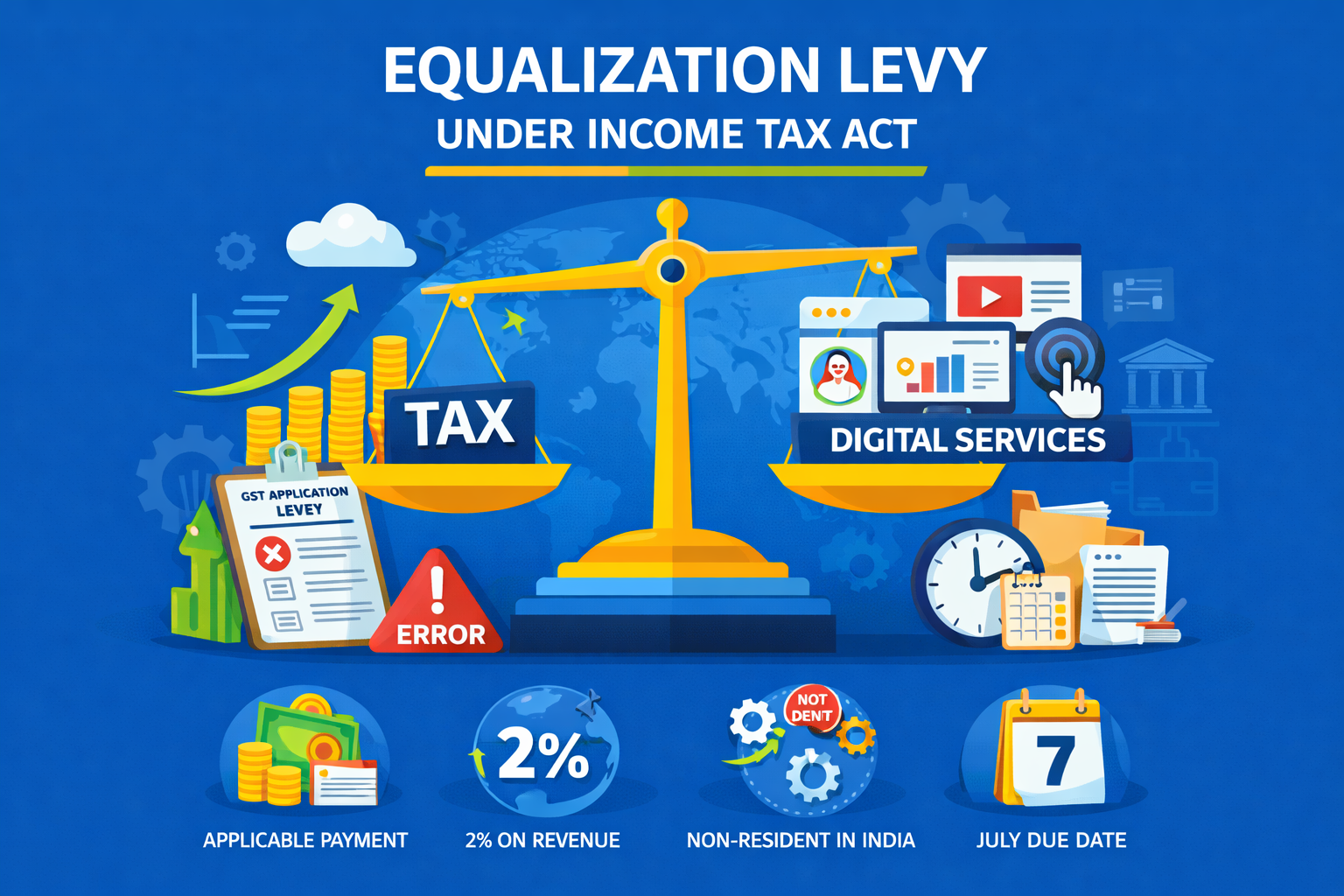
The equalisation levy is a charge imposed when payments are made to non-resident companies for specific online or digital services.

Its objective is to ensure fair taxation between:

  • Foreign digital companies earning income from India, and
  • Domestic Indian businesses already paying income tax

Unlike income tax, the equalisation levy operates as a separate levy, applying only to specified digital transactions. It applies when foreign companies earn revenue from India without having a physical presence in the country.

Fairness is the core principle—income earned from India should be taxed in India, regardless of where the business is located.

Legal Framework of Equalisation Levy

The equalisation levy was introduced through the Finance Act, 2016 as an independent levy, separate from the Income Tax Act, 1961.

Initially, it applied only to online advertising services, but its scope later expanded to cover:

  • Digital marketplaces
  • E-commerce operations
  • Certain cross-border online transactions

This expansion aligns with global efforts to tax the growing digital economy more effectively.

Key Provisions Under the Law

The relevant provisions under the Finance Act lay down:

  • Who is responsible for payment or deduction
  • What services are covered
  • How the levy amount is calculated
  • Consequences of non-compliance

Authorities monitor transactions closely to ensure proper compliance. Over time, the scope has widened beyond the initial digital advertising focus.

What Services Are Covered?

The equalisation levy applies to payments made for specified digital services, including:

  • Online advertising services
  • Provision of digital platforms
  • E-commerce transactions
  • Internet-based sale of goods or services

Digital platforms enable:

  • Online buying and selling
  • Order management
  • Inventory tracking
  • Delivery support through digital networks


When Does the Equalization Levy Apply?

The levy becomes applicable when all of the following conditions are met:

  • The service provider is a non-resident
  • The service recipient:
    • Is a resident of India, or
    • Has a permanent establishment or fixed place of business in India

In cases where a foreign service provider operates through a fixed base in India, and income is directly linked to that base, the levy may not apply.

Types of Equalisation Levy

The equalisation levy mainly falls into two categories, depending on the transaction type.

1. Levy on Specified Digital Services

  • Applies mainly to online advertising and similar services
  • Levy is deducted at the time of payment
  • The Indian payer deducts the levy before making payment

2. Levy on E-commerce Transactions

  • Applies to non-resident e-commerce operators
  • Covers online sale of goods or provision of services to Indian customers
  • In this case, the non-resident operator itself pays the levy

Rates of Equalisation Levy

The rate depends on the nature of the transaction. Different services attract different levy rates.

  • Digital advertising services attract a lower percentage
  • E-commerce transactions typically face a higher levy on gross revenue

These rates are fixed by law and remain unchanged regardless of profit margins. As a result, businesses must plan carefully, as the levy applies on gross receipts, not net income.

Filing & Compliance Requirements

Timely filing of equalization levy returns is crucial to avoid penalties.

Payment Timeline

  • Certain services require quarterly payments
  • E-commerce levy generally requires an annual payment

Return Filing

  • An annual equalisation levy statement must be filed
  • A single due date usually applies each year

Missing deadlines can lead to:

  • Interest charges
  • Monetary penalties
  • Additional compliance scrutiny

Information Required in the Return

The prescribed format requires details such as:

  • Nature of services provided
  • Amount received or receivable
  • Total levy payable
  • Payments already made during the year

Even if no levy is payable, compliance checks remain important to avoid future issues.

Penalties for Non-Compliance

Failure to follow equalisation levy provisions may result in:

  • Interest on delayed payments
  • Penalties for non-deduction or non-payment
  • Penalties for late filing of returns

In some cases, certain expenses may be disallowed, increasing the overall tax burden.

Why Equalisation Levy Matters

The equalisation levy plays a key role in modern digital taxation by:

  • Preventing tax base erosion
  • Creating a level playing field for Indian businesses
  • Aligning India’s tax system with global digital tax standards

As digital transactions grow, compliance is no longer optional. Businesses engaged in cross-border online activities must stay updated, track deadlines carefully, and ensure accurate reporting to avoid financial and operational risks.

Final Thoughts

Introduced in 2016, the equalization levy ensures that online income earned from India does not escape taxation. Applicability depends on transaction type, residency status, and service nature. Rates vary, deadlines are strict, and penalties can be costly.

With rules evolving constantly, professional guidance becomes essential.

With expert support from KKS Capital Advisors, businesses can navigate equalization levy requirements confidently—meeting deadlines, handling filings correctly, and gaining clarity on how the levy impacts their operations in an ever-changing digital tax landscape.

Read More

How to Check GST Registration Rejection Reason and Fix It Quickly

How to Check GST Registration Rejection Reason and Fix It Quickly

Getting registered for GST matters if a business wants to stay within legal boundaries while growing its presence. Yet, plenty stumble after submitting their request only to find it turned down without warning. At that point, many start searching for how to check the GST registration rejection reason, as work might stall, schedules shift, and clarity fades—especially when the message explaining why lacks detail or feels vague. The outcome is uncertainty at the very moment when momentum should be building.

Steps on How to Check GST Registration Rejection Reason 

If your GST application is rejected, the reason is shared on the GST portal itself. Follow these simple steps to find the exact cause of rejection.

Step 1: Open the GST Portal

Visit the official GST website and go to the homepage. Keep your TRN number ready before moving forward.

Step 2: Track Application Status

Click on Services, then select Registration, and choose Track Application Status from the menu.

Step 3: Enter Your TRN Number

Enter your TRN number in the given field and submit it. The portal will show the current status of your GST application.

Step 4: View Rejection Reason

If the status shows Rejected, click on it. The rejection reason will appear in the officer’s remarks or in the attached notice.

Step 5: Download the Rejection Notice

Download the rejection letter and read it carefully. This document explains what went wrong and helps you fix the issue before reapplying.

Understanding the rejection reason early helps you correct mistakes and avoid delays when submitting your GST application again.

GST Application Rejection: Why It Happens

One big thing people face? Their gst application rejection reasons get turned down. What makes it worse? Not knowing why. Sometimes there is no clear message, just a flat no. That leaves applicants stuck, wondering where things went wrong.

Fixing this starts with finding out the exact cause. The tax portal usually has details, buried in messages or status updates. Look closely at every notice linked to your file. Errors often hide in basic info like address proof or bank statements. Maybe numbers did not match up. Or the documents were blurry.

Another issue pops up when forms are filled inconsistently. One section says one thing, another contradicts it. System flags that fast. Then there are cases where nothing shows up—no reason given at all. In those moments, calling support helps. So does visiting an official help center. They might share what online tools won’t.

Once the real problem comes out, fixing it becomes possible. Clean copies, double-checked fields, and correct codes—all matter now. Resubmit only after each gap closes. Getting it right means less delay next time.

Understanding GST Application Rejection

Even when most steps happen online, small or big mistakes might still cause a request to be turned down. Learning the reasons behind those denials gives companies a clearer path to fix errors before trying again. Approval often follows faster once lessons from past attempts are applied.

Common GST Application Rejection Reasons

Mistakes or missing details in paperwork often lead to GST applications being turned down. Examples include using outdated forms, incorrect information, or files that do not match official records.

Incorrect PAN Details

When what’s on paper does not line up with the info given, problems can start. Mismatched data often leads to a decision that stops things from moving forward.

A slip in matching your PAN information with what you put on the GST form might get it turned down. Problems arise when names, birth dates, or the business setup do not align with tax records. Errors like these often lead to applications being refused.

One frequent cause of GST denial hits small owner-run firms hardest. Yet it shows up just as much in shared-business setups.

Invalid Address Proof

When the address shown isn’t legitimate, problems start. A working business location needs real documentation. Officials might say no if what’s submitted doesn’t hold up. Paperwork that fails verification gets set aside without approval.

Proof of where you live is different from what was filled out on the form
Not listed under who applied
Names on papers differ from the requester’s

Few folks lack the paperwork showing they rent here. Some never got a signature on file. Others lost their lease entirely. Without these pages, proof slips away fast.

Non-Response to Clarification Request

When you file your GST return, questions might come up. If an official asks for more details, they expect answers by a set date. Missing that deadline means your filing gets turned down—no second chances. Silence is treated as non-compliance. The system does not wait.

Failing to respond to a clarification request sinks plenty of applications. Missing that step often kills the chance outright.

Duplicate GST Registration Under Same PAN

A second try at GST registration could face refusal when one already exists under the same PAN. That happens if there is no solid justification behind submitting another. Same tax ID, fresh request—without proper cause—it often gets turned down.

Automated GST Application Rejection

A surprise hits many who face this automated reason for GST rejection. It comes from the system, not a person, leaving users puzzled.

Some people pick a signup option they are not allowed to use. Choosing the wrong kind of business structure might get an application turned down. Fitting the rules for voluntary enrollment prevents issues. One mistake in classification can block approval entirely.

Understanding the Rejection Notice

A word comes from the officer—short, without detail. It hangs there, simple on purpose. Not much to hold onto, just enough to move things along. Nothing hidden, nothing stretched out either.

A closer look at the rejection notice? Missing. The applicant skips details. Careful reading falls short. Attention slips away early. Pages get glanced over fast. Understanding stays incomplete. Key points go unnoticed. Errors hide in plain sight. Facts are missed quietly. Clarity never arrives.

It sits inside a file you can pull down. That’s where the explanation hides.

Though it might seem random, every GST rejection has a note logged inside the portal. What looks like chaos actually follows a trail of written records tucked away where few think to check.

Track Application Status

Now go to Application Status. Choose Track Application Status, then type in your TRN. From there, details will appear on screen. Wait a moment for the system to load everything. The page refreshes once you submit the number. Information shows up if the record exists. Sometimes it takes a few seconds longer than expected.

Open the rejection letter once it arrives. Grab a copy of the document explaining why things didn’t move forward. The note comes straight from the reviewing official.

Look closely at what the officer wrote. Their notes hold the precise cause behind your GST application being turned down. Hidden inside those comments or the linked document lies the full story.

Before trying again, it helps to know what was said. Getting clear on the feedback matters most the second time around.

How to Fix a Rejected GST Application

Fixing a rejected GST application starts with knowing why it got turned down. From there, moving forward feels less confusing. What matters most is tackling each issue one at a time.

Fix the mistakes first, then try again for GST registration. Getting it right matters most—no cost details are correct. Another attempt should only be made once everything checks out.

Can You Appeal a GST Rejection?

Yes, it is possible to challenge a GST denial. Most companies decide to submit a new application instead. Going through an appeal often takes too long. It only makes sense if the refusal happened even though every rule was followed correctly.

Resolving the problem first, then sending in a new form, usually works better for many people applying. Most find that it gets things moving more quickly than waiting around.

Impact of GST Rejection on Business

  • GST rejection can:
  • Delay invoicing
  • Keep taxes under control. Stop people taking back tax they paid on supplies
  • Affect vendor and customer trust

Fixing rejections fast matters because it keeps operations running without hiccups. A smooth process avoids delays that pile up later.

Conclusion

Start by reviewing your PAN and Aadhaar information carefully. Ensure every piece of data matches official records exactly. Submit only clear, readable copies when uploading files. Blurry images won’t be accepted—quality matters behind the scenes. Mistakes now might cause delays later without warning.

Stay on top of the GST website. Quick replies when officials ask questions matter to the KKS Capital Advisor.

Read More

Master the 3 Golden Rules of Accounting: A Complete Guide

Master the 3 Golden Rules of Accounting: A Complete Guide

Accounting is the backbone of any business, providing clarity, transparency, and a structured approach to managing finances. Whether you run a small business, a startup, or a large corporation, understanding the golden rules of accounting is essential for accurate record-keeping, compliance, and decision-making.

This guide covers the three golden rules of accounting, explores the types of accounts, explains the benefits of accounting, and highlights how businesses can leverage professional advisory services like KKS Capital Advisor for better financial management.

What Are the Golden Rules of Accounting?

The golden rules of accounting—also known as golden principles of accounting—are the fundamental principles that guide the recording of financial transactions. These rules ensure consistency, accuracy, and clarity in bookkeeping, forming the foundation of the double-entry system of accounting.

Understanding these rules is critical for anyone involved in finance, accounting, or business management.

The Three Golden Rules of Accounting

three golden rules of accounting

Accounting is based on three types of accounts: Personal Account, Real Account, and Nominal Account. Each type follows a specific rule for recording transactions.

1. Personal Account

Definition: Personal accounts relate to individuals, companies, or organizations.

Golden Rule: “Debit the receiver, credit the giver.”

Example:

  • If a business purchases goods on credit from Mr. Sharma, Mr. Sharma is credited because he is the giver, and the business is debited because it is the receiver.

This rule ensures clarity in tracking transactions involving people or entities.

2. Real Account

Definition: Real accounts deal with tangible and intangible assets owned by the business. Examples include cash, machinery, buildings, patents, and vehicles.

Golden Rule: “Debit what comes in, credit what goes out.”

Example:

  • If a company buys furniture for the office, the furniture account is debited (what comes in), and the cash or bank account is credited (what goes out).

This rule helps in maintaining precise records of asset movements within the business.

3. Nominal Account

Definition: Nominal accounts track expenses, losses, incomes, and gains. Examples include salaries, rent, interest, and sales revenue.

Golden Rule: “Debit all expenses and losses, credit all incomes and gains.”

Example:

  • If the company pays electricity bills, the electricity expense account is debited, and cash or bank is credited.
  • Conversely, when the company earns interest income, the interest account is credited.

By following this rule, businesses can accurately record profits, losses, and operational costs.

Types of Accounts in Accounting

Accounting relies on categorizing transactions into various account types. Understanding types of accounts is crucial to applying the golden rules correctly.

1. Personal Accounts

  • Natural Person Accounts: Individuals such as Mr. A, Mrs. B
  • Artificial Person Accounts: Companies, firms, or organizations
  • Representative Personal Accounts: Accounts representing certain people or groups, like “Outstanding Salaries”

2. Real Accounts

  • Tangible Assets: Cash, machinery, buildings, stock
  • Intangible Assets: Patents, goodwill, copyrights

3. Nominal Accounts

  • Expenses and Losses: Rent, salaries, depreciation
  • Incomes and Gains: Interest, commission, sale of goods

By classifying accounts correctly, businesses can maintain organized and transparent financial records, simplifying auditing and reporting.

Benefits of Accounting

Benefits of Accounting

Adhering to accounting rules and applying the golden principles of accounting offers numerous advantages for businesses. Here are some key benefits of accounting:

1. Accurate Financial Records

Proper accounting ensures that all transactions are systematically recorded, reducing errors and discrepancies.

2. Supports Decision-Making

Accurate financial data helps business owners and management make informed decisions regarding investments, expenses, and growth strategies.

3. Legal Compliance

Maintaining books in accordance with accounting principles ensures compliance with statutory requirements like GST, Income Tax, and Company Law in India.

4. Assists in Auditing

Structured accounting simplifies audits, making it easier to assess financial health and compliance.

5. Helps in Budgeting and Forecasting

Well-maintained records allow businesses to forecast revenues, plan expenses, and set realistic budgets.

6. Enhances Credibility

Audited and accurate financial statements improve the trustworthiness of the business in the eyes of investors, banks, and stakeholders.

7. Detects Fraud and Errors

A systematic approach to accounting helps identify irregularities, minimizing financial risks.

8. Facilitates Financial Analysis

Accounting provides insights into profitability, liquidity, and operational efficiency, helping optimize business performance.

How the Golden Rules Simplify Accounting

The three golden rules of accounting create a framework that simplifies bookkeeping:

  • Consistency: Transactions are recorded uniformly, ensuring accurate historical data.
  • Clarity: Each entry clearly shows who received, who gave, and what came in or went out.
  • Error Detection: Following structured rules makes it easier to identify and correct mistakes.
  • Decision Support: Accurate accounting helps management assess the financial position and make strategic choices.

By mastering these rules, businesses can ensure that their accounting processes are accurate, transparent, and compliant with legal standards.

KKS Capital Advisor: Professional Accounting Support

Many businesses, especially startups and SMEs, face challenges in implementing proper accounting systems. This is where professional advisory services like KKS Capital Advisor play a crucial role.

KKS Capital Advisor assists businesses with:

  • Setting up robust accounting systems
  • Bookkeeping and financial reporting
  • Compliance with Indian accounting standards
  • Tax filing and audits
  • Advisory on financial planning and risk management

Engaging experienced advisors ensures businesses maintain accurate records, optimize finances, and comply with statutory regulations.

Conclusion

The golden rules of accounting form the foundation of accurate financial record-keeping. By understanding the types of accounts, applying the golden principles of accounting, and leveraging professional advisory services like KKS Capital Advisor, businesses can ensure transparency, accuracy, and compliance.

Implementing these rules helps in detecting errors, planning budgets, enhancing credibility, and making informed financial decisions. Whether you are a small entrepreneur or a large organization, mastering the three golden rules of accounting is essential for sustainable business growth and financial stability.

Read More

What Is an Audit? A Complete Guide for Businesses in India

What Is an Audit? A Complete Guide for Businesses in India

In a competitive and fast-evolving business landscape like India, transparency, financial accuracy, and regulatory compliance are essential for every organization—whether small, medium, or large. One of the most reliable ways to ensure this is through auditing. As companies expand and financial operations become more complex, audits help maintain trust, credibility, and accountability.

This comprehensive guide explains what an audit is, why it matters, the major types of audits in India, and the advantages of auditing. It also highlights the role of professional firms such as KKS Capital Advisor, which assist businesses in ensuring accurate audits and robust financial governance.

What Is an Audit?

An audit is a systematic examination of financial records, statements, operations, and processes of a business to ensure accuracy, compliance, and fairness. In simple terms, auditing checks whether the financial information presented by a company truly reflects its financial performance and position.

Audits may be conducted internally by company employees or externally by independent auditors. In India, audits must adhere to:

  • The Companies Act, 2013
  • Income Tax Act
  • GST Act
  • Standards on Auditing (SA) issued by ICAI

The primary objective of auditing is to build confidence among stakeholders—owners, investors, lenders, government authorities, and the public.

Auditing in Accounting: Why Is It Important?

Auditing in Accounting

Auditing in accounting refers to the verification and evaluation of a company’s financial statements and accounting records. It helps identify discrepancies, fraud, errors, or misstatements that may affect the reliability of financial information.

Accounting without auditing can lead to:

  • Inaccurate financial reporting
  • Manipulated or fraudulent transactions
  • Poor decision-making
  • Loss of investor confidence

This is why audit is a crucial pillar of corporate governance.

Importance of Auditing for Indian Businesses

Importance of Auditing

Whether you’re running a startup, SME, or corporate enterprise, understanding the importance of auditing is essential.

Here are key reasons why audits matter:

1. Ensures Accuracy and Reliability of Financial Information

Audits verify that all financial transactions are recorded correctly. This gives management confidence in the figures used for planning and strategy.

2. Prevents and Detects Fraud

Regular audits discourage fraudulent behavior and help catch irregularities early.

3. Strengthens Internal Controls

Audit reports evaluate the effectiveness of internal systems, reducing operational risks.

4. Enhances Credibility with Stakeholders

Investors, banks, and regulatory bodies trust companies with audited financial statements.

5. Ensures Statutory Compliance

Indian laws require many types of audits. Non-compliance can lead to penalties, legal issues, or reputational damage.

6. Improves Decision-Making

Accurate, audited financials support budgeting, forecasting, investments, and expansion decisions.

7. Builds Public Trust

Audited companies gain a stronger public image and market confidence.

Types of Audits in India

India has a structured auditing framework with different types of audits to address various legal and financial requirements. Here are the major types of audits in India:

1. Statutory Audit

Mandated under the Companies Act, all companies registered in India must undergo a statutory audit. The objective is to ensure financial statements represent a true and fair view.

2. Tax Audit

Under Section 44AB of the Income Tax Act, businesses crossing specified turnover thresholds must undergo a tax audit. It ensures correct computation of taxable income and adherence to tax laws.

3. Internal Audit

Internal audits are conducted by an organization’s internal team or outsourced experts. They focus on:

  • Internal processes
  • Operational efficiency
  • Risk management

Certain companies are mandated by law to conduct internal audits based on turnover and capital criteria.

4. GST Audit

Businesses with turnover exceeding the prescribed limit must undergo audits to ensure GST compliance, correct input tax credit claims, and accurate tax payments.

5. Cost Audit

Prescribed under the Companies Act, certain industries (like pharma, steel, cement, power) must conduct cost audits to verify cost records.

6. Management Audit

This evaluates managerial policies, decision-making processes, and organizational efficiency.

7. Compliance Audit

Ensures that the organization follows all legal, regulatory, and policy requirements.

8. Forensic Audit

Performed when fraud or financial misconduct is suspected. It involves in-depth investigation and evidence collection.

9. Operational Audit

Focuses on reviewing the effectiveness of operations, workflow, and resource utilization.

10. Due Diligence Audit

Conducted before mergers, acquisitions, or investments to assess financial health and risks.

Each type of audit plays a unique role in strengthening financial discipline and business integrity.

Advantages of Auditing

auditing in accounting

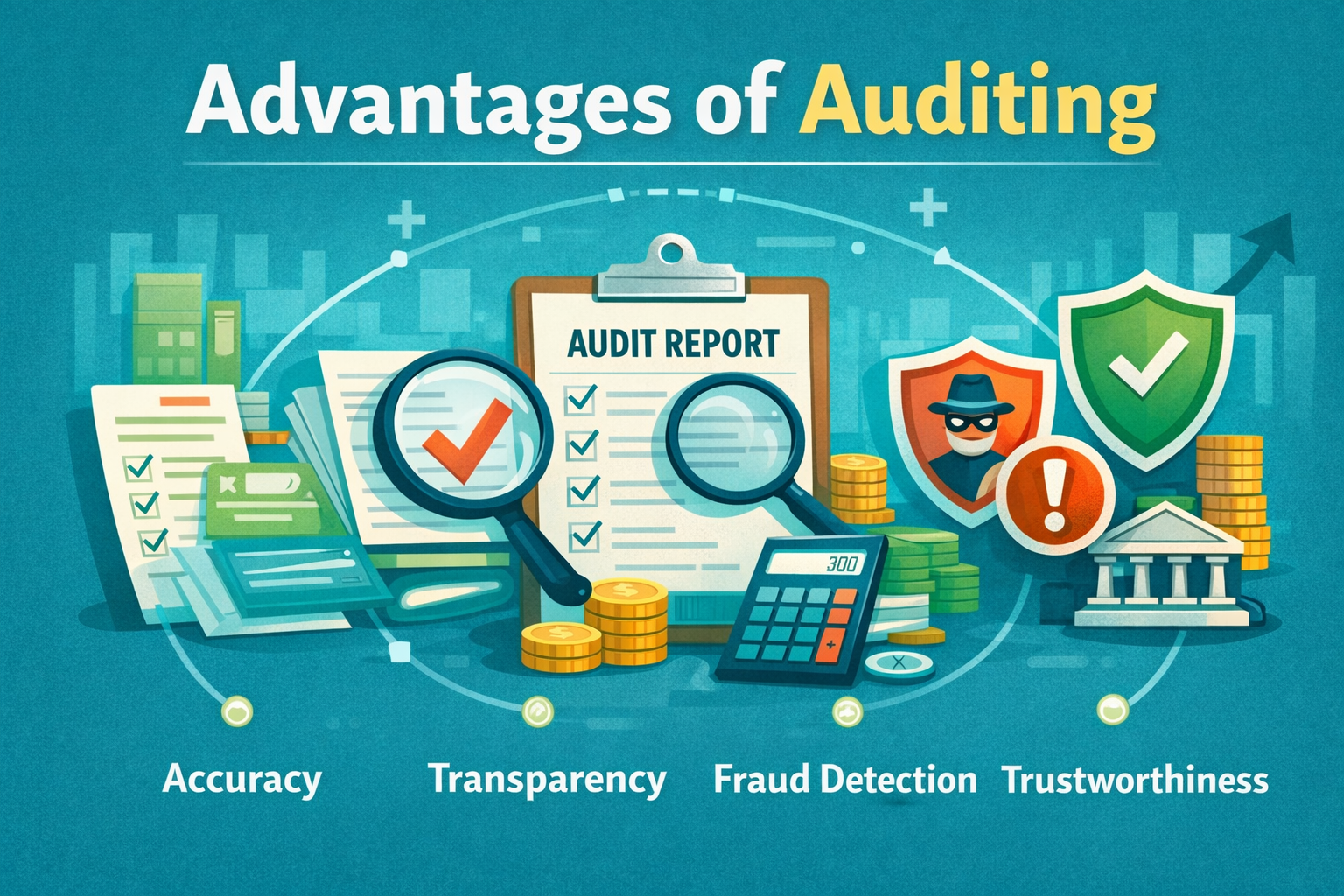
Audits offer numerous benefits beyond compliance. Here are major advantages of auditing for businesses in India:

1. Reduces Business Risk

Audits reveal weaknesses in internal systems, helping companies correct issues before they escalate.

2. Helps in Obtaining Loans and Investments

Banks and investors rely on audited financial statements. It increases trust and smoothens funding processes.

3. Enhances Operational Efficiency

Regular audits highlight inefficiencies and provide actionable recommendations.

4. Ensures Transparency

Audits promote ethical practices and transparency across departments.

5. Facilitates Better Financial Planning

With accurate financial data, budgeting and forecasting become more reliable.

6. Helps in Regulatory Compliance

Timely audits ensure adherence to Indian laws and prevent penalties.

7. Detects Errors and Fraud Early

This protects the organization from financial loss and reputational harm.

8. Strengthens Market Reputation

Audited businesses create confidence among customers, suppliers, and the general public.

The Role of Audit and Advisory Firms – KKS Capital Advisor

Professional firms play a crucial role in ensuring the audit process is smooth, compliant, and insightful. KKS Capital Advisor, for instance, assists businesses with:

  • Financial auditing
  • Tax and compliance audits
  • Internal audit services
  • Risk assessment
  • Business advisory and financial consulting

Their expertise helps companies maintain accuracy, adopt best practices, and meet all regulatory requirements efficiently.

Engaging experienced advisors ensures not just compliance, but also improved financial discipline and better governance across the organization.

Conclusion

Auditing is a vital component of financial management and corporate governance in India. Whether it’s ensuring accuracy in financial statements, boosting transparency, detecting fraud, or meeting statutory compliance, audits play an indispensable role in building strong and trustworthy organizations.

Understanding the importance of auditing, the various types of audits in India, and the advantages of auditing helps businesses strengthen their internal systems and gain stakeholder confidence. Professional firms such as KKS Capital Advisor further support companies in implementing effective audit practices that align with Indian regulations and global standards.

Read More